
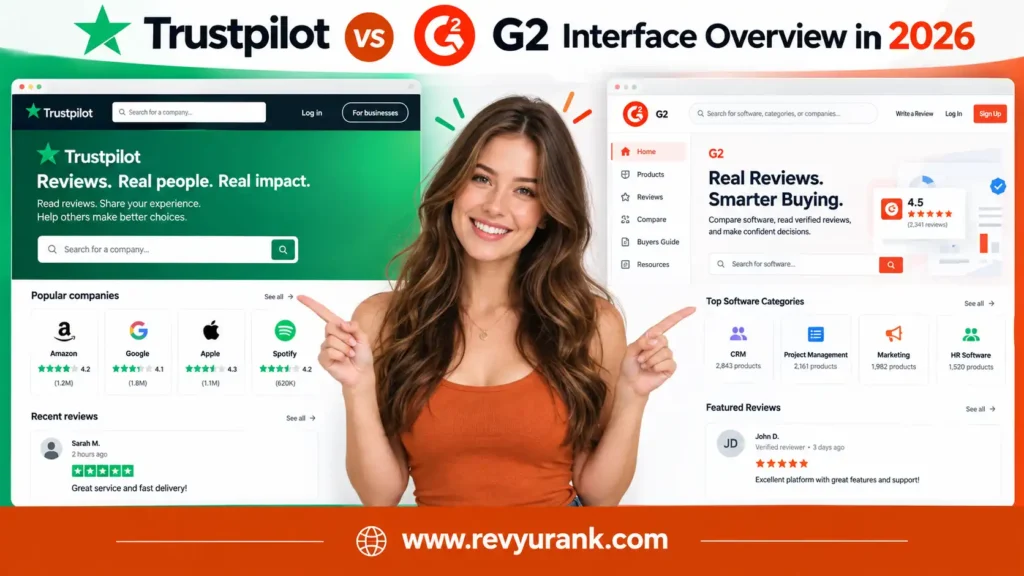
Trustpilot and G2 serve different review needs in 2026. Trustpilot is the stronger choice for broad customer feedback, brand reputation, and trust across e-commerce, services, agencies, and other businesses. G2 is better suited to B2B software and SaaS companies because buyers use it to compare software, read peer reviews, and evaluate products before making business purchasing decisions.
The key difference is audience and buying intent. Trustpilot focuses on customer experiences with businesses and products, while G2 is built around software and services discovery. G2 currently reports more than 3.5 million reviews and highlights its role in helping millions of buyers research software and services. Trustpilot, meanwhile, says its platform has more than 361 million accessible reviews and is increasingly connecting customer feedback with AI-powered search visibility.
Choose Trustpilot if your priority is overall brand trust and customer reputation. Choose G2 if your company sells B2B software, SaaS, or business services and wants to reach high-intent software buyers. For some companies, using both can make sense: Trustpilot can strengthen broad customer trust, while G2 can support software-specific discovery and comparison.
In short, there is no universal winner in the Trustpilot vs G2 in 2026 comparison. The better platform depends on what you sell, who your buyers are, and where they research before purchasing.

Overview of Trustpilot and G2 in 2026
At a high level, Trustpilot and G2 are both major review site brands, but they are built for different buying journeys. Trustpilot leans toward broad customer reviews, vendor reputation, and public-facing trust signals. G2 is much more focused on software review use cases, category research, and B2B buyer comparisons.
In 2026, the main difference is still audience fit. Trustpilot works best when your market presence depends on public trust and service feedback. G2 works best when software buyers need feature comparisons, category maps, and review-based orientation before they speak to sales.
What Is Trustpilot? Key Features and Focus
Trustpilot is a broad review platform used by businesses ranging from local startups to global firms. Its strength is visibility around trustpilot reviews tied to real customer feedback about billing, support, cancellation, delivery, and overall experience. That makes it especially useful for public reputation, not just product evaluation.
For many brands, Trustpilot supports market presence by showing what customers actually say after purchase. It is often used as a public trust layer across websites, ads, and social media. That broad consumer orientation gives it value well beyond software companies.
Its review management approach is also different from G2. Trustpilot helps brands gather ongoing sentiment from everyday customers at scale. The result is often a wider stream of public opinion, which is helpful if your goal is trust, customer satisfaction, and reputation monitoring rather than deep software review comparisons.
What Is G2? Key Features and Focus
G2 is a platform built around business software research. Its core value comes from user reviews, software review category pages, and comparison-driven discovery. Buyers use it to scan product options, explore rankings, and understand where tools sit in crowded software categories.
What makes G2 stand out is structure. It offers category overviews, Grid positioning, comparison tools, and market signals like Leaders and High Performers. Those features are designed for software buyers who want a fast way to understand the landscape, not just read a basic star rating.
Its review management model reflects that purpose. Vendors use G2 to collect reviews tied to product usage, build category visibility, and support sales conversations. In 2026, G2 also offers something Trustpilot does not: a stronger B2B software framework that directly shapes software buying research and AI-driven discovery.

Major Updates to Both Platforms for 2026
The biggest 2026 shift affects G2 more than Trustpilot. G2 acquired Capterra, Software Advice, and GetApp, which changed the software review market in a major way. That means many buyers who think they are cross-checking platforms may now be looking at one larger ecosystem.
At the same time, both platforms face more pressure around fake reviews, authenticity, and trust. AI content has raised the stakes, and businesses now have to think about review quality, not just review volume. That matters because AI language models increasingly read and surface review-platform information.
Key 2026 updates include:
- G2 now controls a much larger share of software review influence.
- G2 remains one of the most cited domains in AI language models.
- Trustpilot still stands out as an independent platform for vendor reputation checks.
- Review quality concerns, including fake reviews and synthetic submissions, matter more across all major review platforms.
Target Audiences for Trustpilot and G2
Your best choice depends on business model, buyer type, and what kind of proof your brand needs. Trustpilot fits companies that serve broad audiences and want public-facing customer sentiment at scale. G2 fits businesses selling into professional buyers who compare vendors inside software categories.
Company size matters too, but it is not the first filter. A smaller brand can still win on either platform if the fit is right. The real question is simple: are you selling to consumers and service buyers, or to teams researching business software?
Who Should Use Trustpilot – B2C & E-Commerce Brands
Trustpilot is a strong fit for e-commerce brands, direct-to-consumer businesses, and service providers that need visible customer reviews in the open web. If people judge your brand based on delivery, billing, support, or overall experience, a strong trustpilot profile can support that buying decision.
It is also useful for companies that rely on fast reputation signals before a sale. A shopper comparing stores, or a service buyer checking reliability, will often care more about business reputation than deep feature comparisons. That is where Trustpilot is practical.
For most SaaS companies, though, Trustpilot is not the better primary platform if the sales process is driven by software evaluation. It can still help with vendor trust and support perception. But if your audience is comparing tools, integrations, or use cases, G2 usually has stronger alignment.
Who Should Use G2 – B2B, SaaS, and Tech Companies
G2 is the better fit for SaaS companies, tech vendors, and B2B brands that sell business software. It is designed for software buyers who want category maps, peer comparisons, and structured user reviews before they shortlist vendors.
That makes G2 especially important when your product is part of a crowded market. Buyers often visit G2 to compare features, scan category leaders, and decide which vendors deserve a demo. In that setting, review management is not only a reputation play. It is a demand-generation channel.
So which platform is better for SaaS companies in 2026? In most cases, G2. It matches how B2B buyers research, how teams compare options, and how software companies build visibility. Trustpilot can complement that, but G2 is usually the stronger starting point for business software brands.
Platform Suitability by Business Type in the USA
In the USA, platform choice should follow buying behavior, not hype. Trustpilot is stronger for public trust and broad reputation. G2 is stronger for software evaluation and B2B comparison. That difference shapes review management, outreach, and even sales enablement.
Smaller vendors should be especially careful. If your audience is not actively browsing software directories, a G2 investment may not deliver the best business outcomes. On the other hand, a SaaS vendor without G2 presence may lose credibility during buyer research.
A simple fit guide:
- Use Trustpilot if you are a local business, service brand, agency, or e-commerce company.
- Use G2 if you sell to teams evaluating software categories and business software.
- Use both if vendor reputation and software comparison both influence your pipeline.
Review Collection and Verification Mechanisms
Review collection matters because not all review volume is equally useful. A platform can have millions of reviews and still create weak signals if buyers do not trust the process. That is why verification and moderation deserve close attention.
Trustpilot and G2 both gather customer feedback at scale, but they do it differently. One leans toward broad public participation. The other is more tied to software review workflows. If you want to judge credibility, you need to look beyond stars and examine how each platform handles submissions and negative reviews.
How Trustpilot Gathers and Verifies Reviews
Trustpilot gathers trustpilot reviews through business invitations and public submissions. That wide entry point helps brands build strong review volume, especially when they already have many transactions, orders, or service interactions taking place each month.
Because of that model, review velocity on Trustpilot can be high for active B2C brands. An online store or consumer service may collect new feedback much faster than a niche software vendor on a specialized review site. That helps with freshness, but it also means businesses need steady review management software and internal processes.
Verification on Trustpilot centers on identifying suspicious activity and managing reported issues, while still keeping the platform open enough for broad participation. For brands, the upside is scale and visibility. The tradeoff is that review scores should always be read alongside review timing, written detail, and complaint patterns.
G2’s Review Collection and Verification Process
G2 collects reviews within a more structured B2B review site model. It is built for users of software products, not general shoppers, which gives it stronger relevance for business software evaluation. Vendors often run focused campaigns to gather reviews from customers after onboarding or product success milestones.
One important factor is incentivized reviews. In 2026, G2 is widely associated with gift-card-driven review collection. That can increase participation, but it can also create selection bias if vendors mainly ask happy customers to respond. So vendor reputation should never be judged by star scores alone.
Review management on G2 is more strategic and campaign-based than on Trustpilot. SaaS teams use it to support category rankings, sales collateral, and comparison visibility. That makes G2 powerful for pipeline growth, but buyers still need to read the written reviews where the actual signal lives.
FTC Compliance, Transparency, and Authenticity Comparison
If your brand is collecting reviews in the USA, FTC compliance and transparency are not optional. Buyers want to know whether customer feedback is authentic, whether incentives are disclosed, and whether moderation is fair. That is true for both Trustpilot and G2.
The trust question is less about perfect systems and more about visible standards. Trustpilot offers broad public authenticity signals. G2 offers structured software-oriented validation, but its incentive culture can raise extra questions. In both cases, businesses should avoid shortcuts and focus on safe, documented collection practices.
Watch for these red flags:
- sudden spikes in reviews with no product launch or major event
- overreliance on aggregate star ratings without written context
- poor transparency around incentives or solicitation methods
- polished widgets that hide recent complaints or critical feedback
User Trust, Credibility, and Review Quality in 2026
Customer trust in 2026 depends less on a perfect star rating and more on believable patterns. Buyers are better at spotting inflated profiles, thin praise, and suspicious bursts of activity. That makes review quality a bigger issue than raw totals.
Both Trustpilot and G2 can influence trust, but they do it in different ways. Trustpilot signals broad public reputation. G2 signals product validation inside software markets. If you want to judge credibility well, look at the written reviews, recency, consistency, and whether the profile feels grounded in real user reviews.
How Trustpilot Builds User Confidence
Trustpilot builds confidence through visibility and openness. Buyers can quickly scan trustpilot reviews, see praise and complaints together, and form a picture of how a company treats customers after the sale. That open format creates strong social proof when the profile looks active and balanced.
User trust grows when a brand has a healthy mix of recent feedback, clear responses, and believable detail. For many shoppers and service buyers, that matters more than a polished homepage claim. They want signs of real customer satisfaction, not just marketing copy.
Compared with G2, Trustpilot often feels more useful for trust questions tied to operations and service quality. It helps people judge reliability, billing friction, and support behavior. So if your goal is user trust at the public reputation level, Trustpilot often has the edge.

Methods G2 Uses to Establish Review Credibility
G2 establishes credibility through software-specific structure. Its category pages, comparison tools, and buyer-oriented review format help users evaluate products in context. That context is why many SaaS teams value G2 even when they know aggregate star ratings can be inflated.
Its rankings, including Leaders and High Performers, give buyers a quick frame for research. That can be useful, especially early in the buying process. Still, the best insight comes from written comments that reveal actual customer sentiment, setup realities, and use-case fit.
In 2026, G2 remains credible for software decisions because of scale and relevance, not because every score is perfect. Trust comes from the depth of software-oriented review quality and the consistency of buyer usage. The wise move is to treat badges and aggregate star ratings as a starting point only.
Addressing Fake Reviews and Moderation Policies
Fake reviews are a major concern across every review site in 2026. AI-generated text, mass solicitation, and selective outreach can all weaken trust. That means moderation quality now matters almost as much as review count.
Trustpilot and G2 both face this challenge from different angles. Trustpilot must handle broad public participation. G2 must manage structured software submissions while dealing with incentive-driven collection. In both systems, moderation has to catch suspicious behavior without burying legitimate negative reviews.
Good review reading habits include:
- checking for timing patterns, especially sudden clusters
- comparing recent criticism with older praise
- focusing on detailed written feedback over short generic posts
Search Engine Visibility (SEO Benefits)
Review platforms do more than influence buyers on their own pages. They also affect search results, branded visibility, and how your reputation appears across the web. That makes platform choice an SEO decision as well as a trust decision.
Trustpilot and G2 offer different search benefits. Trustpilot can support public reputation and local seo signals for customer-facing brands. G2 supports discoverability inside software searches and may have wider influence in AI-shaped research. Your review management strategy should reflect where your buyers actually search.
SEO Advantages of Using Trustpilot
Trustpilot offers strong SEO value for brands that depend on public trust. A visible trustpilot profile can appear when people search your company name, check complaints, or compare service quality before buying. For e-commerce and service brands, that can shape first impressions in a big way.
Its benefits are strongest when review velocity stays active. Businesses with frequent transactions can gather ongoing reviews faster than many software brands, which keeps the profile fresh. That freshness can support branded search visibility and reinforce trust around review scores.
For local and consumer-facing brands, Trustpilot can also complement google customer reviews and broader local seo efforts. It is not a replacement for Google signals, but it strengthens the reputation layer around your brand. If buyers are already searching for you by name, Trustpilot can help you control that trust conversation.
SEO Impact for Brands Listed on G2
G2 has major SEO value for SaaS companies because it ranks strongly across software review platforms and category-based search results. Buyers searching for the best CRM, help desk, or analytics tool often encounter G2 pages early in the research journey.
That makes G2 powerful for online reputation management in B2B software. A strong presence can influence shortlist creation, comparison behavior, and even how your brand appears in non-branded searches. For software companies, this is a core reason G2 is usually the better platform.
There is another layer in 2026. G2 is one of the most cited domains in AI-shaped discovery, which means its review volume and category presence can affect ai answers before a prospect visits your site. For SaaS brands, that creates visibility value that Trustpilot usually cannot match in software research.
Comparing Trustpilot vs G2 for Online Reputation Management (ORM)
When you compare them for online reputation management, the answer depends on where trust is formed. Trustpilot is stronger for public-facing business reputation, especially when buyers care about customer service, support, and post-purchase reliability. G2 is stronger for software evaluation and category-driven brand authority.
Your review management priorities should match that context. If you want public credibility that supports website trust, branded search, and social media messaging, Trustpilot is often more useful. If you want software buyer visibility and competitive positioning, G2 usually delivers more value.

| Factor | Trustpilot | G2 |
| Primary ORM strength | Public reputation and service trust | B2B software positioning |
| Best audience | Consumers, services, e-commerce | SaaS, tech, software buyers |
| Search impact | Branded trust and local reputation | Category search and AI visibility |
| Monitoring focus | Support, billing, delivery, sentiment | Product fit, comparisons, category standing |
Lead Generation and Conversion Potential
Reviews do not just inform buyers. They also move revenue. The right platform can improve conversion rates, reduce hesitation, and create stronger business outcomes across ads, landing pages, and sales conversations.
Still, lead generation works differently on Trustpilot and G2. Trustpilot tends to improve confidence for customer-facing purchases. G2 tends to influence shortlist selection and B2B intent. So before you invest, ask a simple question: do you need trust at checkout, or trust during software comparison?
How Trustpilot Drives Leads for E-Commerce
Trustpilot helps e-commerce brands convert skeptical shoppers by reducing perceived risk. When buyers see recent trustpilot reviews and believable service feedback, they are more likely to move forward. That is especially true for brands people have not purchased from before.
Positive reviews can support conversion rates across product pages, checkout journeys, and branded search clicks. For online stores, that kind of proof often matters more than a technical comparison page. Buyers want confidence that the company will actually deliver and support them.
Review velocity is a big reason this works. Consumer businesses often generate feedback more frequently than software vendors, which keeps the profile current. Fresh reviews make the trust signal feel alive. For e-commerce brands, Trustpilot often acts as a direct conversion tool, not just a reputation badge.
Leveraging G2 for B2B Lead Generation
G2 supports B2B lead generation by placing your brand where active buyers research business software. A prospect comparing tools in a category may discover your product, review your positioning, and move into a shortlist before talking to sales.
That behavior matters because software review intent is high intent. Buyers on G2 are often deeper in the journey than general web visitors. They want proof of fit, signs of adoption, and reassurance that the tool can solve a real problem. That is why G2 can drive qualified pipeline.
It also helps sales teams. G2 pages, rankings, and review excerpts can reinforce claims about customer service, product value, and category standing. For SaaS companies, G2 is usually the stronger lead-generation channel because it aligns with how B2B software buying actually happens in 2026.
Conversion Optimization Strategies on Both Platforms
Good conversion optimization starts with fit. Trustpilot should support trust-building near purchase points. G2 should support buyer validation during comparison and sales enablement. The platform is different, so the review management strategy should be different too.
On Trustpilot, brands should focus on steady customer feedback and reputation consistency. On G2, SaaS teams should focus on category relevance, written review quality, and buyer-facing proof points. In both cases, the goal is not just more reviews. It is better decision support.
Practical tactics include:
- place review site proof where buying hesitation is highest
- prioritize recent, detailed customer feedback over vanity metrics
- align review requests with real milestones, not random mass outreach
Pricing Models and Cost Considerations
Cost matters, but price alone should not decide your platform. The bigger question is whether the spend matches your business model and buyer journey. A cheaper tool can still waste money if it reaches the wrong audience.
Trustpilot and G2 both offer ways to get started, but premium value comes from paid visibility, profile features, and brand support. That means your starting point should be business fit first, then pricing tiers, then expected return from review-driven trust and demand.
Trustpilot’s Pricing Tiers and Value for U.S. Businesses
Trustpilot can offer real value for U.S. businesses when public trust directly affects sales. If you run an e-commerce brand, service company, or agency, trustpilot reviews can improve reputation and help buyers feel safer about choosing you.
Its pricing tiers should be judged against outcomes like stronger branded trust, better on-site proof, and improved conversion confidence. If your audience rarely uses software comparison sites, Trustpilot may create better business outcomes than a more expensive B2B-focused platform.
Compared with G2, Trustpilot does not center on software-specific features like category grids or structured business software comparisons. That is an important distinction. If your sales motion depends on those features, Trustpilot may not be the right primary spend. But for public trust, it can still be the better value.
G2’s Pricing Structure Explained
G2’s pricing structure ranges from entry-level participation to much more expensive vendor programs with added visibility and tools. That can work well for SaaS brands, but the value depends on how much your audience relies on g2 reviews during vendor evaluation.
For software companies, G2’s value often comes from category presence, buyer discovery, and sales support. If your prospects compare tools online before requesting demos, a paid presence may be worth it. If not, the spend can be hard to justify.
Smaller vendors should be realistic here. A G2 investment is most effective when your company already has some traction, category fit, and a review-generation process. Otherwise, the pricing structure may feel heavy compared with the return. It is a powerful platform, but not every vendor needs the same level of spend.
Which Platform Offers Better ROI?
ROI depends on alignment, not brand size. Trustpilot tends to produce better returns when public trust affects purchase decisions. G2 tends to produce better returns when software review behavior drives lead flow, shortlist inclusion, and deal confidence.
So which one wins? For B2C and service-led companies, Trustpilot often gives faster business outcomes. For SaaS and B2B tech, G2 usually offers stronger ROI because it sits closer to how buyers research. The smarter move is to match the platform to the revenue path.
Use this quick rule:
- Trustpilot ROI is strongest for e-commerce, services, and vendor reputation building.
- G2 ROI is strongest for SaaS, tech, and category-led software discovery.
- Trustpilot supports public trust signals.
- G2 supports software comparison and pipeline influence.
Enhancing Brand Authority with Review Platforms
Review platforms do more than collect opinions. Used well, they strengthen brand authority by showing independent proof that buyers can check for themselves. That matters whether you sell sneakers, subscriptions, or enterprise software.
Still, authority grows differently on each platform. Trustpilot builds broad business reputation and public confidence. G2 builds software review credibility inside structured buying categories. If your goal is stronger social proof, you need the platform that mirrors how your buyers judge trust and customer feedback.
Case Study: Using Trustpilot for E-Commerce Growth
Imagine a U.S. e-commerce brand selling nationally. Its challenge is simple: shoppers do not know the brand, so trust is low before the first order. In that case, a strong trustpilot profile can act as public reassurance that the company delivers, responds, and resolves problems.
As new customers leave feedback, the brand builds visible proof around customer satisfaction. That proof can be used across the website and other channels while still remaining checkable on the review site itself. The result is better confidence at the moment of purchase.
Would this help IT leaders seeking honest customer feedback? Not as a primary source for software evaluation. Trustpilot is better here for vendor reputation and service trust. For e-commerce growth, though, it is often the more practical authority platform.
Case Study: Scaling SaaS with G2 Reviews
Now consider a SaaS company in a crowded software category. Prospects search alternatives, compare vendors, and expect third-party proof before booking a demo. In this setting, g2 reviews can help the company appear in the right category conversations.
With disciplined review management, the SaaS brand gathers detailed user input, improves visibility, and supports positioning against competitors. Recognition as one of the category High Performers or Leaders can give buyers a faster way to frame the market, even if they still need to read beyond the badges.
For IT leaders seeking honest customer feedback, G2 is usually more useful than Trustpilot when the decision is product-led. It is built for software research. Trustpilot can still help as a secondary check on vendor behavior, but G2 is the stronger scaling platform for SaaS companies.
How revyurank.com Optimizes Profiles and Builds Social Proof
Choosing a platform is only the first step. Execution matters just as much. That is where revyurank.com can help brands strengthen social proof, improve review management workflows, and build safer systems for collecting customer feedback across major platforms.
For businesses comparing Trustpilot and G2, revyurank.com can help match the platform to the right use case. It supports profile optimization, trust-building strategy, and verified review acquisition without pushing brands into risky shortcuts that can damage credibility.
Its support is especially useful for brands that need to:
- optimize Trustpilot and G2 profiles for trust and conversion
- build compliant review collection systems across major channels
- strengthen authority with verified feedback and better profile presentation
Frequently Asked Questions
Q: Which platform has more accurate customer reviews in 2026?
A: Accuracy depends on context. Trustpilot offers broad customer reviews and often stronger public trust signals. G2 offers more relevant actual user reviews for software buyers. In both cases, review volume and star rating alone are not enough. Read the written detail and judge ease of use, timing, and consistency.
Q: What are the pros and cons of using Trustpilot versus G2 for review management?
A: Trustpilot is better for public review management and reputation monitoring on a broad review site. G2 is better for business software visibility, comparison tools, and feature comparisons. Trustpilot is less software-specific. G2 is more strategic for SaaS, but buyers should stay cautious about incentives and inflated scoring.
Q: Is Trustpilot or G2 better for IT leaders seeking trustworthy feedback?
A: G2 is usually better for IT leaders researching the best software because it is built for software advice, category review, and buyer comparisons. Trustpilot is better as a secondary check on vendor reputation. If an ai assistant suggests a tool, remember the actual signal lives in the written reviews, not the badge.
Conclusion
In conclusion, choosing the right review platform can significantly influence your brand’s online reputation and lead generation efforts. Trustpilot is ideal for B2C and e-commerce brands aiming to bolster customer trust and drive sales, while G2 is better suited for B2B and SaaS companies focusing on credibility and authority within their niche. Both platforms offer unique advantages in terms of user trust, SEO benefits, and review moderation.
As you weigh your options, consider your business type, target audience, and specific goals. To ensure you’re making an informed decision, visit revyurank.com, where we can help you optimize your online profiles and securely acquire verified reviews. Take the next step to scale your online reputation confidently!