
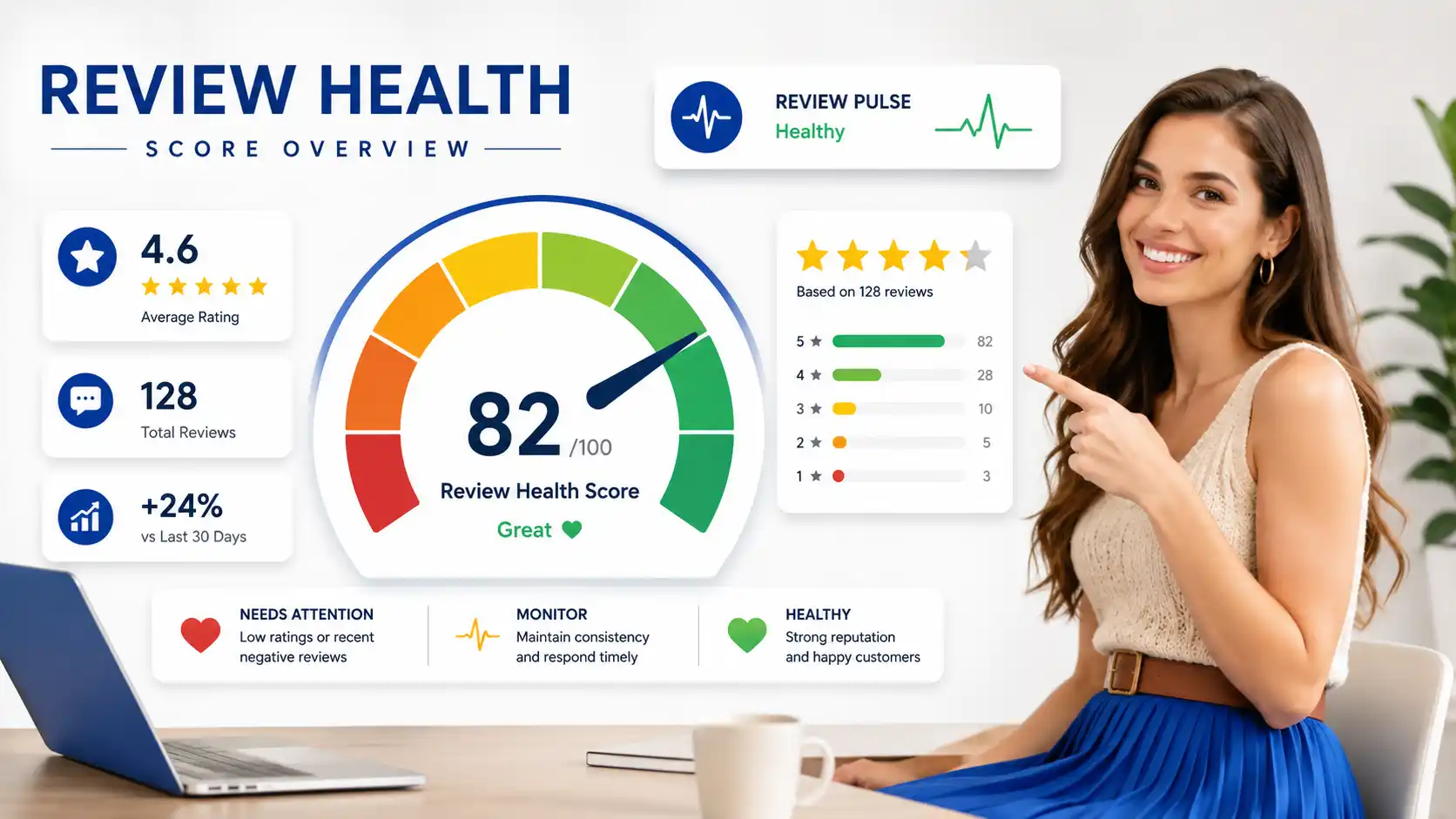
A Review Health Score is a practical way to measure the overall quality, consistency, credibility, and impact of your customer reviews across relevant platforms. Instead of looking only at your average star rating, a strong review health analysis tracks multiple signals, including review volume, rating trends, review velocity, recency, response rate, response time, sentiment, and recurring customer feedback themes.
The goal is to understand not just how many stars your business has, but whether your review profile is healthy, active, trustworthy, and improving over time. For example, a high average rating with very few recent reviews may signal weaker customer engagement than a business with a slightly lower rating but a steady flow of recent, authentic feedback and timely responses.
The most important metrics to track include:
- Average star rating – Shows overall customer satisfaction.
- Review volume – Measures how much customer feedback your business receives.
- Review velocity – Tracks how consistently new reviews are generated over time.
- Review recency – Helps identify whether your feedback profile is current and active.
- Rating trend – Reveals whether customer satisfaction is improving, declining, or remaining stable.
- Review response rate – Measures how consistently your business responds to customer feedback.
- Response time – Shows how quickly you acknowledge and address customer concerns.
- Sentiment analysis – Identifies positive, negative, and neutral patterns within review content.
- Recurring topics and complaints – Helps uncover operational issues that may affect customer experience.
- Platform coverage and review distribution – Shows where your reputation is strongest and where additional attention may be needed.
A healthy review profile is not defined by a perfect 5-star rating alone. The strongest review health strategy focuses on earning genuine customer feedback consistently, monitoring changes in sentiment and ratings, responding professionally, and using review data to improve the customer experience.
By tracking these review health metrics regularly, businesses can identify reputation risks earlier, understand what customers value most, improve customer engagement, and make better decisions based on real feedback. In short, a Review Health Score turns scattered customer reviews into measurable insights that support stronger trust, reputation management, and long-term business growth.
Understanding the Review Health Score
A review health score is a focused form of health scoring built around public customer feedback. It helps you judge whether your online reputation is improving, stable, or slipping. Instead of relying on one visible number, it combines several review signals into a more useful picture.
Think of it as a reputation layer beside a customer health score. A customer health score often uses product usage metrics, support interactions, and engagement levels. A review health score looks at review patterns, freshness, replies, and sentiment. Those foundations matter because each one reveals a different part of customer experience.
Definition and Core Purpose of Review Health Score
At its core, a review health score is a structured way to measure the strength of your review presence across platforms. It uses health scoring to combine signals such as review count, response behavior, sentiment, and timing. The goal is simple: turn scattered customer feedback into one clear view of reputation health.
That matters because a score helps you move from guesswork to action. In a business, a customer health score is important because it helps teams track relationship strength, predict risk, and improve business outcomes. A review health score applies that same idea to public opinion and customer experience.
Unlike models that rely on product usage metrics, review scoring focuses on what people say, when they say it, and how you respond. For customer success teams and reputation managers, that creates an early warning system for trust, visibility, and brand perception.
Key Benefits for Businesses in Tracking Review Health
Tracking review health gives you a more reliable picture of how the market sees your business. It helps you move beyond isolated comments and understand patterns across your customer base. When review trends shift, you can often connect them to customer satisfaction issues before they affect customer retention.
There is also a practical benefit for day-to-day decisions. A review health score can help you prioritize outreach, improve reply workflows, and support better customer relationships. That creates stronger customer outcomes and a more consistent customer experience.
Key benefits include:
- Earlier detection of issues that may harm loyalty or trust.
- Better visibility into which review metrics need immediate attention.
- Clearer guidance for teams working to protect retention and reputation.
Because reviews influence buyers directly, this type of tracking helps you protect growth as well as service quality.
How Review Health Score Differs from Customer Health Score
A review health score and a customer health score may sound similar, but they serve different jobs. A customer health score usually tracks the strength of an existing customer relationship. It often includes customer engagement, support issues, renewal signals, and product adoption. That helps customer success teams manage retention risk and expansion opportunities.
A review health score looks outward. It measures public-facing reputation signals such as freshness, reply speed, review volume, and sentiment across platforms. It is less about account health and more about how visible, current, and trustworthy your brand appears to prospects and customers.
Different companies use different metrics because their business model, customer journey, and goals are not the same. A SaaS business may weight product usage heavily in customer health scoring, while a local service company may depend more on review momentum and public trust signals.
Why Star Rating Alone Isn’t Enough
A high average rating looks great at first glance, but it rarely tells the whole story. Two businesses can both hold 4.6 stars while having very different customer experience patterns. One may receive steady, recent customer feedback and reply quickly. The other may have old reviews and little engagement.
That gap matters. Customer satisfaction is not static, and your business model may depend on trust signals that go beyond stars. To understand reputation health, you need the overlooked factors behind the average.
Limitations of Relying Solely on Average Star Ratings
Average ratings compress a lot of information into one number. That makes them easy to read but hard to act on. You cannot tell whether customer sentiment is improving, whether recent reviewers are happier, or whether negative experiences are being resolved. In other words, the number hides movement.
This creates blind spots for teams trying to connect review performance to business outcomes. If your rating stays flat while review freshness drops or complaints increase, your customer experience may be weakening without a clear warning. That is why an effective system measures multiple signals, not just one summary figure.
Star ratings alone miss key context, including:
- Whether review quality is rising or falling over time.
- Whether customers are receiving replies that improve trust and satisfaction.
A strong review model works when it helps you detect these changes early and supports better decisions.
Overlooked Factors That Influence Reputation
Many businesses focus on the visible score and ignore the signals shaping it underneath. Yet reputation is often influenced by timing, response habits, and consistency. These factors affect how new buyers interpret your customer feedback, even before they read individual comments.
For example, an older review profile can make a business look inactive. Slow replies can suggest weak customer engagement. Big differences between review sites can raise doubts about customer satisfaction. These patterns may also influence retention rates because trust affects whether people stay, return, or recommend you.
The most overlooked factors include:
- How many new reviews you earn over time.
- How recently customers have left feedback.
- Whether your score and sentiment look consistent across platforms.
When you monitor these signals, you understand your customer base more clearly and avoid being misled by one headline number.
Real-World Consequences of Rating-Only Tracking
When businesses track only average rating, they often react too late. A steady score can hide a drop in new reviews, slower reply times, or rising negative sentiment. By the time the average moves, reputation damage may already be affecting the customer journey and buyer confidence.
That has direct business outcomes. Fewer recent reviews can reduce trust. Unanswered complaints can weaken loyalty. A pattern of worsening comments may hurt referrals and reduce expansion opportunities. Public feedback often shapes decisions long before a sales conversation begins.
In customer success, examples of metrics that directly impact health scores include engagement trends, support interactions, and product adoption. In review health, the parallel signals are velocity, freshness, response rate, sentiment, and consistency. These are the factors that help you act before a visible rating drop turns into a larger problem.
The 7 Essential Metrics That Shape Review Health Score
A strong scoring model needs more than star averages. To build useful health scoring for reviews, you need metrics that capture momentum, quality, and responsiveness. That gives you a fuller picture of public reputation and helps you avoid false confidence.
The seven essential metrics are review velocity, recency, responsiveness, review volume, sentiment analysis, rating trend, and consistency across platforms. Together, they create a review framework that works much like a customer health score, but for customer feedback in public spaces.
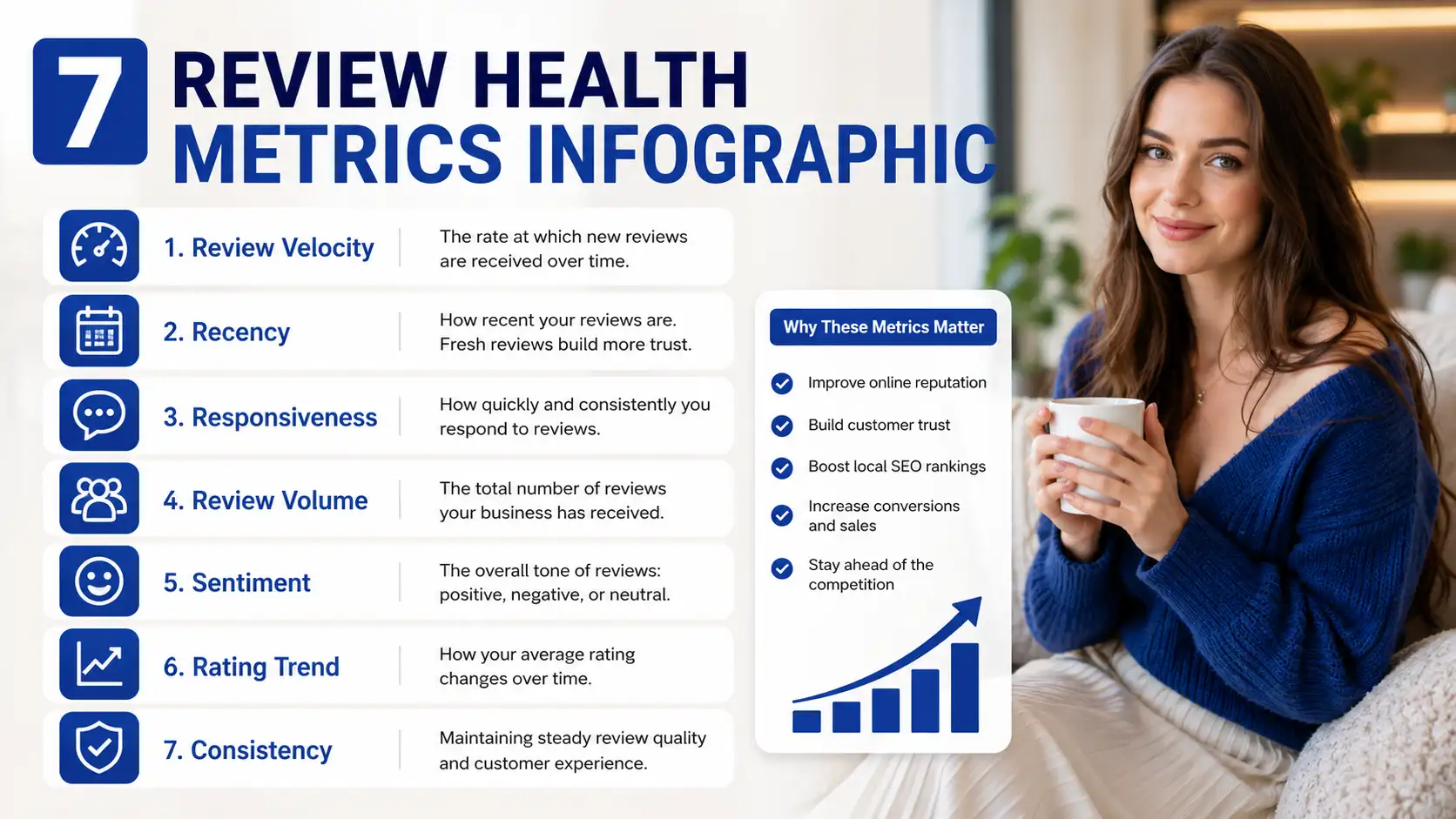
Review Velocity: Monitoring New Reviews Over Time
Review velocity measures how often new reviews appear over a set period. It tells you whether customer feedback is flowing steadily or slowing down. A healthy pace suggests active customer experience signals and a business that continues to generate engagement.
This metric matters because a profile with strong review velocity usually looks more credible than one built on old praise. Even if your score is solid, long gaps between reviews can make your reputation feel stale. For some businesses, shifts in volume may also reflect changes in demand, service quality, or product usage patterns.
You should monitor:
- The number of new reviews each week or month.
- Whether review flow is stable, rising, or declining over time.
When review velocity drops, it can be an early sign that outreach, service delivery, or customer follow-up needs attention.
Recency: Importance of Fresh and Relevant Feedback
Recency looks at how fresh your latest reviews are. This matters because buyers want current proof that your business still delivers a strong experience. Old praise can help, but it does not always reflect your present customer journey.
Fresh customer feedback also gives you faster insight into customer satisfaction changes. If recent comments mention delays, confusion, or support issues, you can respond before those concerns spread. If recent reviews are positive, you gain stronger social proof at the right moment.
Because conditions change, you should review and update your metrics regularly rather than treating them as fixed. A useful review score should be dynamic, just like customer health scoring. As a practical rule, check recency trends on an ongoing basis so your model reflects what customers are saying now, not what they said last year.
Responsiveness: Measuring Reply Rate and Speed
Responsiveness measures two things: how often you reply to reviews and how quickly you do it. This is a visible sign of customer engagement. It shows whether your business listens, acts, and values the people sharing feedback.
Reply behavior can shape customer relationships even after a problem occurs. Fast, thoughtful responses can lower frustration and improve trust. Slow or missing replies can suggest weak customer support, even if the original complaint was small. In public review spaces, support interactions are part of your brand story.
In customer success, response time and issue resolution often affect account health. The review equivalent works the same way. Reply rate and reply speed directly affect perceived care, professionalism, and accountability. If you want stronger review health, make responsiveness a core operating habit rather than a last-minute task.
Review Volume: Assessing the Quantity of Reviews
Review volume measures how many reviews your business has collected. On its own, quantity does not guarantee quality, but it does add credibility. A larger set of customer feedback gives prospects more confidence that they are seeing a fair reflection of your service.
Volume also provides better context for interpreting trends. A 4.8 rating from ten people says less than a 4.6 rating from hundreds. More reviews can reveal patterns in customer satisfaction and create a stronger signal for your review health score. It is similar to how larger data sets improve confidence in product usage metrics or customer behavior analysis.
Pay attention to:
- Total review count by platform.
- Growth in review count over consistent time periods.
If volume stalls while your customer base grows, that gap may signal missed opportunities to capture authentic feedback.
Sentiment Analysis: Understanding Customer Feelings
Sentiment analysis looks beyond stars to understand how people actually feel. It focuses on the tone, themes, and language inside customer feedback. That helps you see whether reviewers are expressing trust, frustration, loyalty, or confusion.
This matters because two reviews with the same rating can tell very different stories. One may praise speed and service. Another may sound hesitant despite a decent score. Tracking customer sentiment gives you richer insight into customer experience and helps protect customer relationships before issues become larger trends.
In health scoring, sentiment is a direct signal because emotion often predicts behavior. Repeated mentions of delays, poor communication, or unresolved issues may point to future reputation risk. Positive language around helpful service, smooth onboarding, or strong value can signal healthier relationships and stronger long-term loyalty.
Rating Trend: Tracking Patterns Over Time
Rating trend measures whether your scores are rising, stable, or slipping over time. This is different from a static average. A business with a 4.5 rating today may be improving quickly or declining slowly. Without historical data, you cannot tell which story is true.
That is why rating trend is a key part of reliable health scoring. It helps you compare present customer feedback with past performance and identify meaningful direction. If your recent ratings are lower than earlier ones, that may point to service issues, operational strain, or changing customer experience expectations.
To build a reliable score, use effective metrics that capture movement, not just totals. Rating trend works best alongside review volume, recency, and sentiment. Together, these signals show whether changes are isolated or part of a broader pattern you need to address.
Consistency Across Platforms
Most businesses receive customer feedback in more than one place. That is why consistency across platforms matters. If your ratings, themes, or response habits differ sharply between sites, your reputation may appear uneven. Buyers often compare sources before they make decisions.
A good scoring model should pull from multiple data sources rather than relying on one channel. This helps you spot gaps that a single platform might hide. For example, strong reviews on one site do not cancel out poor response habits or negative trends elsewhere. A balanced view creates a more accurate read of customer experience.
When reviewing this metric, compare average rating, sentiment themes, review volume, and response behavior across your key platforms. Consistency builds trust. Major differences suggest that your review process, service delivery, or follow-up systems may need closer attention.
Calculating Your Review Health Score
Once you know the seven metrics, the next step is turning them into a practical scoring model. This is where health scoring becomes useful. You assign value to each signal, combine them, and create a score that shows whether your review profile is healthy, at risk, or in need of urgent work.
Like a customer health score, the goal is not the number alone. The goal is better business outcomes through faster action, clearer priorities, and more consistent tracking.
Choosing and Weighting Key Metrics
Start by choosing the metrics most tied to your reputation goals. A review-based health score model should reflect what actually affects trust and conversion in your market. That means using relevant data from your major review platforms, then deciding which signals deserve more weight.
Not every metric should count the same. A business that depends heavily on fresh social proof may weight recency and review velocity more than raw volume. Another may place more value on responsiveness. The key is to build a scoring model that fits your workflow and customer expectations.
A simple weighting process can include:
- Selecting the most useful data sources for your business.
- Assigning higher value to metrics that best predict reputation risk.
- Reviewing weights regularly as patterns and priorities change.
That is how you create a more reliable score using effective metrics instead of guesswork
Step-by-Step Calculation Example
A practical way to calculate your score is to normalize each metric on a 0 to 100 scale, apply a weight, and then total the results. This mirrors common customer health scoring methods. Even though this model uses customer feedback rather than product usage metrics, the logic is the same.
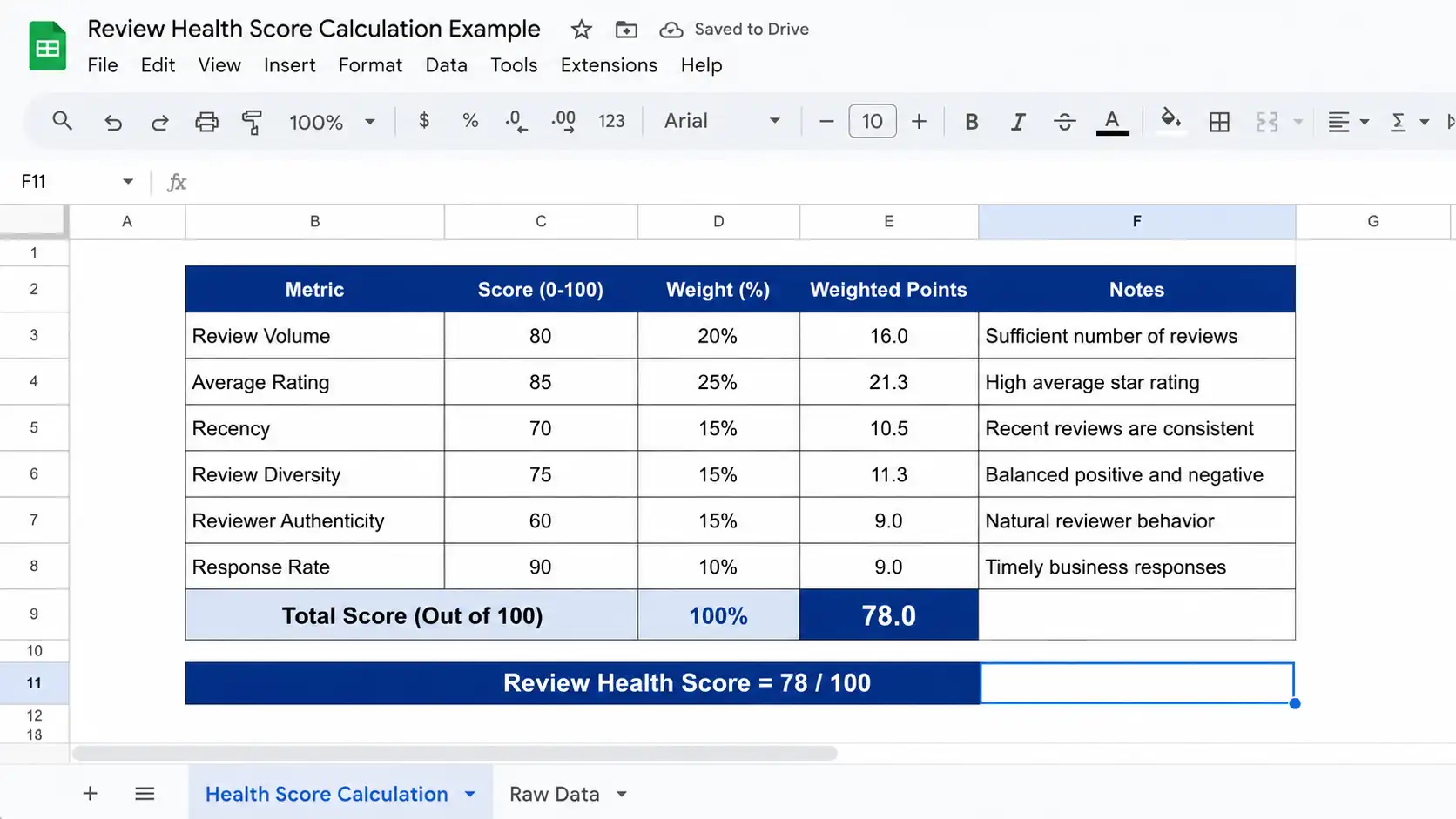
Here is a simple example:
| Metric | Score | Weight | Weighted Points |
| Review Velocity | 80 | 20% | 16 |
| Recency | 90 | 15% | 13.5 |
| Responsiveness | 70 | 15% | 10.5 |
| Review Volume | 75 | 15% | 11.25 |
| Sentiment Analysis | 85 | 15% | 12.75 |
| Rating Trend | 60 | 10% | 6 |
| Consistency Across Platforms | 80 | 10% | 8 |
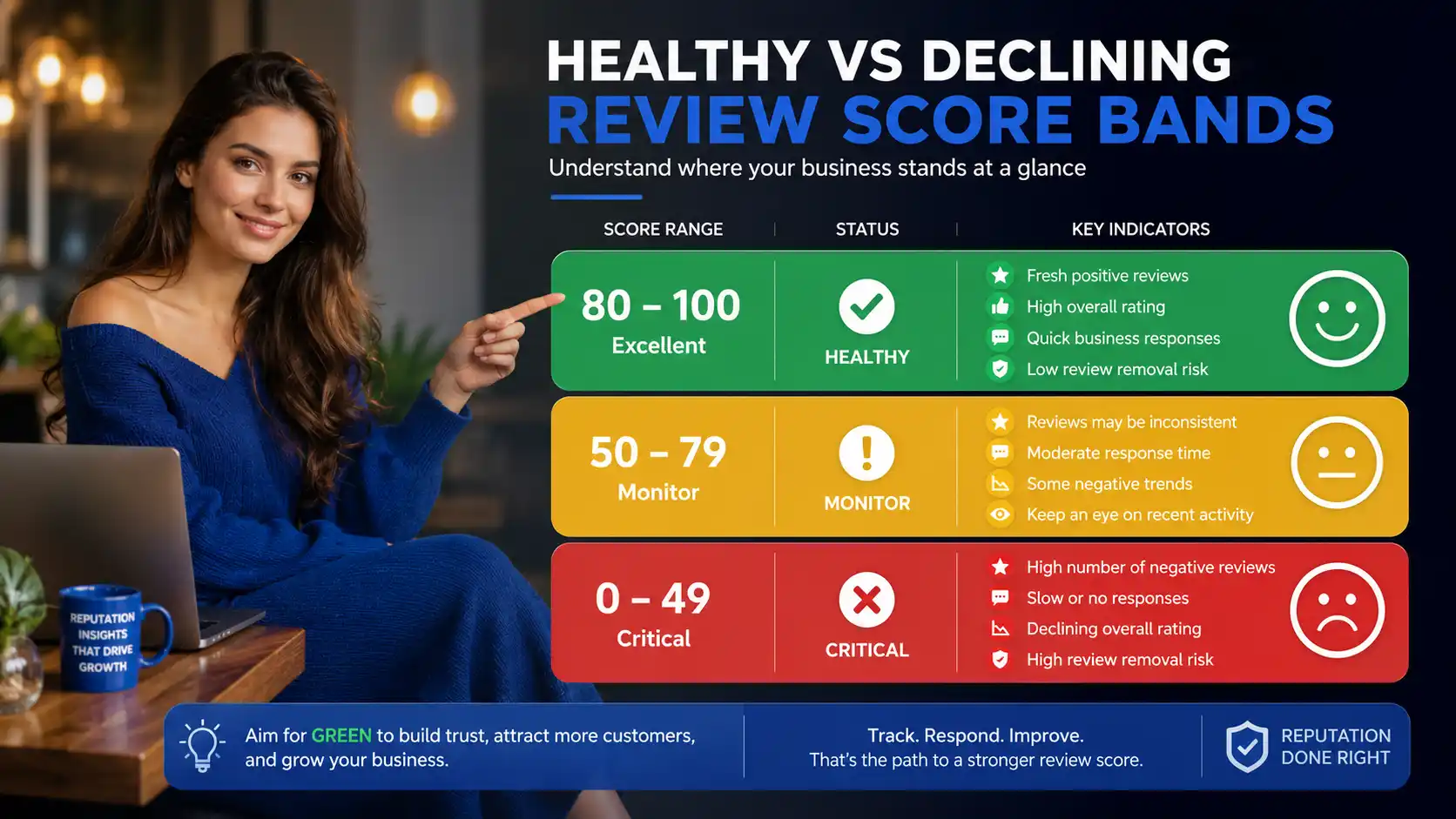
Add the weighted points to get a final score of 78. If you use clear score bands, such as healthy, monitor, and critical, your scoring model becomes easier to use. That turns raw numbers into action.
Tools and Software for Automated Tracking
Manual tracking works at small scale, but it gets hard as review sources grow. Automated tools help collect customer data, update scores, and flag changes in real time. That makes it easier to respond quickly and keep your model current.
The compiled guidance on customer health scoring points to CRM and customer success platforms as useful for automation. These tools often combine signals such as product usage metrics, support tickets, and feedback. SaaS companies use them to monitor account health, but the same approach can support review-based tracking when you pull in review platform data.
Helpful software should support:
- Ongoing score updates and clear dashboards.
- Alerts when trends, sentiment, or responsiveness start to decline.
The best tool is the one that helps your team move from observation to action without adding unnecessary complexity.
What Does a Healthy Score Look Like?
A healthy review health score is one that signals steady trust, active feedback, and responsive management. In simple terms, it means your reviews are recent, your volume is growing, your sentiment is positive, and your responses are timely. Those are strong signs of good account health in public view.
Still, healthy does not look identical for every business. Benchmarking matters because review patterns vary by industry, customer expectations, and service model.
Benchmarks by Industry
Benchmarking helps you judge performance in context. A healthy score for one industry may look average in another. The compiled guidance on customer health score models makes an important point: what counts as healthy varies by business model, customer base, lifecycle stage, and goals. The same thinking applies here.
You can measure whether your system is effective by checking whether your score aligns with real outcomes. If higher-scoring profiles show better trust, stronger engagement, or healthier retention rates, your model is likely useful. Compare your review patterns against your own historical performance first, then refine by industry.
A practical benchmarking view may look like this:
| Industry Type | What a Healthy Review Profile Usually Shows |
| SaaS companies | Steady new reviews, strong responsiveness, improving sentiment, and visible consistency across platforms |
| Service-based businesses | Fresh feedback, high reply rate, and enough volume to reflect the active customer base |
| Subscription businesses | Ongoing review flow, stable rating trend, and review signals that support renewal confidence |
Use benchmarking as a guide, not a fixed rule.
Signs of Declining Health Scores
A declining review health score often shows up in patterns before it becomes obvious in your average rating. That is why it works as an early warning system. When review freshness slows, sentiment weakens, or replies stop, your public account health may be slipping even if the headline score still looks stable.
These changes matter because they can increase retention risk and affect business outcomes. Less current feedback can reduce trust. More unresolved complaints can damage credibility. If your model does not detect those shifts, it loses value.
Common warning signs include:
- Fewer new reviews over a consistent period.
- Slower response times or lower reply rates.
- More negative themes appearing in recent customer feedback.
A major pitfall is building a model that is too static. If weights and thresholds never change, you may miss meaningful signals until the damage is harder to reverse..
Frequently Asked Questions
Q: How often should businesses review their health score metrics?
A: Businesses should review health scoring metrics regularly because customer feedback and behavior change over time. A static model becomes less useful. Ongoing review helps customer health scoring stay aligned with current customer outcomes and business outcomes, especially when service patterns, review flow, or expectations begin to shift.
Q: What are the common pitfalls to avoid in building a review health score model?
A: Common pitfalls include relying too much on one metric, using static thresholds, and treating the scoring model like a report instead of an action tool. Even unlike models built around product usage metrics, review scoring still needs context. If not, you may miss retention risk, falling customer satisfaction, or customer journey problems.
Q: What strategies can improve a low review health score?
A: To improve a low score, focus on steady review collection, faster replies, and closer monitoring of sentiment and trend changes. These customer success strategies support stronger customer engagement and customer loyalty. The goal is not just a better customer health score, but better customer feedback patterns over time.
Conclusion
In conclusion, understanding and tracking your Review Health Score is vital for any business aiming to maintain a strong online reputation. By focusing on the seven key metrics outlined—review velocity, recency, responsiveness, review volume, sentiment analysis, rating trend, and consistency across platforms—you can gain invaluable insights into customer perceptions and behaviors.
This comprehensive approach ensures you’re not just looking at star ratings but are also considering the nuances that truly impact your business’s success. Regularly monitoring and acting upon these metrics will help you improve your score and ultimately enhance customer satisfaction. If you’re ready to take charge of your Review Health Score, get a free consultation with our experts to learn how to optimize your strategy effectively

Robert Miller works as a Reputation Management Consultant. He has been helping U.S. businesses for over ten years. His work involves helping people protect and enhance their online image.Robert has worked with a wide range of companies. He has helped new businesses, local places that give a service, and big companies. He helps turn customer reviews into something that helps people trust their company and drives business growth.