
Introduction
Choosing between Google Reviews vs Trustpilot can feel harder than it should. Both are trusted names, but each review platform serves a different purpose. Google reviews can help people find you fast, especially in local searches. Trustpilot reviews are often used when shoppers want to research a company before buying, especially in a competitive space. So which one fits your business better? The answer depends on how customers find you, what builds trust in your market, and what you want reviews to do. For a deeper understanding of review management and online reputation strategies, visit: RevyuRank.
Understanding the Role of Online Reviews for Businesses
Customer reviews do more than reflect opinions. They shape business reputation, influence buying choices, and act as trust signals when people compare brands. If you want new customers to feel confident, reviews need to be part of your review strategy.
At the same time, your business goals matter. Google Reviews and Trustpilot solve different problems. Google is tied to local discovery, while Trustpilot is more focused on reputation research. That difference matters when you decide where to invest time, tools, and effort.

Why Online Reviews Matter in Customer Decision-Making
When people are close to making a purchase, they often look for proof that others had a good experience. That is where customer trust starts to form. A strong review platform gives buyers quick social proof before they spend money.
Still, the platform customers check most often depends on intent. If someone is searching for a nearby business, Google is usually the first stop because the reviews appear directly in search and Maps. If they are researching a brand before a higher-value purchase, Trustpilot often becomes more relevant during the decision stage of the buying journey.
You can also learn from review insights, not just display them. Reviews show what customers value, where concerns appear, and how your brand is perceived. That makes reviews useful for marketing, service improvements, and better conversion decisions.
Impact of Reviews on Business Reputation and Trust
A steady flow of reviews can strengthen your business reputation fast. Positive reviews tell people your service is reliable, while visible responses to negative reviews show that you take customer feedback seriously. Both are important trust signals.
Trust can shift by platform. Google reviews feel convenient because they are visible right where people search for a business. Trustpilot, on the other hand, often carries stronger brand trust because it is an independent destination where people go specifically to assess a company’s reputation.
Neither platform is perfect. Google can attract more review volume because anyone with a Google account can post, but that openness can also create fake review concerns. Trustpilot reviews may feel more trustworthy to some customers because of stronger review moderation and verified review options, even though suspicious content can still appear.
Google Reviews Overview: Features and Reach
Google reviews appear on your Google Business Profile and show up when people search your business name or browse Google Maps. For local businesses, that visibility, especially with lots of reviews, is hard to match. Reviews are often seen before a customer even visits your website.
Because Google reviews are tied to your business profile, they help shape first impressions in local search. They are not the main source for Google Shopping ads seller ratings, though. That role is more closely linked to approved third-party partners like Trustpilot, which creates an important difference.
How Google Reviews Work for Local Businesses
For local businesses, Google reviews and customer ratings are built into how customers discover nearby options. Reviews appear on your Google Business Profile, in Google Maps, and inside local search results. That means they influence visibility and trust at the same time.
If you run a small business, Google often deserves the first focus. Restaurants, clinics, gyms, salons, contractors, and repair shops usually depend on local discovery. In those cases, better review volume and a higher average rating can help your listing compete more effectively.
Key reasons Google reviews matter for local businesses:
- They appear directly in Google Maps where local customers are searching.
- They support stronger placement in local search results and the local pack.
- They are free to collect from anyone with a Google account.
That makes Google reviews the more practical starting point for many small, location-based businesses.
Integration with Google Search and Maps
Google Reviews are deeply connected to Google Search and Google Maps. When people look up your business, your star rating, review count, and comments—along with video reviews—often appear alongside your business profile. That gives customers quick context before they click or call.
For local SEO, Google is clearly more beneficial. Positive reviews and a solid number of reviews can help improve visibility in search results, especially for local searches. If your goal is to rank better in the local pack, Google reviews matter far more than Trustpilot.
Trustpilot can still appear in branded searches, especially when people search for your company plus the word reviews. But it does not improve Maps placement or local rankings. So if SEO means local visibility for your business, Google Search and Maps provide the bigger advantage.
Trustpilot Overview: Platform & Capabilities
Trustpilot is a dedicated review platform where people go to research brands and share their insights on social media, not just find nearby businesses. Your Trustpilot profile acts as a public reputation page that can show review volume, ratings, and customer comments in one place.
Some entrepreneurs pay for Trustpilot because it offers more than basic review collection. Paid plans can unlock automation, stronger moderation tools, deeper reporting, and integrations with ecommerce platforms, granting access to a full feature set. For brands that depend on trust during longer buying decisions, those capabilities can justify the cost.
Trustpilot’s Review Collection and Display System
Trustpilot’s system is built around structured review collection. Businesses can send review invitations to customers, and verified review labels help signal that feedback came from a real transaction or invited experience. That adds order to the process.
Its display tools are also part of the appeal. The Trustpilot logo and TrustBox widgets are recognizable to many shoppers, which can strengthen credibility on a website. On paid plans, businesses can use automated review invitations, track trends with other features that reduce manual work.
What the platform offers includes:
- Review invitations that help businesses request feedback at scale.
- Verified review labeling that supports stronger authenticity signals.
- Paid plans with automation and more advanced display options.
That said, paying for Trustpilot does not mean paying for 5-star reviews. Businesses pay for tools, access, and features, not guaranteed ratings.
User Engagement and Community on Trustpilot
Trustpilot works like a destination for reputation research. People visit it with intent, which changes user engagement. They are not casually browsing a map listing. They are actively checking whether a business looks dependable before buying.
That focus can create a stronger sense of community around feedback. A Trustpilot profile becomes a central place where customers read, compare, and leave trustpilot reviews. Review volume can matter here because shoppers often look for patterns, not just one or two comments.
If you are choosing for your website, think about customer behavior, business type, and buying journey. Do visitors need quick local proof, or do they need stronger trust signals before a higher-value purchase? Also consider whether you need branded widgets, analytics, review invitations, or just a simple place for public feedback.
Key Differences between Google Reviews and Trustpilot
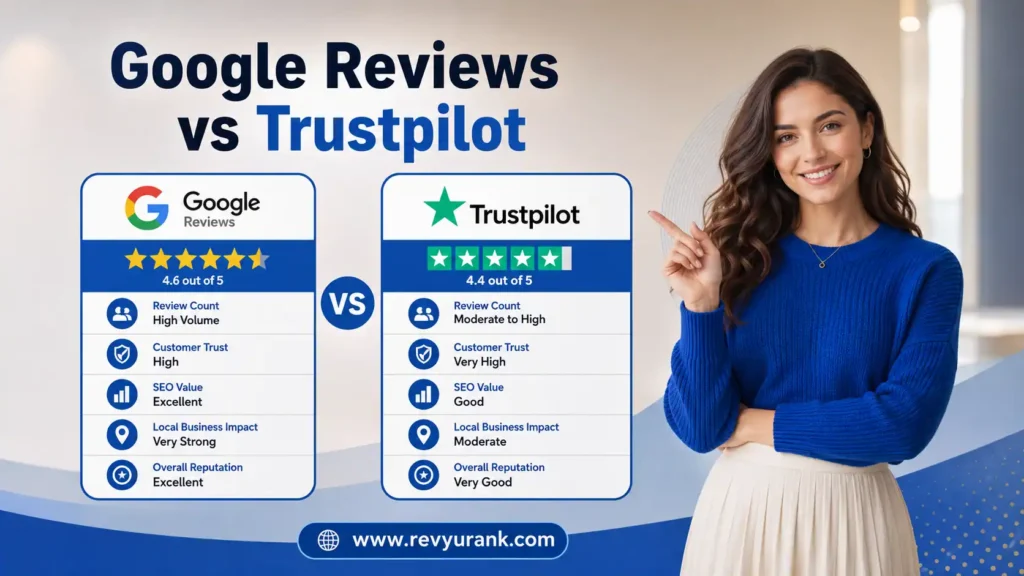
The biggest difference is purpose. Google reviews are tied to your Google Business Profile and help local discovery. Trustpilot reviews live on an independent review platform built for reputation research, brand comparison, and buyer reassurance.
Cost is another major gap. Google runs on a free plan with no charge for core use, while Trustpilot has a limited free plan and broader features inside a paid plan. If you compare them fairly, Google helps visibility, while Trustpilot offers more structured tools and control.
Visibility and Influence on Local SEO
If your goal is local SEO, Google reviews are the stronger choice. They influence how your business profile performs in Google Search and Maps, and they can support better placement in local search results. That makes them especially useful for businesses serving a local area.
Trustpilot reviews support visibility in a different way. They can show up when people search for your brand name, especially brand-plus-review searches. That helps reputation research, but it does not improve your local pack presence or Maps ranking.
| Factor | Google Reviews | Trustpilot Reviews |
|---|---|---|
| Main visibility area | Google Search, Google Maps, local pack | |
| SEO value | Strong for local SEO and local searches | |
| Connection to business profile | Directly linked to Google Business Profile | |
| Brand-name search presence | Limited compared with dedicated review pages | |
| Trustpilot search impact | Can rank for branded search results, not local rankings |
So, for improving SEO tied to nearby discovery, Google reviews are more beneficial.
Review Authenticity, Moderation, and Control
Managing authenticity is one of the clearest differences between these platforms. Google allows reviews from anyone with a Google account, which helps volume but can increase fake reviews and spam concerns. Its review moderation is relatively limited.
Trustpilot puts more emphasis on fraud detection and structured controls. Verified review signals and moderation tools can make suspicious activity easier to flag. That does not remove every problem, but it gives businesses more support when dealing with questionable content or disputed posts.
In practical terms, businesses often find negative feedback easier to manage on Trustpilot because of stronger systems, such as:
- More visible moderation tools for reporting suspicious reviews.
- Fraud detection that looks for unusual behavior patterns.
- Verified review options that add authenticity signals.
Google is simpler and more open, but that can also mean less control.
Pros and Cons of Google Reviews for Businesses
Google reviews are appealing because they are free, easy to access, and visible where many people already search. Through the business profile dashboard, you can monitor ratings, respond to customer feedback, and build credibility in public. The downside is that openness cuts both ways. Anyone with a Google account can leave a review, which may raise authenticity concerns. Positive Google reviews are powerful for discovery, but some customers may still view independent platforms as stronger trust signals for deeper brand research. Businesses looking to strengthen their review strategy and online reputation can explore RevyuRank for additional insights and review management resources.

Advantages: Free Access and Wide Reach
Google’s biggest advantage is simple: access. The free plan gives businesses a no-cost way to collect and show reviews and offers basic features in places customers already use every day. That is hard to beat, especially for local businesses with limited budgets.
Its wide reach also matters. Google reviews appear in Google Maps and search results, which means your social proof can influence people before they ever land on your website. For many businesses, that visibility alone makes review requests worth prioritizing.
Key benefits include:
- Free access with no paid subscription for basic use.
- Strong exposure through Google Maps and local search.
- Fast social proof where customers already search.
So why do companies still pay for Trustpilot? Usually because they want automation, verified workflows, seller ratings support, or stronger brand trust tools that go beyond Google’s basic setup.
Challenges: Managing Public Feedback and Potential Risks
Google reviews can create headaches when public feedback turns negative. Because the platform is open, businesses may face unfair comments, spam, or fake reviews that are difficult to remove quickly. That can put pressure on your business reputation.
There is also the visibility issue. Negative reviews on Google are easy for customers to see because they sit directly inside search results and Maps listings. If problems are not addressed, they can influence calls, visits, and clicks right away.
Common challenges include:
- Limited review moderation compared with more controlled platforms.
- Fake reviews that may be hard to dispute successfully.
- Public negative reviews appearing where discovery happens.
For many businesses, this means Google is powerful but less forgiving. Compared with Trustpilot, managing negative feedback is usually harder because you have fewer moderation tools to work with.
Pros and Cons of Trustpilot for Businesses
Trustpilot reviews can strengthen credibility because they live on an independent review platform people use to evaluate brands, rather than relying solely on a brand’s own website. A public Trustpilot profile, paired with stronger moderation tools, can make the platform attractive for businesses in competitive markets.
The tradeoff is cost. While there is a free option, many useful capabilities sit behind paid tiers. Entrepreneurs often choose those plans because they want better automation, analytics, and reputation controls than Google’s free setup can provide.
Advantages: Moderation Tools and Custom Branding
Trustpilot stands out when control and presentation matter. Its moderation tools are stronger than Google’s, and that can help businesses monitor suspicious content, track reputation trends, and manage public sentiment with more confidence.
Brand presentation is another advantage. The trustpilot logo carries recognition, and businesses can use display tools that feel polished on landing pages and checkout flows. For websites where trust must be earned before purchase, that can be valuable.
Consider these strengths:
- Better moderation tools for handling review quality and flagged activity.
- Custom branding options that help reviews fit your site experience.
- Deep analytics and advanced features on higher plans.
If your website needs more than basic stars, Trustpilot can be a better fit. It is especially useful when buyers compare brands carefully before they commit.
Challenges: Subscription Costs and Platform Limitations
The most obvious challenge with Trustpilot is price. Subscription costs rise quickly once you move beyond the limited free option. For a small business, those paid plans can feel hard to justify unless reviews directly affect conversions or ad performance.
There are also platform limitations. Trustpilot is a dedicated review destination, but it does not influence local Maps rankings. If your business type depends on nearby searches, Google may deliver more direct value even with fewer advanced features.
Main drawbacks include:
- Paid plans that can become a major recurring expense.
- Limits on free review collection, including invitation caps.
- Less value for businesses that rely mostly on local discovery.
That is why some entrepreneurs still pay for it: not because Google is weak, but because Trustpilot solves different problems tied to branding, verification, and ad-related trust signals.
Frequently Asked Questions
Q: Are Google Reviews or Trustpilot reviews more trustworthy for customers?
A: Both can build customer trust, but Trustpilot reviews are often seen as more credible for brand research because of stronger review authenticity signals and review moderation. Google reviews feel convenient and visible, though their open system can raise more concerns about fake or unverified feedback, according to a July 2025 study by Trustpilot and London Research.
Q: Which review platform supports business SEO more effectively?
A: For local SEO, Google reviews are the stronger review platform. They influence visibility in search results, Google Maps, and the local pack. Trustpilot reviews can appear for branded searches, but they do not improve local rankings, so their SEO value is narrower and more reputation-focused.
Q:Why do companies pay for Trustpilot when Google Reviews are free?
A: Companies pay for Trustpilot reviews because a paid plan can offer structured review collection, automated invitations, moderation support, seller ratings eligibility, and advanced features beyond what google reviews provide for free. The value is usually stronger for ecommerce, SaaS, and brands selling through longer decision cycles.
Conclusion
In conclusion, choosing between Google Reviews and Trustpilot ultimately depends on your business needs and goals. Both platforms offer unique advantages and challenges, impacting your online presence and customer engagement. Google Reviews can enhance local SEO and visibility, while Trustpilot provides moderation tools and a community-driven approach to feedback.
Understanding these differences allows you to make an informed decision that aligns with your brand strategy and customer expectations. Embrace the power of online reviews to build trust and credibility in your market. If you want to explore how to maximize your business reviews, don’t hesitate to reach out for guidance!