

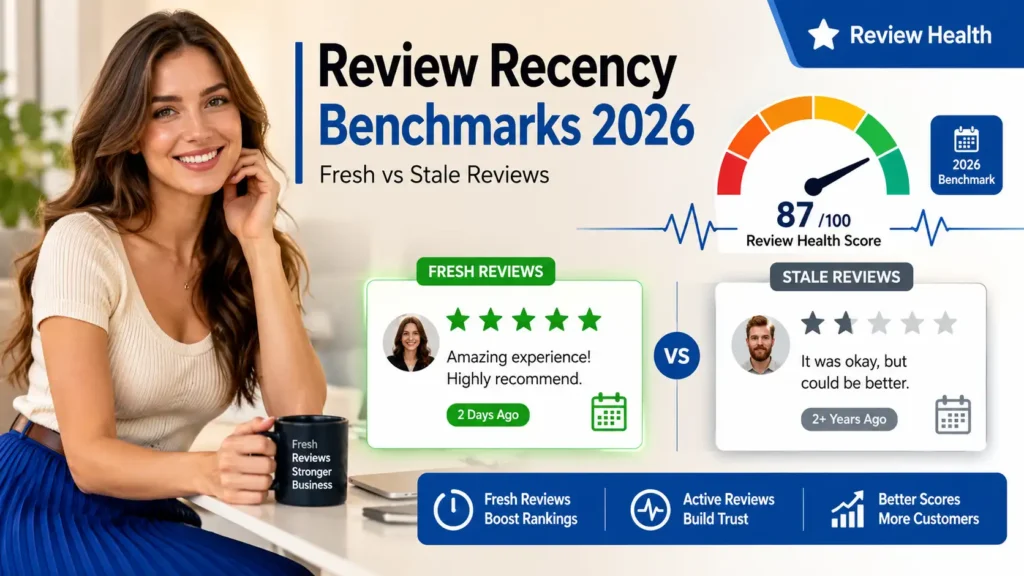
Review recency benchmarks in 2026 refer to how recently and consistently a business receives authentic customer reviews. A strong review profile is no longer defined only by a high star rating or a large number of reviews. Customers increasingly look for recent feedback that reflects the business’s current products, service quality, and customer experience.
For most businesses, there is no single “perfect” number of days that makes a review profile successful. The right benchmark depends on your industry, customer volume, location, and how often competitors receive new reviews. However, businesses should focus on maintaining a steady flow of genuine reviews, avoiding long periods without new feedback, and monitoring how recent their newest reviews are compared with local competitors.
In 2026, the most useful review recency metrics include:
- Days since the latest review
- Number of new reviews received in the last 30, 60, and 90 days
- Review velocity and consistency over time
- The percentage of recent reviews compared with older reviews
- Recency compared with direct competitors
- Whether recent reviews reflect current customer experience
The key takeaway is simple: old reviews still provide valuable reputation history, but recent reviews provide current proof of trust. Instead of chasing sudden spikes or artificial review activity, businesses should build a sustainable system that encourages real customers to share feedback after genuine interactions. By tracking review recency benchmarks alongside rating, review volume, sentiment, and response activity, businesses can identify when their reputation is becoming stale and take action before customer trust or local visibility begins to weaken.
Understanding Review Recency for 2026
Review recency is about how recently customers posted feedback on your google business profile and other important review sites. In 2026, that timing matters more because buyers want proof that your service quality is current, not something you delivered a year ago.
At the same time, review velocity and review volume still matter. A healthy review profile needs all three working together. To see where review recency fits, it helps to separate these terms and understand how each one affects trust and visibility.
What Is Review Recency and Why It Matters More Than Ever
Review recency means the age of your latest customer feedback. It looks at how recent your last review was and whether your business keeps earning feedback over time. For business owners, this matters because people no longer judge you only by star rating or total google reviews.
What changed in 2026? Consumer expectations rose fast. Many people now care only about reviews from the last three months, and a sizable group looks for feedback from the last two weeks. That makes review recency a stronger trust signal than it used to be.
There is also a local seo angle. Buyers use more platforms, and AI tools now summarize business reputation across them. If your recent feedback is thin, your profile can look inactive. Fresh feedback signals that your service is still reliable right now.
Key Differences Between Recency, Velocity, and Volume in Reviews
These three terms sound similar, but they measure different parts of your review profile. Review recency looks at how old your newest google reviews are. Review velocity tracks how often new feedback comes in. Review volume is your total review count over time.
For local businesses in 2026, the current benchmark is clear: recent activity matters. Reviews inside 30 to 90 days are the strongest practical range, while long gaps weaken trust even if review volume is high.
- Review recency = how fresh your newest feedback is
- Review velocity = the pace of incoming reviews each week or month
- Review volume = the total review count on your profile
If you want stronger results, do not treat these as substitutes. A high review count helps, but it works best when paired with steady review velocity and current feedback.
How Recent Should Reviews Be in 2026?
For most local businesses, new reviews should be arriving consistently, with visible activity inside the last 30 to 90 days. That is the range where review recency still feels current to both shoppers and platforms scanning your google business presence.
There is no single magic number for every company. Still, if your last review is older than three months, your profile may start to look stale. The next two sections break down what counts as fresh and how to check your own benchmark.
Defining “Fresh” Reviews: Google’s 2026 Standards
In 2026, fresh reviews are not just nice to have. They are part of what makes your business look active, dependable, and worth considering. Based on current consumer behavior, the strongest window for review recency is within the last three months, and the best-performing signals are often even newer.
Some people want to know the exact cutoff. A practical answer is this: reviews from the last 30 days look very fresh, reviews within 90 days still support local seo well, and anything older starts losing impact. That does not make old google reviews useless, but it does reduce their persuasive power.
Google’s ai and other discovery tools also rely on patterns. If your feedback keeps mentioning great service, fast turnaround, or transparent pricing in recent posts, those themes are more likely to support trust and visibility.

Minimum Review Age Benchmarks for Local SEO Impact
A simple way to measure review recency is to look at your review profile and ask two questions: when did the last review arrive, and how many reviews came in during the last 30, 90, and 180 days? That gives you a clear starting point for review generation.
You should also compare review age to your review request habits. If you only ask in bursts, gaps will show up fast. A steady process supports local seo better because it keeps your profile active and believable.
| Review age | Practical impact on local seo |
| 0-30 days | Strong freshness signal and best support for an active review profile |
| 31-90 days | Still valuable and generally current for most local businesses |
| 91-180 days | Weaker influence; profile may start to feel dated without new activity |
| 180+ days | Limited freshness value unless supported by recent review generation |
The Recency Decay Curve Explained
Review decay is the gradual loss of value that happens as online reviews age. In simple terms, a glowing review from last week carries more weight than one from last year because it reflects your current operation more clearly. That is the core idea behind review recency.
For local seo and conversion, the value drops in stages rather than all at once. The biggest shifts usually happen across the first 30, 90, and 180 days. Let’s look at why those timeframes matter so much.

Why the First 30 Days Matter Most for Search and Conversion
The first 30 days matter most because they show your business is earning praise right now. That matters for search visibility, but it also matters when people compare options and want proof that your service is consistent today, not just historically.
In 2026, that expectation is stronger because consumers are using more platforms and more AI-driven summaries before making a choice. If your newest google reviews are recent, your business looks active. If not, even a solid rating can feel less convincing.
There is a conversion angle too. Businesses with steady review velocity usually perform better than those that gather reviews in short campaigns. Fresh feedback reduces hesitation, supports social proof, and helps people move from browsing to booking or buying faster.
Benchmark Data Points: 30, 90, and 180 Day Review Value
If you want an easy benchmark, think in three layers. Reviews from the last 30 days carry the highest review value. Reviews within 90 days still support local seo well. By 180 days, the freshness signal is much weaker unless new feedback keeps coming in.
This does not mean older feedback disappears. It still adds to review count and long-term credibility. The issue is that aged feedback cannot do the same job as current activity when buyers want up-to-date proof.
| Time window | Benchmark meaning | Review value |
| 0-30 days | Very fresh and highly persuasive | Highest |
| 31-90 days | Current enough for most local business profiles | Strong |
| 91-180 days | Acceptable but fading | Moderate |
| 180+ days | Historical support only | Low for freshness |
What Today’s Consumers Expect from Reviews (2026 Data)
Consumer expectations around online reviews are much higher now. The local consumer review survey shows that people are not just checking ratings. They want recent proof, enough total feedback, and signs that the business still delivers what it promises.
That shift changes how you should think about new reviews. It is no longer enough to collect feedback once in a while. To understand what buyers now expect, it helps to look at freshness standards and how those standards shape trust.
Insights from 2026 Consumer Surveys on Review Freshness
The local consumer review survey shows a sharp rise in expectations around review recency. Most consumers now care about reviews from the last three months, and many look for something even newer. That means your review request process needs to run all year, not only during special campaigns.
This trend also points to a quality issue. People want recent feedback that sounds real and specific, not generic praise. New reviews that mention service details help future customers trust what they are seeing.
- Many consumers only care about reviews written within the last three months
- A notable group specifically looks for reviews from the last two weeks
- Steady new reviews outperform burst campaigns because they show consistency
If you are wondering how often to ask, the answer is simple: often enough that your profile never looks quiet for long.
How Recency Influences Consumer Trust and Purchase Decisions
Review recency shapes trust because people use fresh feedback as a shortcut for present-day quality. When they see recent online reviews, they feel more confident that the business still delivers the same experience others describe.
That confidence affects purchase decisions in a direct way. Positive reviews make people more likely to choose a business, while stale or missing feedback creates doubt. Many shoppers continue researching after reading reviews, so your latest feedback often acts as the entry point instead of the finish line.
To measure whether your reviews are recent enough, check the date of your last review, count how many came in during the last 90 days, and look
for long quiet periods. If gaps are obvious, your social proof may be weaker than you think.
Setting Review Targets by Industry in 2026
Not every local business needs the same review pace. A busy restaurant, dental office, and HVAC company all serve customers at different volumes, so their review targets should reflect that reality. Still, review recency matters in every category.
The best way to set industry benchmarks is to match review activity to customer flow. High-volume businesses need more frequent feedback, while lower-volume companies still need consistency. Here is how those targets can be applied in practical terms.

Review Recency Benchmarks for Service-Based Businesses
Service business categories are heavily affected by review recency because buyers often compare trust, responsiveness, and reliability before contacting anyone. That includes home services, legal services, salons, and any business where personal experience strongly shapes the decision.
An HVAC company is a good example. Customers want proof that the team is still prompt and professional, especially during peak seasons. That is why a regular review request process supports local seo better than waiting for a campaign every few months.
| Service business volume | Suggested pace for new reviews | Why it matters |
| High-volume | 3-10 per week | Keeps review recency strong and shows steady operations |
| Mid-volume | 1-3 per week | Maintains visibility and trust without long gaps |
| Low-volume | 2-4 per month | Prevents a stale profile and supports ongoing relevance |
How Often Retail, Healthcare, and Other Sectors Need New Reviews
The ideal frequency depends on how many customer interactions your business has, but the core rule stays the same: collect reviews often enough to keep visible activity on your profile. Retail and healthcare usually need a more disciplined review strategy because shoppers and patients compare current experiences closely.
For these sectors, review velocity matters almost as much as the total number of reviews. Long pauses can make the business look less active, even when the average rating is strong.
- Retail businesses should aim for regular weekly feedback if customer volume is high
- Healthcare practices should maintain a steady monthly or weekly rhythm based on patient flow
- Other sectors should choose a pace that avoids long gaps in review recency
The goal is not a spike. It is a stable pattern that supports local seo month after month.
Frequently Asked Questions
Q: Do older reviews still count in 2026 or is recency everything?
A: Old reviews still help because they add history, context, and review signals such as overall trust and experience. Still, review recency matters more in 2026 for local seo and conversions. The best approach is to keep old google reviews working for you while adding fresh ones consistently.
Q: Has Google changed its review ranking algorithm in 2026 to focus more on recency?
A: Current 2026 patterns show stronger weight on review recency, even if the focus is better understood through behavior and results than a simple google ranking announcement. Google’s ai and discovery systems favor current, consistent signals, so a steady review request process is a safer strategy than relying on older feedback.
Q: What’s the best strategy for keeping reviews recent all year round?
A: Use an ongoing review strategy instead of occasional campaigns. Send each review request right after service completion or a positive interaction, reduce friction with a google review link, SMS, or QR codes, and track review generation monthly so new reviews keep arriving throughout the year.
Conclusion
In conclusion, understanding review recency is crucial for enhancing your business’s online presence in 2026. As we have explored, fresh reviews significantly impact consumer trust and purchasing decisions, making it essential to stay ahead of the curve. By setting specific review targets and adhering to industry benchmarks, you can cultivate a positive reputation that resonates with potential customers.
Remember, it’s not just about the volume of reviews but their recency that matters. To ensure your strategy is effective and aligned with the latest trends, consider scheduling a consultation with our experts. They can guide you on how to optimize your review strategy for maximum impact. Don’t underestimate the power of recent feedback in shaping your business’s success!