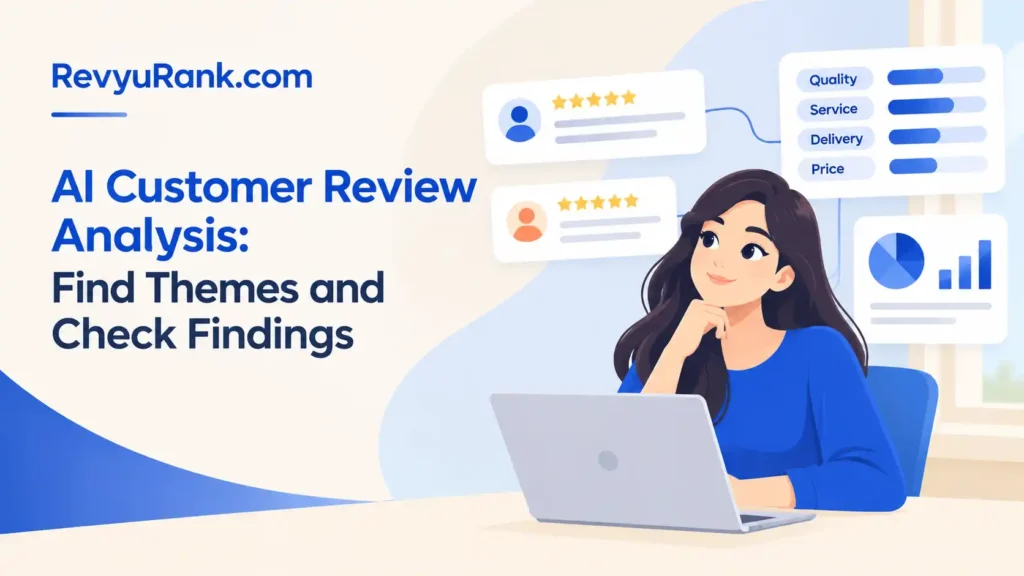
AI customer review analysis works best as a decision aid, not as a fully automatic judge. It can group review topics, detect sentiment, find repeated complaints, and flag urgent comments, but a person should check important findings before you change a product or policy.
The result changes with review quality, language, volume, and the AI model you use. Your goal also matters: trend tracking needs different checks from fraud detection, support triage, or product research.
Who needs review analysis?
A support manager may already have thousands of reviews but no clear way to sort them. They need topic groups, urgent complaint flags, and links back to the original wording. A useful workflow should show how many reviews support each theme and open the original examples behind it. A product manager usually needs repeated feature requests, defect patterns, and differences between customer groups.
A small business owner may have fewer reviews and may not need an advanced platform. A spreadsheet export, a language model, and a careful review sample may answer the first question. The key need is a reliable view of what customers mention most often, not the most complex dashboard. Compare groups only when the same fields are present across the reviews.
A research or data team may want API access, custom labels, confidence scores, and regular reports. They also need to test whether the system treats short reviews, slang, accents, and negative wording fairly. Their work is less about reading every comment and more about measuring whether the labels stay useful. Include positive and negative comments, since a model tested only on complaints can miss what customers value.
This page serves teams analyzing text reviews for themes, sentiment, and action. It assumes you can export the reviews legally and can check a sample yourself. A sample can reveal errors that aggregate scores hide, especially when reviews use slang or mixed languages. It isn’t for building a legal fraud case, making employment decisions, or diagnosing a customer’s health from review text.
What changes the result
Your question comes first. “What do customers dislike?” Needs topic and sentiment labels. “Which defect causes returns?” Needs product, order, and return data joined to the review. Before using AI, write one sentence describing the decision the analysis must support.
Review quality matters more than review count. A review with “bad” gives little detail, while a longer comment may mention delivery, fit, price, and support at once. Check the date, product version, rating, language, and whether the same customer appears more than once.
The label design controls the output. Broad labels such as “service” hide useful differences between slow replies, rude replies, and unresolved cases. Start with labels that match your business, then leave an “other” category so the model doesn’t force every comment into a poor fit.
Context changes sentiment. “The battery lasts forever” is positive, but “the wait felt forever” is negative. Sarcasm, mixed opinions, negation, and comparisons can confuse automated scoring. The mistake people make most often is treating a sentiment score as the customer’s full meaning.
Language and source affect comparison. A one-star review from a marketplace may use different wording from a support survey. If you compare channels, record the source, country, language, product, and collection date. Otherwise, a channel difference can look like a product difference.
Human checking sets the safe boundary. If an AI label will change a product, refund, safety response, or public claim, manually check representative examples. If it only creates a private reading queue, lighter checking may be enough, but keep the original reviews beside every summary.
How to analyze customer reviews
Use this process for a review export or a small pilot. Keep the original text, review ID, date, rating, source, product, and language with every result.
-
Define the decision. Write one question, such as “Which product issues appear most often in one-star reviews from the last quarter?” The finished report should answer that question without adding unrelated findings.
-
Collect the source fields. Export the review text, rating, date, product or service name, channel, country, and language. Confirm that every row has a stable review ID, and remove exact duplicate rows before analysis.
-
Remove unsafe personal details. Mask names, phone numbers, email addresses, order numbers, and addresses unless you need them for a permitted business purpose. Keep a protected original only under your organization’s approved access rules.
-
Set the labels. Create 8-15 initial topics based on the decision, such as delivery, fit, packaging, price, quality, billing, and support. Add sentiment labels such as positive, mixed, negative, and unclear, plus an “other” topic.
-
Test a sample. Select 50-100 reviews from the real dataset, including short, long, positive, negative, mixed, and non-English examples. Label them yourself or with trained reviewers before asking AI to label the same sample.
-
Run the AI analysis. Give the model the label definitions and require structured output for each review. Ask it to return the review ID, topic, sentiment, evidence phrase, and uncertainty flag rather than a free-form summary.
-
Check the labels. Compare the AI output with your sample labels. Read false positives, missed complaints, mixed-sentiment reviews, and “other” cases. If a topic is unclear, rewrite its definition before processing the full dataset.
-
Process the full set. Keep one row per review and one result per selected topic, or clearly mark multiple topics when a review contains more than one issue. Don’t count a review twice unless your report explains the counting method.
-
Compare the groups. Break results down by product, rating, date, channel, language, and customer segment only when each group has enough reviews to be meaningful. Compare both counts and the share of that group’s reviews.
-
Read the evidence. Open the original comments behind each important finding. If a summary can’t be traced to real review text, don’t use it for a customer-facing decision.
The judgement call is whether a pattern is strong enough to act on. If the issue appears across sources and the original comments say the same thing, prioritize it; if it appears in one unclear cluster, investigate it before changing the product.
Review analysis by situation
The right method depends on the decision, the review source, and the amount of text available.
| Situation | What to do in it | What it takes | What to watch for |
|---|---|---|---|
| Few detailed reviews | Read and label manually | Low setup effort | Small sample bias |
| Large review archive | Classify by topics | Export and review time | Duplicate comments |
| Product quality concern | Filter by product and date | Product data join | Version changes |
| Support complaint trend | Group service issues | Agent and ticket context | Channel differences |
| Multilingual reviews | Detect language first | Translation review | Lost local meaning |
| Fake review concern | Flag unusual patterns | Platform and account data | AI can’t prove fraud |
| Executive summary | Use reviewed themes | Evidence links | Missing minority views |
If a decision affects refunds, public claims, or product safety, use the table as a starting point rather than a final answer. The cost of a slower review is usually lower than acting on a wrong pattern.
Details that improve accuracy
Prepare labels before prompts
A useful topic label has a clear boundary and a positive example. “Delivery” might include late arrival and damaged shipping boxes, while “product quality” covers defects after the item arrives. Write what belongs and what doesn’t belong in each label.
Use the same wording across your test sample and full run. Changing “support” to “customer service” halfway through can create two groups for the same issue. Store the prompt, label definitions, model name, date, and settings with the output so another person can repeat the analysis.
Keep sentiment separate from star rating. A four-star review can contain a serious complaint, and a one-star review can praise one feature while criticizing another. Ask for an evidence phrase so you can see which words caused the label.
Check patterns while they form
Review the largest topic groups first, then inspect small groups that could carry high risk. A rare complaint about an allergic reaction, billing error, or dangerous defect shouldn’t disappear because it has a low count.
If the model returns a confident label for vague text, mark that output for review instead of accepting the confidence number. Confidence scores are model outputs, not proof that the interpretation is correct. Compare them with your own sample errors.
Leave the source text alone when summarizing. A summary can shorten a comment, but it shouldn’t soften “the charger overheated” into “some charging feedback.” If the wording suggests safety, legal, medical, or financial risk, stop automated interpretation and send the original comment to the responsible team.
Common review analysis problems
A visible error usually points to a data, label, or interpretation problem. Start with the original comments before changing the model.
| What you notice | What it usually means | What to do first | How to stop it happening again |
|---|---|---|---|
| Same review appears repeatedly | Duplicate source records | Group by review ID | Deduplicate before analysis |
| Positive review gets negative label | Mixed wording confuses model | Read evidence phrase | Allow mixed sentiment |
| “Other” is unusually large | Labels miss key topics | Sample other comments | Update topic definitions |
| One channel dominates results | Unequal source volume | Compare channel shares | Report channels separately |
| Short reviews seem unreliable | Too little context | Mark unclear cases | Keep an uncertainty label |
| Translation changes complaint | Meaning was flattened | Check original language | Use bilingual review |
| Urgent issue ranks low | Frequency hid risk | Review risk terms | Add safety escalation |
A common costly mistake is reporting raw topic counts without showing the source mix. That can make a channel with more reviews look worse, while the smaller channel has the higher complaint rate.
Rules for review data
The legal rules depend on where you operate, how you collected the reviews, and what you publish from them. In the United States, the Federal Trade Commission’s Consumer Reviews and Testimonials Rule addresses deceptive review practices, including fake reviews and incentives tied to a particular sentiment; read the FTC reviews rule before using AI findings in marketing. State laws, platform rules, and industry-specific requirements may add restrictions, particularly for health, finance, employment, or children’s products.
AI classification doesn’t make false review content acceptable. Don’t turn a small, uncertain pattern into a claim such as “customers agree” unless your records support that wording. Before publishing a model-generated theme or rating, check the underlying reviews and preserve enough context to test the claim. Keep the source reviews and the method used to select them.
Privacy rules can also apply to review text. A public review may still contain personal information, health details, account data, or another person’s identity. Where possible, remove direct identifiers before sending text to an AI service without destroying context needed for analysis. Ask your privacy or legal team which data can enter the AI service, where it can be stored, whether the vendor may use it for training, and how long it can be kept.
If you need to identify fraud, harassment, threats, or a safety event, stop at the flag. Preserve the original review, relevant timestamps, and the model output for the assigned investigators. A trained trust-and-safety, legal, security, or product-safety team should investigate the original evidence. Don’t make a final accusation from an AI score.
The real cost of analysis
The money cost depends on the tool, model, review volume, storage, and whether a person must check every result. Ask vendors for current pricing based on your monthly review count and data-retention needs. Don’t compare only the subscription price; include setup, export work, integration, and human review.
Time is often the highest cost. Cleaning duplicate records, defining labels, checking multilingual output, and reading evidence can take longer than sending text to a model. A small pilot shows the real workload better than a sales estimate.
There’s also a trade-off between speed and control. A ready-made dashboard is quicker to start, but it may limit your labels, evidence fields, and data location. A custom workflow gives more control, but it needs technical maintenance and repeat quality checks.
Risk is another cost. A wrong theme may waste product work, while a missed safety complaint may cause a much larger problem. If X affects a customer promise or safety response, use human approval; if it only sorts private reading queues, automate more of the first pass.
Compare tools using the same sample. Check topic accuracy, mixed-sentiment handling, language support, export options, audit records, access controls, and deletion settings. Those details can matter more than the number of dashboard charts.
Keeping analysis useful
Store each analysis with the review export date, source filters, label definitions, model or tool name, prompt version, and human-check notes. This record lets you explain why a result changed when the next report uses newer reviews or a different product version.
Keep the original review beside the topic and sentiment output. A summary without its evidence becomes difficult to audit, especially after a team member leaves or the model changes. Limit access to personal details and use masked text for routine reporting.
Review the label list when the “other” group grows, a new product launches, or customers start using a new term. The sign that the system needs attention isn’t a fixed calendar date; it’s a repeated mismatch between the label and what the original comments say.
When “other” climbs past roughly a fifth of your total volume, that’s the practical trigger to stop and inspect. Pull twenty reviews from that bucket at random. If most of them share a clear theme, you need a new label. If they’re genuinely miscellaneous, the classifier is working, and the proportion is the real finding worth reporting.
Don’t restart the whole project when one label fails. Save the accepted results, revise the unclear label, and recheck the affected sample. If the source format changes or review IDs disappear, pause the comparison until the records can be matched safely.
The mistake teams make here is reclassifying every historical batch after a label change. That destroys the trend line you spent months building. Revise forward from a fixed cutoff date, note that date in the record, and keep the old series intact for reference.
When AI review analysis is wrong
This method isn’t the right choice when you have too few reviews to protect customer privacy or support a useful pattern. Read the comments manually and describe them as individual examples instead of presenting a trend. Whether a pattern is worth reporting depends on the sampling design, variability, and decision; a small sample may be dominated by one customer.
It’s also wrong for proving that a review is fake. AI can flag repeated wording, unusual timing, or account patterns, but it can’t establish who wrote a review or why. Use the platform’s investigation process, account records, and trained trust-and-safety staff.
Don’t use automated sentiment as the only basis for refunds, account restrictions, employee action, medical advice, or safety decisions. Send the original evidence to the relevant legal, support, security, or safety team. Acting on a sentiment label alone, without reading the source comment, is where teams get this wrong most often — and the cost is a decision that can’t be defended if it’s challenged.
The limit is clear: AI can organize the language customers used, but the useful meaning varies with context, source, language, and product version. A review calling a feature “overwhelming” reads as negative in a wellness app and positive in a game. You can read your own limit by checking whether a human reviewer reaches the same label from the original comment. If they don’t, the pattern needs a second pass before it drives any action.
Frequently asked questions
Can AI analyze customer reviews accurately?
Yes, but accuracy depends on the labels, review language, and the type of decision. AI usually handles clear comments better than sarcasm, mixed opinions, short phrases, or local slang. Test it on a sample from your own reviews, compare its labels with human labels, and keep uncertain cases for manual checking.
Why is AI sentiment analysis wrong for some reviews?
AI sentiment analysis can fail when one review contains both praise and criticism, uses sarcasm, or describes a problem without emotional words. Star ratings can also conflict with the text. Ask for mixed or unclear labels, require an evidence phrase, and read the original comment before treating the result as a customer opinion.
How long does AI customer review analysis take?
A small sample can be prepared in a few hours when the reviews are clean, in one language, and already exported. A larger project takes longer because cleaning, label design, testing, translation checks, and human review add work. Time the full process on 50-100 real reviews before promising a delivery date.
Is it safe to send customer reviews to an AI tool?
It can be safe only when the tool, contract, access settings, and data handling fit your privacy duties. Remove names, contact details, order numbers, and sensitive information when they aren’t needed. Ask your privacy or legal team before sending reviews that contain health, financial, or account details.
What happens if AI misses a serious review complaint?
The complaint may disappear inside a low-frequency topic or a positive overall score. Search separately for safety, billing, threat, harassment, and defect terms, then route matches to a trained team. Don’t wait for the topic chart to rank the issue first.
Does review volume matter for AI analysis?
Yes, because a small set can’t show whether a pattern is broad or unusual. There’s no universal minimum that fits every product, language, or decision. Show the number of reviews behind each result, compare sources separately, and label findings as examples rather than trends when the sample is thin.
Can AI detect fake customer reviews?
It can flag unusual patterns, but it can’t prove that a review is fake from text alone. Repeated phrases, sudden timing, or extreme ratings may justify a platform investigation, not an accusation. Use account, purchase, and platform evidence handled by the team responsible for review integrity.
Start AI review analysis
Start with one decision, one clean export, and a human-labeled sample of 50–100 real reviews. You should see clear topic groups tied to original evidence, with mixed or uncertain comments kept visible.
Pick the decision that’s already stalled for lack of customer evidence. Feeding AI a well-scoped question — “why do buyers return this size?” — produces sharper groupings than “tell me everything about our reviews.” Broad prompts return broad buckets that nobody acts on.
Label your sample yourself before the AI touches it. When your labels and the model’s disagree, inspect the disagreements to decide whether to revise the labels or prompt, collect more representative data, or retain human review.
Stop and get help from privacy, legal, security, or product-safety staff when a review includes sensitive personal data, a serious threat, or a possible safety defect. Running that material through a general-purpose tool without clearance can create liability before you see a single insight.

Robert Miller works as a Reputation Management Consultant. He has been helping U.S. businesses for over ten years. His work involves helping people protect and enhance their online image.Robert has worked with a wide range of companies. He has helped new businesses, local places that give a service, and big companies. He helps turn customer reviews into something that helps people trust their company and drives business growth.