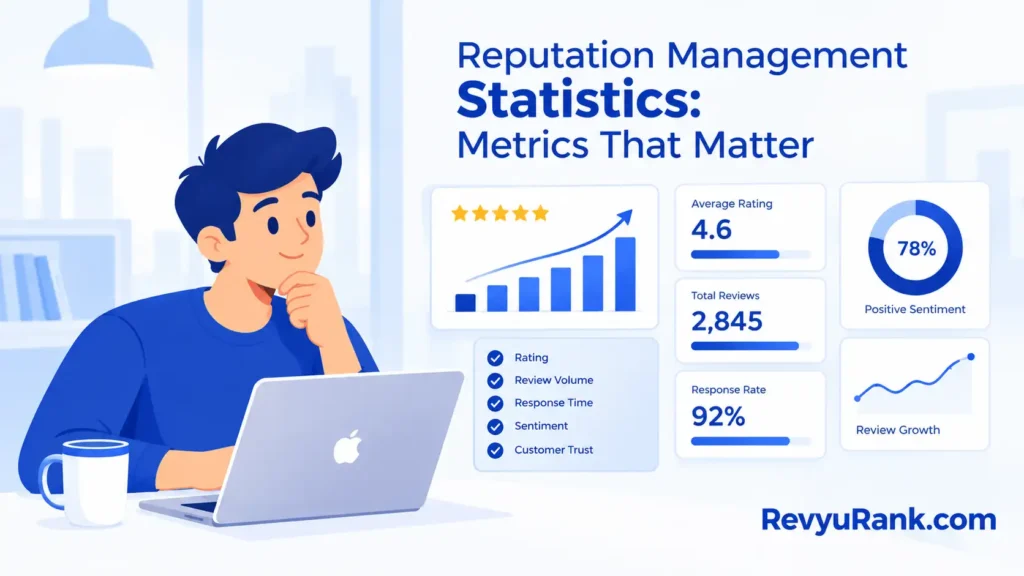
Review ratings, review volume, response time, search visibility, sentiment, and complaint resolution are the main measures covered here. Reputation management statistics are useful when they connect public feedback with business results.
Reputation management: key statistics

These measures answer different questions, so you’ll get a clearer view when you read them together.
| Measure | Best for | Recognizable example |
|---|---|---|
| Review ratings | Overall customer opinion | 4.6-star Google rating |
| Review volume | Trust and activity | 250 recent reviews |
| Response time | Service follow-through | Reply within two days |
| Search visibility | Finding reputation risks | Branded search results |
| Sentiment | Repeated customer themes | “Slow shipping” comments |
| Complaint resolution | Recovery after problems | Refund and public reply |
Review ratings
A review rating summarizes how customers score a business, product, or service. It suits anyone who needs a quick public signal, but it shouldn’t replace reading recent reviews and checking the rating platform’s review rules.
- Shows the broad direction of customer opinion
- Helps compare similar local businesses
- Reveals whether service changes improved scores
- Gives review readers a fast first filter
Harvard Business School researcher Michael Luca reported that a one-star increase on Yelp was linked with a 5–9% increase in revenue for independent restaurants.
Review volume
Review volume counts how many customer reviews a business has, often with attention to recent activity. It suits shoppers who want evidence that a rating reflects more than a small group of customers.
- Shows whether feedback is ongoing
- Makes a high rating easier to assess
- Helps spot sudden review changes
- Supports location or competitor comparisons
The trade-off is simple: a large review count can build confidence, but it may hide recent service problems.
Response time
Response time measures how quickly a business answers a review, complaint, message, or public question.
- Shows whether complaints receive attention
- Helps managers compare teams or locations
- Exposes delays in customer support
- Makes improvement easier to measure
This measure needs a clear starting point, such as the time a review appears or the time a ticket enters the system.
Example: record a complaint posted Monday at 9 a.m. and a first reply Tuesday at 11 a.m. as a 26-hour response.
Search visibility
It helps organizations identify reputation risks before customers or partners raise them.
- Finds negative pages near the top results
- Shows whether official pages are easy to find
- Tracks branded search changes over time
- Helps separate visibility from sentiment
Search position can change with location, device, language, personalization, and search history. Don’t treat one person’s results as a universal ranking. Google Search Console can show performance for a website you control, while public searches reveal what other users may see.
Sentiment analysis
Sentiment analysis groups feedback as positive, negative, or neutral and can also identify repeated topics.
- Finds recurring service complaints
- Groups praise by product feature
- Shows changes after a policy update
- Helps prioritize reviews for human reading
It needs equipment or software, and the output still needs human checking. Sarcasm, mixed opinions, short comments, and different languages can confuse automated labels.
Example: review 200 comments and tag “late delivery,” “helpful staff,” and “damaged package” separately.
Other reputation measures
The measures below add context when ratings alone don’t explain what customers are experiencing.
- Complaint resolution rate — Tracks solved issues; use it when service teams need recovery results, not just reply speed.
- Share of positive mentions — Compares favorable comments with total mentions; use it for campaigns or product launches.
- Review recency — Shows how fresh feedback is; use it when an old rating may hide current service changes.
- Brand mention volume — Counts public references; use it when a launch, incident, or news event changes attention.
How to choose reputation measures
Start with the decision you need to make. If you’re checking broad trust, use review ratings and review volume; if service recovery is the issue, use response time and complaint resolution rate.
If customers can’t find accurate information, choose search visibility. If you have many written comments and need themes, choose sentiment analysis; if a campaign or incident caused attention, add brand mention volume.
Frequently asked questions
How many reviews does a business need?
No reliable review count guarantees trust. Compare the total with competitors, review dates, and rating changes; a smaller business may need fewer reviews than a national brand to show recent activity.
Can reputation statistics predict sales?
They can support a sales analysis, but they can’t predict sales alone. Michael Luca’s Yelp study linked a one-star increase with a 5–9% revenue increase for independent restaurants in its study setting.
Why does a high rating still bring complaints?
A high rating can still include complaints because averages combine different customers, dates, products, and locations. Read the newest negative reviews and check whether the same problem appears repeatedly.
How long should a company take to reply?
Set a target based on your support process, then measure the actual time in hours. A public review and an urgent safety complaint shouldn’t follow the same response path or priority.
Is it safe to remove negative reviews?
Remove a review only when the platform’s published rules allow it, such as for spam or threats. Don’t remove genuine criticism simply because it lowers the average rating.
What happens if a company buys reviews?
Purchased or fake reviews can violate platform rules and consumer-protection laws. The Federal Trade Commission’s Consumer Reviews and Testimonials Rule addresses deceptive review practices in the United States.
Does review recency matter?
Yes, recency matters when service, staff, ownership, or products have changed. Compare recent reviews with older ones instead of using the overall rating as the only signal.
Using reputation statistics first
Start by recording your current rating, review count, response time, and recent complaint themes from the platforms you manage. Expect a useful result when repeated problems become easier to see; stop and get specialist help if reviews involve threats, privacy, fraud, or legal claims.

Robert Miller works as a Reputation Management Consultant. He has been helping U.S. businesses for over ten years. His work involves helping people protect and enhance their online image.Robert has worked with a wide range of companies. He has helped new businesses, local places that give a service, and big companies. He helps turn customer reviews into something that helps people trust their company and drives business growth.