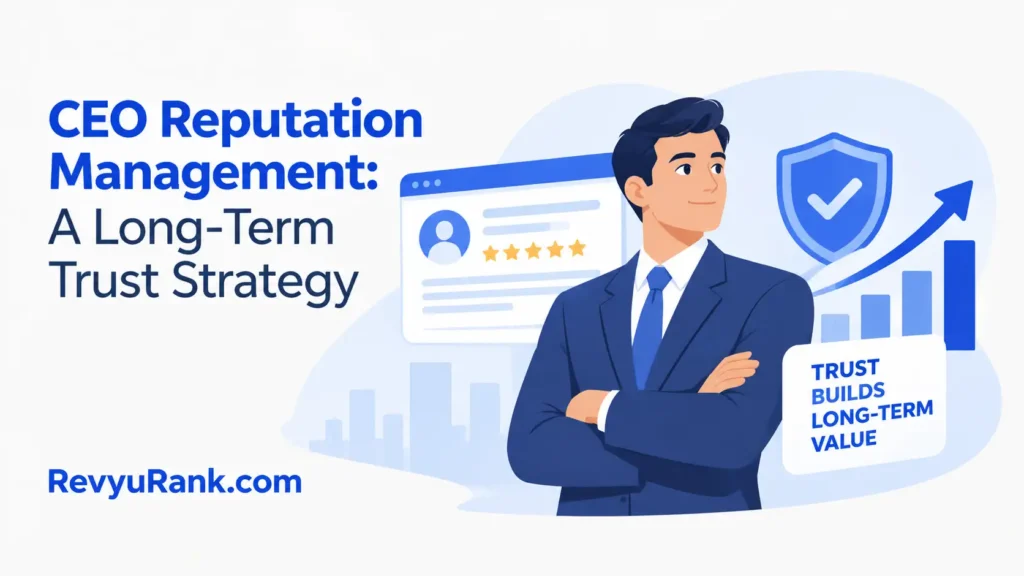
Ceo reputation management should be treated as a long-term trust program, not a quick search-result cleanup. Start with a public audit, correct false claims with evidence, and publish useful proof through channels the CEO controls.
The result changes with the CEO’s industry, public role, search visibility, and the seriousness of the issue. A quiet executive needs a different plan from a founder facing a legal claim or a viral complaint.
Who needs CEO reputation management
A company founder may search for this topic after a negative article, customer complaint, or social post starts ranking for their name. They need a practical response plan that protects trust without making the story larger.
A newly appointed CEO may have little public history but still needs accurate profiles, clear company information, and a consistent public voice. An executive in finance, health care, or public service also needs tighter review because claims can affect investors, customers, or regulators.
This page serves best when the issue is public but still manageable. It assumes you can access the company website, verified social accounts, public records, and a person who can approve statements. A serious allegation, active investigation, or threat of legal action needs a reputation lawyer and communications professional instead.
What changes the reputation result
The allegation’s strength matters most. A false claim with clear records can often be challenged. A true mistake needs correction, restitution, and time. Read the exact wording, record the date, and separate facts from opinion before choosing a response.
The response speed has a trade-off. A fast correction can stop confusion, but a rushed statement can create a second story.
The available proof sets the ceiling. A dated filing, published result, customer record, or direct quote is stronger than a general denial. If you can’t show the evidence publicly, explain what can be verified and avoid claiming more than the record supports.
How to manage a CEO reputation
Use this process for a public issue that doesn’t involve immediate danger, active litigation, or confidential information.
- Search the CEO’s full name in a private browser, plus the company name and industry. Save the first three result pages as dated screenshots or PDFs.
- Sort each result into accurate, outdated, misleading, false, or opinion. Keep the original URL, publisher, date, and exact claim in a spreadsheet.
- Collect proof for every disputed fact. Use filings, company records, published policies, contracts, or direct source documents rather than memory.
- Choose one response owner inside the company. Confirm that person can approve wording, corrections, and publication before any public reply.
- Correct material errors privately first by contacting the publisher or platform. State the exact error, provide the evidence, and request a correction without threatening language.
- Publish a factual profile on the company’s official site. Include the CEO’s role, relevant experience, current responsibilities, and links to verifiable company information.
- Answer public questions briefly through the channel where they appeared. Correct the record once, then avoid repeated arguments or personal attacks.
- Track changes weekly for the first month. Record rankings, new mentions, corrections, and unanswered claims so the plan follows evidence instead of emotion.
The key judgment is whether a response adds useful facts or simply repeats the accusation. If the issue involves defamation, market-sensitive information, personal safety, or an active investigation, stop public drafting and use counsel.
Reputation situations compared
The right action depends on what readers see and how much proof you have.
| Situation | What to do | What it takes | What to watch for |
|---|---|---|---|
| Sparse search results | Build accurate profiles | Consistent publishing effort | Thin, copied content |
| Outdated biography | Request a correction | Evidence and follow-up | Publisher response time |
| False factual claim | Send documented correction | Careful wording | Defamation risk |
| Valid customer complaint | Acknowledge and fix | Service recovery work | Defensive replies |
| Viral social criticism | Respond once, briefly | Approval and monitoring | Adding more attention |
| Active legal matter | Pause public details | Lawyer review | Confidential information |
| Investor-sensitive event | Follow disclosure policy | Counsel and finance review | Unequal disclosure |
Details that improve the result

Prepare the evidence
Strong work starts with a claim log, not a press release. Copy the exact sentence people are seeing, then place the supporting record beside it. If the source is an opinion, label it as opinion; don’t present a disagreement as a factual error.
Use the same spelling, job title, company name, and dates across the official website and verified profiles.
Control the response
Publish owned information before chasing every mention.
Check every statement against the evidence before publishing. If a correction is accepted, update the claim log and save the publisher’s confirmation.
CEO reputation problems and fixes
The visible problem often points to a different first action. Use the narrowest fix that matches the evidence.
| What you notice | What it usually means | What to do first | How to stop it happening again |
|---|---|---|---|
| Old job title ranks first | Profile lacks updates | Correct official profiles | Review bios quarterly |
| False article ranks highly | Publisher has disputed facts | Send documented correction | Keep evidence ready |
| Angry review spreads | Unresolved service issue | Contact customer privately | Log complaint ownership |
| CEO replies repeatedly | Response is escalating attention | Pause public replies | Use one approval owner |
| Conflicting biographies appear | Teams use different records | Create one approved bio | Centralize profile updates |
| Negative result won’t change | Source still has authority | Publish stronger proof | Maintain useful updates |
Rules for public CEO statements
Rules depend on the company’s country, industry, listing status, and communication channel.
The U.S. Securities and Exchange Commission’s Regulation FD rules can affect how public companies share material nonpublic information. Review the SEC’s published guidance and ask securities counsel before a CEO discusses earnings, transactions, forecasts, or other potentially material facts.
The Federal Trade Commission requires clear disclosure for certain endorsements and sponsored relationships. Its Endorsement Guides for businesses explain disclosure duties; check the current FTC guidance before using testimonials, paid posts, or influencer content.
If a statement could affect investors, customers’ safety, an investigation, or a legal claim, don’t improvise. A lawyer, compliance officer, or investor-relations lead should approve the wording before publication.
The real cost of reputation work
The main cost is staff time, not just agency fees. Someone must collect records, approve language, monitor mentions, contact publishers, and keep profiles accurate.
Compare proposals by deliverables rather than promises. Ask how many searches they monitor, who writes responses, what evidence they require, how they report changes, and what happens when a legal issue appears.
Keeping the reputation plan current
Keep one approved biography, fact sheet, media contact, and evidence log in a controlled company folder.
If monitoring shows a legal threat, private data exposure, or a regulatory question, preserve the records and send the matter to counsel.
CEO Reputation Management Errors
This approach isn’t suitable when someone faces an immediate physical threat, doxxing, stalking, or account takeover. Contact platform safety teams, law enforcement, or a qualified security professional instead.
If the criticism is accurate and customers were harmed, publishing more positive content won’t solve the cause. Fix the service, offer the available remedy, and communicate the correction through the proper company channel.
Frequently Asked Questions
Can a CEO remove negative search results?
Sometimes, but not usually by deleting the search result directly. Ask the publisher to correct false facts, report policy violations to the platform, and publish accurate source information that readers can verify.
Why does a CEO biography rank poorly?
A biography may rank poorly because it has little authority, inconsistent details, or stronger competing pages. Check the exact name, company links, publication date, and accuracy across official profiles.
How long does CEO reputation management take?
A simple profile correction may take days or weeks, depending on the publisher. A wider search problem has no honest fixed schedule; track results weekly and follow each source’s response.
Is it safe for a CEO to reply publicly?
Yes, for a simple factual correction with approved wording. It isn’t safe to improvise about confidential deals, active cases, threats, or investor-sensitive information without legal or compliance review.
What happens if a CEO denies a true complaint?
The denial can damage trust and create a second public record. Verify the complaint, acknowledge the valid part, explain the remedy, and avoid claiming that accurate criticism is false.
Does it matter who publishes the correction?
Yes. A correction from the original publisher is strongest for that article, while an official company page helps readers verify the wider facts. Use both when each serves a different purpose.
Can a CEO use social media to repair trust?
Yes, when the account is verified and the message is factual, brief, and approved. Social media can clarify a record, but it can’t replace customer service, legal advice, or an actual remedy.
Start with the CEO reputation record
First, search the CEO’s name and save the exact claims, sources, and dates before responding. You should see a cleaner, more consistent public record over time. Stop and get help if the issue involves threats, litigation, confidential data, or investor-sensitive information.

Robert Miller works as a Reputation Management Consultant. He has been helping U.S. businesses for over ten years. His work involves helping people protect and enhance their online image.Robert has worked with a wide range of companies. He has helped new businesses, local places that give a service, and big companies. He helps turn customer reviews into something that helps people trust their company and drives business growth.