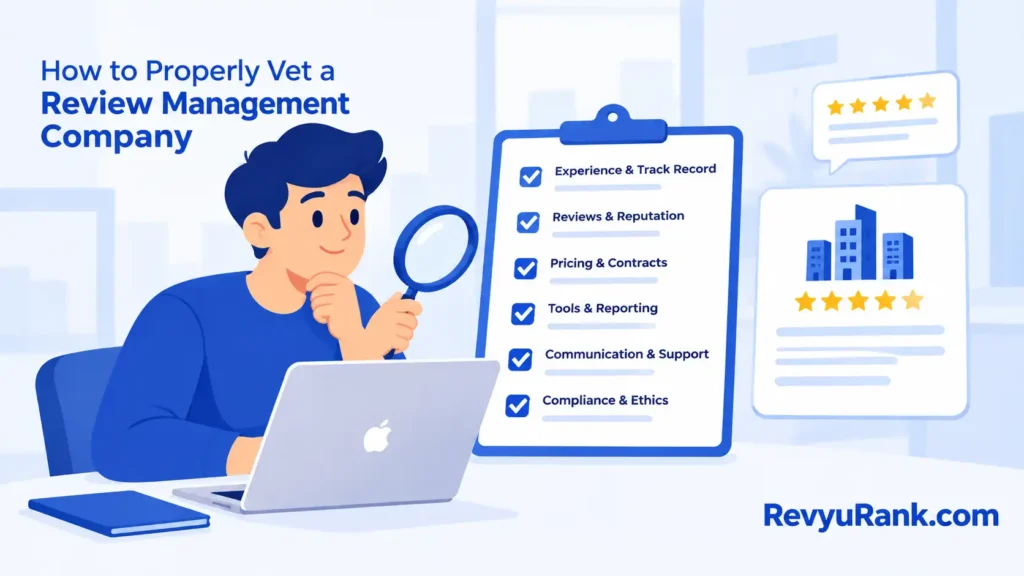
The safest way to vet a review management company is to compare three candidates, check two real client references, and test the service with a 30-day pilot. How to properly vet a review management company comes down to proof, clear rules, and control of your customer data. It suits businesses that need steady review work, not a one-time cleanup.
What You Need to Vet a Company

Bring the same information to every sales call. That makes promises easier to compare.
- Your review profiles on Google, Yelp, Facebook, and industry sites
- Your current review count, average rating, and recent review dates
- A list of locations, brands, and staff who may need access
- Your monthly customer or transaction volume
- Three recent customer-service problems and how you handled them
- Your privacy, marketing, and brand policies
- A draft budget and the name of the person approving the contract
Don’t share personal customer data until the company explains its security and access controls.
Steps to Vet Review Management Companies
-
List your real goal. Decide whether you need review requests, monitoring, replies, reporting, or all four. If you mainly need better replies, don’t pay for a large campaign system.
-
Shortlist three companies. Use referrals, trusted industry groups, and direct searches. Remove any company that promises a specific rating or a guaranteed number of positive reviews.
-
Ask for a live product tour. Require the company to show review alerts, response approval, reporting, user permissions, and data export. A slide deck isn’t enough.
-
Check how requests are sent. Ask whether every eligible customer receives the same request. If the system sends requests only to happy customers, reject it.
Careful: The company should never write fake customer reviews, offer rewards for positive reviews, or hide negative feedback.
-
Contact two references yourself, using phone numbers or emails you found independently.
-
Test the reporting. Ask for a sample report using your business name, locations, review sites, response times, and unresolved issues. Confirm that you can export the data in a usable format.
-
Read the contract line by line. Check setup fees, monthly charges, message fees, renewal terms, cancellation, ownership of content, and access after termination. If the contract includes legal or privacy duties you can’t assess, send it to your attorney or privacy adviser.
-
Run a controlled pilot. Start with one location or one service line for 30 days. Set approval rules, record the starting review counts, and compare the promised work with what was delivered.
The usual mistake is choosing a polished demo over clear ownership and reporting.
Costs Change by Situation
Your workload, locations, and review channels change the time and effort needed.
| Situation | Time or money impact | What changes | Watch while it runs |
|---|---|---|---|
| One location | Lower setup effort | Fewer profiles and users | Response speed |
| Several locations | More setup and monthly work | Separate access and reports | Cross-location errors |
| High customer volume | More message or platform usage | More requests and replies | Consent and opt-outs |
| Sensitive industry | More review and approval time | Stronger privacy controls | Claims in replies |
| One-time cleanup | Short project | Less ongoing monitoring | Lost history or access |
Starting with a small pilot is safer because you can add locations and channels later, instead of paying for unused capacity or creating a large data problem.
Signs the Review Process Works
A good result has accurate review alerts, useful reports, timely replies, and requests sent through a fair process.
The common quality problem is generic responses that sound unrelated to the customer. Prevent it with approved reply rules, human review for complaints, and separate templates for praise, questions, and service failures.
The company should also show what happens when a review is disputed. You want a documented escalation path.
Rules and Ongoing Care
The Federal Trade Commission’s rule bans fake reviews and testimonials, buying reviews with required positive sentiment, and some forms of review suppression; read the FTC fake review rule before signing. Keep login ownership, export reports, approval records, and customer opt-out records.
Review the service monthly at first, then adjust the schedule to review volume and unresolved complaints.
Other Ways to Manage Reviews
Handle It In-House
A staff member can monitor profiles and answer reviews with a shared process. This costs less in cash, but it takes regular time and can fail when that person is absent or customer complaints increase.
Use a Review Platform
Software can collect alerts, send approved requests, and create reports without full-service help. You’ll usually keep more control, but your team must write replies, manage settings, and check compliance.
Hire a Local Agency
A local marketing agency can combine review work with listings, search, and customer communications. It may offer broader help, but ask who performs the work and whether review management is a real service or a small add-on.
Frequently asked questions
Can a review management company remove bad reviews?
Usually, no. A company may report content that breaks a platform’s rules, but it can’t promise removal of honest criticism. Ask for the platform policy, the reason for any report, and a record of what was submitted.
Why do review companies ask for customer data?
They may need contact details to send review requests or connect transactions with feedback.
How long should I test a review management company?
Use a 30-day pilot for one location when the goal is to test access, alerts, replies, and reporting. A longer period may be needed to judge review volume, but don’t expand before the basic workflow works.
Is it safe to give a company access to Google reviews?
It can be safe when access is limited to the required account functions and your business keeps the owner account. Use separate user access, strong passwords, and multi-factor authentication; never hand over the only recovery email.
What happens if a review management company closes?
You may lose dashboards, stored replies, or login access if the contract doesn’t require an export. Before signing, confirm that you can download review data and keep control of the original business profiles.
How much does review management cost?
There’s no reliable single price because location count, message volume, features, and service level change the quote. Compare the full monthly cost, setup charges, per-message fees, and cancellation terms in writing.
Conclusion
A strong provider makes your review process clearer, not more dependent on a sales promise. Choose the company that gives you fair customer outreach, usable records, and control when the relationship ends.

Robert Miller works as a Reputation Management Consultant. He has been helping U.S. businesses for over ten years. His work involves helping people protect and enhance their online image.Robert has worked with a wide range of companies. He has helped new businesses, local places that give a service, and big companies. He helps turn customer reviews into something that helps people trust their company and drives business growth.