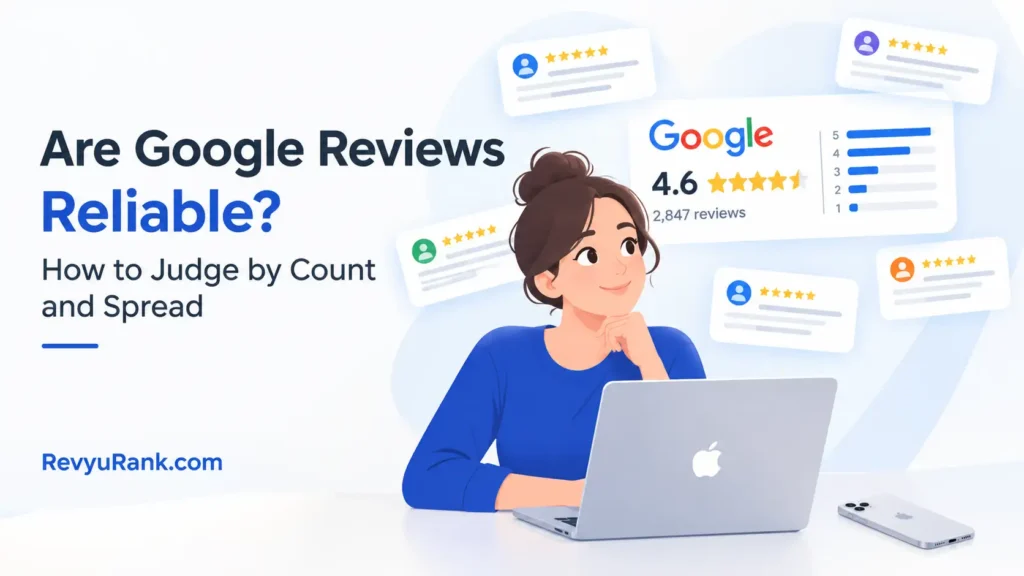
A business with 4.5 stars from 200 reviews is usually trustworthy, but the same score from 8 reviews means almost nothing. Determining whether Google reviews are reliable depends on the ratio between the total count and how spread out the ratings are. A high average built on dozens of separate accounts over several months carries weight.
Three things change what that number actually means for you: the total review count, the age of those posts, and the type of business you’re looking at. A restaurant’s score moves faster than a plumber’s because people eat out more often than they call a contractor.
Who should trust Google reviews?
Someone searching for a local dentist needs a different signal than someone comparing two hotels across the country. Three readers land on this question, and each one brings a different starting point to the search.
The first reader has a specific shop or service provider in mind. They’ve already found the name and just want to know if it’s safe to spend money there. They need a way to read the score without getting fooled by five fake five-star posts written last week.
The second reader is comparing three or four options side by side. They don’t care about one business yet. They need a method to rank them fairly when one has 500 reviews, and another has 12.
The third reader owns a business and wants to know if their competitors’ scores reflect reality. This page doesn’t serve them. They need reputation management advice, not a consumer guide.
This page serves the first two readers. It assumes you’re choosing where to spend your own money or time. It also assumes you’re looking at a business with at least ten posted ratings, since anything below that number is just noise.
What changes a rating’s trustworthiness
Five details decide whether a star rating reflects actual customer experience or just manipulation. The most important one is the total count, and it’s the one people get wrong most often by treating a 5.0 from three people the same as a 4.6 from three hundred.
Total review count matters more than the average score. A business with 150 ratings has survived enough real transactions to smooth out one angry customer or one paid bot. If the count is under 20, treat the average as a rough guess rather than a fact.
The spread of the stars tells you more than the average. A healthy profile shows mostly fours and fives with a few ones and twos. If every single rating is exactly five stars, especially across 50 or more posts, the owner likely bought them or pressured staff to collect them.
Written details inside the text carry more weight than the star itself. A post that names the employee who helped, mentions a specific product, or describes a wait time proves the writer was actually there. One sentence saying “great place” could come from anyone, including the owner’s cousin.
How old the posts are decides if the current team still performs well. A plumbing company might have 80 five-star ratings from 2021, but if nothing new appeared in 2025 or 2026, the original owner may have sold the business. Check the dates before trusting the score.
Finally, the owner’s replies show how they handle problems. A polite, specific response to a bad rating suggests a business that fixes its mistakes. No replies at all, or angry arguments with customers, signals a risk you’ll face if something goes wrong with your order.
How to judge a business profile
You don’t need special software to figure this out, but you do need a checklist so you don’t just glance at the big yellow number and click buy. Follow these steps in order on your phone or computer.
- Look at the total number of ratings next to the star average. If it’s under 30 for a busy type of business like a restaurant, keep looking for better proof.
- Look for the most recent posts by scrolling down the list, since the default view shows the most relevant ones first. Check if any posts arrived in the past 90 days. A dead profile means the information is outdated.
- Read five of the lowest-rated posts first. Look for the same complaint appearing twice, like cold food or hidden fees. Repeated problems are patterns, not accidents.
- Read five of the highest-rated posts. Check if they mention specific names, dates, or items. Skip the ones that only say “awesome” or “five stars” with no other words.
- Check the reviewer profiles by clicking their names. If an account has only reviewed this one business and nothing else anywhere, discount that rating entirely.
- Look at the owner’s responses to the bad posts. Count how many times they offered a real solution versus how many times they blamed the customer or stayed silent.
- Compare the overall score against two competitors in the same town. A 4.3 might look low until you see the others sit at 3.8 and 4.0.
- Search the business name plus the word “scam” or “complaint” in a normal search engine. Sometimes the worst problems end up on forums instead of the map listing.
The judgment call happens after step six. You have to weigh a pattern of specific complaints against a high overall average. If three people describe the same broken part on a product, that detail outweighs fifty empty five-star clicks. When a dispute involves a serious legal issue, fraud, or physical danger, stop researching and contact your local consumer protection agency directly.
Situations that change what to look for
Different types of searches require you to shift your focus when reading the feedback left by past customers.
| Situation | What to check | Effort needed | Warning sign |
|---|---|---|---|
| Restaurants | Recent food photos | 2 minutes | Only text, no pictures |
| Plumbers or electricians | Owner reply tone | 3 minutes | Angry owner responses |
| Hotels | Room-specific complaints | 5 minutes | Vague praise only |
| Retail shops | Return policy mentions | 2 minutes | Refusal to refund noted |
| Doctors or clinics | Wait time details | 4 minutes | No recent visits logged |
| Car mechanics | Parts and pricing notes | 5 minutes | Same wording repeated |
A restaurant’s score can drop in a week if the head chef leaves, so recency is everything there. For a mechanic, the volume is lower, so you must read the full text of older posts to find out if they use quality parts. Adjust your effort based on how much money the transaction involves. Spending a small amount on lunch requires less digging than paying for expensive car repairs.
Details that separate good research from guessing
Reading the text behind the stars
The star graphic is just a summary. The actual truth lives in the sentences people typed after they left the building. A useful post gives you a fact you can test yourself when you arrive.
Look for numbers in the text. A diner who writes “we waited 40 minutes for our table on a Friday night” gives you a schedule you can plan around. Someone who just says “slow service” leaves you guessing if they mean ten minutes or an hour.
Check the photos attached to the posts. Real customers take slightly blurry pictures of their food or the waiting room. Stock-quality images or perfectly lit shots of the storefront often come from the marketing team, not the buyer.
Spotting the fake entries
Paid services sell batches of false ratings, and they leave fingerprints if you know where to look. The Federal Trade Commission finalized rules banning the sale and purchase of fake consumer reviews and testimonials, which covers fabricated map listings too.
Identical phrasing across multiple accounts is the biggest giveaway. If three different names all write “excellent customer service and fast delivery” within the same month, one person wrote all three.
Accounts created on the same day that only interact with one business are bots or hired workers. Click the reviewer’s name. A real person usually has history across different towns and different types of stores.
Why a score drops or looks wrong
Sometimes the number on the screen doesn’t match the service you receive. Here is how to connect what you see to what actually happened.
| What you notice | What it usually means | What to do first | How to stop it happening again |
|---|---|---|---|
| Sudden jump to 5.0 | Bought fake ratings | Read newest text carefully | Ignore spikes without details |
| Many 1-star posts recently | New bad manager | Check dates of complaints | Avoid businesses with fresh anger |
| Only short vague praise | Staff asked friends | Look for detailed stories | Trust long specific paragraphs |
| Owner argues in replies | Defensive business culture | Move to a competitor | Note tone before booking |
| High score but few ratings | Not enough data yet | Find older established rival | Wait until count passes 30 |
| Same wording across posts | One person wrote them | Discount those specific entries | Verify reviewer profile history |
A sudden spike isn’t always fraud. A business might have run a successful event or fixed a known problem. But if the spike lacks detailed stories attached to the new stars, treat it as suspicious until you find proof otherwise.
Rules platforms and governments enforce
Google’s own policies ban business owners from paying for ratings, offering discounts in exchange for stars, or reviewing their own company. They use automated systems to filter out spam, but the filters aren’t perfect.
In the United States, the FTC treats buying or selling fake endorsements as a violation of federal law, carrying potential financial penalties for the companies involved. Other countries have their own advertising standards authorities that handle similar complaints.
If you spot a clear violation, you can flag the post directly through the interface. However, removal takes time, and the platform won’t tell you the outcome of your report.
For disputes involving stolen money or dangerous conditions, a platform’s reporting tool isn’t enough. You need to file a formal complaint with your state attorney general or local trading standards office. Don’t rely on a tech company to act as your lawyer or safety inspector.
Time and risk involved in checking
Checking a profile properly costs you about five to ten minutes per business. That’s the real price of avoiding a bad purchase. If you’re comparing three plumbers, set aside half an hour to read through their histories properly.
Skipping this step costs more. Booking a bad contractor because you only looked at the 4.8 average can waste hundreds of dollars and weeks of waiting. The trade-off is simple: spend five minutes reading now, or spend five days fixing a mistake later.
The value of your time shifts depending on the purchase. For a coffee shop, glancing at the top three recent posts takes thirty seconds, and that’s enough. For a medical clinic, you shouldn’t rush.
Prices for services don’t live here. A high score doesn’t mean cheap work, and a low score doesn’t mean a bargain. You still have to call the business and ask for a quote. The rating only tells you if they’ll likely show up on time and do what they promised.
Keeping track of what you find
Once you pick a business, save a screenshot of their profile on the day you booked. Scores change, and if the service goes wrong later, you’ll want proof of what the rating looked like when you made your decision.
If you use the service, leave your own honest post. Mention the date you visited, the name of the person who helped you, and exactly what happened. This helps the next person who does the same research you just did.
Watch the score over the next few months if it’s a place you visit repeatedly, like a grocery store or a mechanic. A slow drop from 4.5 to 3.9 usually means staff turnover or a change in ownership.
When you see that downward trend, don’t assume it’s temporary. Go back to the newest one-star posts and read them. If the complaints match the reason you chose them in the first place, start looking for a backup option before you need them urgently.
When a map rating isn’t enough
Some decisions require proof that strangers on the internet simply can’t provide. Relying only on a star average in these cases leads to expensive or dangerous outcomes.
If you’re hiring someone for major structural home repairs, a map listing isn’t sufficient. You need to verify their state contractor’s license number and check their insurance bond directly with your local licensing board. A five-star rating doesn’t replace a valid license.
For medical treatments or prescription advice, skip consumer maps entirely. Consult your primary care doctor or check verified hospital directories. Patient satisfaction scores measure bedside manner, not clinical safety or surgical skill.
When buying a used car from a private seller, online feedback won’t protect you. Pay an independent mechanic to inspect the vehicle before handing over cash. No amount of positive digital history guarantees an engine won’t fail tomorrow.
If a situation involves signing a legally binding contract worth thousands of dollars, hire a professional to review the paperwork. Consumer feedback sites are for everyday choices, not for replacing lawyers, inspectors, or doctors.
Frequently asked questions
Can a business delete its bad reviews?
No, a business owner can’t remove a negative post themselves. They can only flag it to the platform if it breaks content policies, like containing hate speech or spam. The platform’s support team makes the final choice, and legitimate complaints stay visible.
Why does my favorite place have a low score?
A low average often comes from a few highly detailed angry posts dragging down many quiet satisfied customers. People who have a bad experience are statistically more motivated to type out a complaint than those who had a normal, fine afternoon.
How long does it take for a new review to appear?
Most posts show up immediately, but some enter a filtering period lasting 24 to 72 hours. The platform holds them briefly to check for automated spam or policy violations. If yours hasn’t appeared after three days, it likely triggered a filter.
Is it safe to trust a 5.0 rating?
Only if the total count is very low, like under five posts, or if the business is brand new. Once a company serves hundreds of people, maintaining a perfect 5.0 is nearly impossible. A 4.7 with 300 posts is much safer to trust than a 5.0 with 12.
What happens if a business buys fake reviews?
The platform may suspend their listing, removing them from search results entirely. In the US, the FTC can also pursue financial penalties against companies caught purchasing false endorsements. It risks both their digital presence and their legal standing.
Does the owner replying help the score?
Replies don’t change the mathematical average, but they change how future customers perceive the business. A polite, helpful response to an angry post often convinces a browsing shopper that the company will fix problems if they occur.
Can I edit my review after posting it?
Yes, you can update the star rating and the written text at any time through your account settings. People often do this if the business reaches out and successfully resolves the issue that caused the original complaint.
Do older reviews count less toward the average?
Mathematically, older posts carry less weight than recent ones because the platform’s algorithm factors in how new the feedback is. However, human readers naturally discount old information, which is why sorting by “newest” is the standard practice.
Your first move before you buy
Open the business profile right now and sort the feedback by “newest.” Read the last five detailed posts to see if the current team matches the overall score. You’ll know it’s safe to proceed when recent visitors describe the exact service you need. Stop and find another option if the newest posts repeat the same unresolved complaint.

Robert Miller works as a Reputation Management Consultant. He has been helping U.S. businesses for over ten years. His work involves helping people protect and enhance their online image.Robert has worked with a wide range of companies. He has helped new businesses, local places that give a service, and big companies. He helps turn customer reviews into something that helps people trust their company and drives business growth.