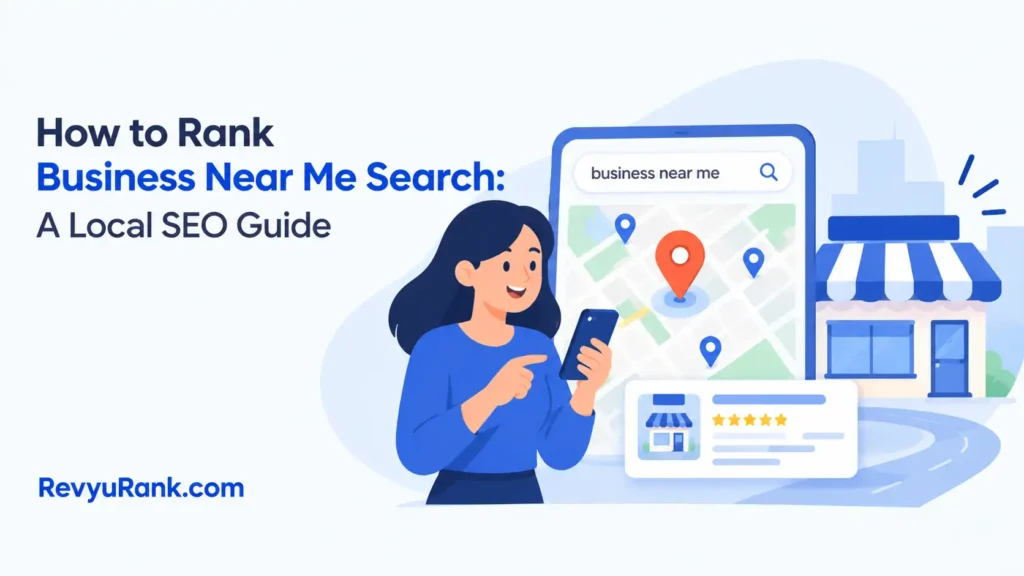
The best way to rank a business in nearby searches is to keep your Google Business Profile accurate, match your website to local intent, and earn trusted local mentions. Results also depend on the searcher’s distance, competition, and business category. This guide covers setup, timing, mistakes, rules, and ways to track progress.
What Local Search Ranking Means
Local search ranking decides which nearby businesses appear in Google Maps and local results. Google uses information such as your business category, location, website content, reviews, and mentions on other websites. The system tries to match the searcher with a relevant and trusted local business.
This is mainly for businesses that meet customers in person, visit them, or serve a defined local area. A plumbing company, dental office, restaurant, and moving company can all benefit from local optimization.
The common misconception is that adding “near me” to every page will improve rankings. It won’t. Google understands local intent from the searcher’s location and the business information around your brand.
Your business name, address, phone number, hours, and services should match across important sources. Small differences can create confusion, especially when old addresses or duplicate profiles remain online.
Improve Business Near Me Search Rankings
Use this process for one real business location. Work through each step in order, and record changes so you can see what affects calls, directions, and website visits.
- Claim one Google Business Profile for each real location. Select the most accurate primary category, then add your phone number, website, hours, service area, and business description.
- Complete the services section with the services you actually provide. Use clear customer language, such as “emergency drain cleaning,” but don’t add unrelated keywords.
- Create or improve one local page for each location you serve. Include the real address, service area, contact details, opening hours, parking or access information, and useful answers for customers.
- Add clear business photos that show the storefront, team, vehicles, interior, or finished work. Use original images and accurate descriptions instead of stock photos.
- Ask every genuine customer for an honest review after the service. Send one direct review request, and reply to positive and negative reviews without copying the same wording.
- Check local mentions and directories for the same name, address, phone number, and website. Correct old listings before creating more new ones.
- Track results for at least one full business cycle, such as several weeks of normal customer demand. Compare calls, direction requests, website actions, and customer quality before changing the strategy.
The main judgment call is location coverage. If customers visit one address, focus on that location; if you travel to customers, define the service area accurately and avoid creating fake office pages.
Ranking work can involve profile verification, website changes, or technical fixes. If you can’t verify ownership or a profile is suspended, use Google Business Profile support rather than creating another listing.
Local Search Timing and Settings
These ranges are planning estimates, not promises from Google. Your starting condition, competition, location, and the quality of your website can change the result.
| Situation | What to use | How long | What to watch for |
|---|---|---|---|
| New local profile | Complete profile with real details | 1-2 hours | Verification requests or missing fields |
| One-location service business | One profile and one strong location page | 1-3 weeks to build | Address and service area must agree |
| Multiple locations | Separate real profiles and location pages | Several weeks to organize | Don’t combine locations into one listing |
| Review improvement | Genuine requests after completed jobs | Ongoing | Never offer rewards for positive reviews |
| Directory cleanup | Consistent name, address, phone, and URL | 2-6 weeks | Old listings may update at different speeds |
| Local content update | One useful page or service section | 1-2 days to publish | Avoid copying the same text by city |
| Performance check | Profile, Search Console, calls, and directions | Monthly review | Track quality, not only ranking position |
What Makes Local Rankings Strong
Accurate business facts are the foundation of effective local search work. Match the business name, address, phone number, hours, and website across your profile and important directories.
The order also matters. Fix ownership and category details first, then improve services and location pages, then request reviews and clean up outside listings.
Leave irrelevant keywords, fake locations, and copied city pages alone. They may make a page look optimized, but they can reduce trust and waste time. The trade-off is reach: a wide service area can attract more searches, but a tightly defined area usually gives clearer location signals.
Distance from the searcher varies most; judge value from calls, directions, website actions, and qualified leads rather than one search.
Fix Business Near Me Problems
A local listing problem often has a simple first check. Use the table before changing your website or opening another profile.
| What you notice | What it usually means | What to do first |
|---|---|---|
| The wrong hours appear | An old profile field or directory is still active | Update the official profile and major listings |
| Two profiles show the same office | A duplicate listing exists | Request a merge or removal instead of editing both |
| The business name looks stuffed with keywords | Extra wording was added to influence ranking | Use the real-world name customers recognize |
| Reviews appear on the wrong listing | Customers or staff used a duplicate profile | Report the duplicate and guide future requests to the correct profile |
| The map pin is in the wrong place | The address or map marker is inaccurate | Correct the address and marker, then complete verification if requested |
Creating a second profile is a costly mistake when the first one is merely incomplete.
Google Business Profile Rules
Google’s Business Profile guidelines say a profile should represent a real business and use the name customers know in the real world. Don’t create listings for places that don’t exist, virtual offices that don’t meet customers, or areas where you have no legitimate service.
The U.S. Federal Trade Commission also requires advertising and endorsements to be truthful. Don’t buy reviews, hide material connections, or claim results you can’t support. If verification, ownership, or suspension problems continue, contact Google Business Profile support or a qualified local SEO professional.
Maintain Local Search Visibility
Review your profile whenever your hours, phone number, address, services, or staff-facing contact process changes. Test the website link and phone number after each important update, because a correct listing with a broken contact path still loses customers.
Keep a simple record of profile edits, review requests, calls, direction requests, and qualified leads.
When Local SEO Isn’t Right

A business with no local customers, no service area, and no in-person contact usually shouldn’t build a local search strategy. Focus on national organic search, referrals, or industry directories instead.
A company serving several cities shouldn’t create thin pages that only swap the city name. Build a useful page only where you have real service coverage, local proof, and a clear way to help customers there.
If your listing has a serious suspension or ownership dispute, don’t keep making replacement profiles. Use Google’s support process or ask a qualified professional to handle the account safely.
Frequently asked questions
Can I rank without a Google Business Profile?
Yes, but it’s usually harder to appear in Google Maps and the local pack without a verified profile. A website can still rank in ordinary organic results, especially when it clearly explains the service, location, and customer problems it solves.
Why does my business rank in one neighborhood but not another?
Your position can change because Google evaluates the searcher’s location, local competitors, and the relevance of your business to that query. Check the same keywords from several nearby points, then compare leads rather than relying on one map view.
How long does local SEO take to work?
A meaningful local SEO change often needs several weeks or longer to judge, especially for a new profile or a competitive city. Watch for improved impressions, calls, direction requests, and qualified inquiries instead of expecting an instant position change.
Is it safe to add keywords to my business name?
No, not when those words aren’t part of the real business name. Extra keywords can make the listing look misleading and may create a policy problem. Use keywords in relevant services, pages, and helpful descriptions instead.
What happens if I create several profiles for one location?
You may split reviews and customer actions between duplicate listings. Customers can also see conflicting hours or phone numbers. Keep the profile that represents the real location, then request help with duplicate listings rather than managing both.
How often should I ask customers for reviews?
Ask after each completed job or purchase, using the same honest request for all customers. Don’t pressure people to leave a positive review, offer rewards for a certain rating, or write reviews on their behalf.
Conclusion
Accurate information, useful local pages, and genuine customer feedback give your business the strongest foundation. Track real customer actions, fix errors quickly, and let the searcher’s location set realistic expectations.

Robert Miller works as a Reputation Management Consultant. He has been helping U.S. businesses for over ten years. His work involves helping people protect and enhance their online image.Robert has worked with a wide range of companies. He has helped new businesses, local places that give a service, and big companies. He helps turn customer reviews into something that helps people trust their company and drives business growth.