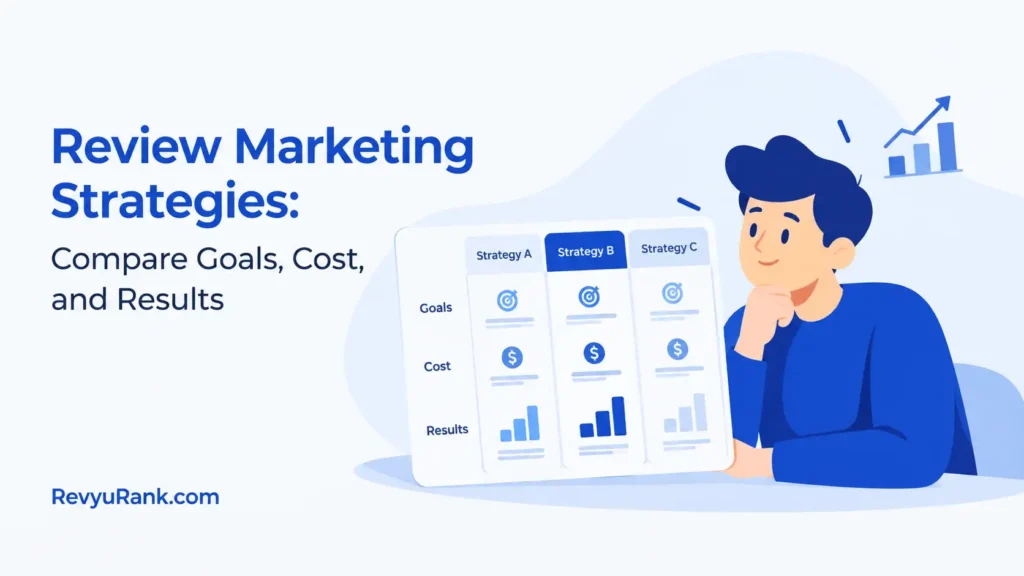
Review marketing strategies by comparing their goals, audience, cost, reach, conversion rate, and customer value. Start with the business result, then check whether each channel brings the right people at an acceptable cost. A strong strategy should produce useful action, not just attention.
The answer changes with your goal, sales cycle, budget, and available data. A local service business may value calls, while an online store may value completed purchases. Your tracking quality also matters: poor attribution can make a good channel look weak or make an expensive channel look successful.
How to review marketing strategies

A business owner usually searches this topic when several marketing activities are running, but the results are unclear. They may have social posts, email campaigns, paid ads, content, or partnerships, yet lack a fair way to compare them. This reader needs a simple review process tied to business outcomes.
A marketing manager may already have reports and campaign data. Their need is different: they want to find waste, compare channels, and decide where the next budget should go. They also need to separate a weak strategy from a weak landing page, poor targeting, or incomplete tracking.
A student, new founder, or small team may know common marketing terms but lack enough historical data. That reader needs sensible starting measures and a way to avoid false conclusions from small samples. A single sale or post rarely proves that a strategy works.
This page serves the owner or manager who has at least one active marketing channel and can access basic data such as spend, leads, sales, website visits, or customer records. It assumes the business has a clear offer and can identify the main conversion it wants. If you have no defined audience, offer, or tracking method, start with positioning and measurement before comparing strategies.
The page isn’t best for a specialist trying to build a full econometric model across national media. That work needs larger datasets, controlled experiments, and specialist analysis. It also isn’t a substitute for legal advice about advertising claims, privacy, endorsements, or regulated products.
What changes the marketing result
The business goal matters most. A strategy built for awareness shouldn’t be judged only by immediate sales. A strategy built for direct sales should show movement toward qualified leads, purchases, or booked calls. Write one primary goal beside each campaign before reviewing it.
The audience changes the channel choice. A professional service may need trust and repeated contact before a sale. A low-cost product may convert after a short visit. Check where your customers actually spend time, what questions they ask, and how long they take to buy. If the audience rarely uses a channel, strong creative can’t fully repair the mismatch.
The offer changes conversion. Two campaigns can reach the same people but produce different results because one offer is clearer, cheaper to understand, or easier to accept. Compare the promise, price, proof, call to action, and landing page before blaming the channel.
The buying cycle changes the timing. A customer who buys once every few years won’t behave like someone who orders every month. Review early actions such as email sign-ups, consultations, or qualified inquiries when the final sale takes time. Then connect those actions to later revenue when the data becomes available.
Measurement quality can change the verdict. Check whether links have campaign labels, forms record the source, phone calls are logged, and sales are matched to the original or assisting touchpoint. Missing data often shifts credit toward the last measurable click. This is the factor people get wrong most often because a clean dashboard can still describe an incomplete customer journey.
Use this simple test: if the goal is immediate revenue, prioritize verified sales and profit; if the goal is future demand, use qualified actions and later conversion evidence. Don’t compare a reach campaign with a sales campaign using one shared score.
How to review a marketing strategy
A useful review moves from business goal to evidence, then from evidence to a decision. Use the same date range and customer definition for every channel you compare. These steps fit a small or medium campaign with access to basic analytics, ad reports, and sales records.
-
Write the business goal in one sentence. Use a result such as “generate 30 qualified consultations in June” or “sell 100 units at a positive contribution margin.” The goal is ready when it has an outcome, audience, and time period.
-
Name the audience and offer. Record who the campaign targets, what problem the offer addresses, and what action the person should take. If the message could fit any audience, stop and rewrite it before reviewing performance.
-
List every active channel. Include paid search, social advertising, organic content, email, direct sales, partnerships, events, and referral activity. Mark the channel as paid, owned, or earned so you don’t mistake free distribution for zero cost.
-
Set the review window. Use the same start and end dates for comparable campaigns, but account for the buying cycle. A short sales cycle may need days or weeks of data; a long sales cycle needs later customer records before revenue can be judged.
-
Check the tracking path. Open the ad or post, click the link, submit the form if appropriate, and check whether the source appears in the analytics or customer record. Confirm that phone calls, offline sales, and coupon codes have a matching recording method.
-
Record reach and response. Capture impressions or reach, clicks, visits, inquiries, sign-ups, purchases, and revenue where available. Keep the definitions consistent; a “lead” should mean the same thing across all channels.
-
Calculate the useful rates. Divide the desired action by the relevant earlier action, such as purchases by qualified leads or qualified leads by visits. For paid campaigns, compare spend with qualified leads, customers, revenue, and contribution margin rather than clicks alone.
-
Check quality, not only volume. Review lead fit, refund rate, repeat purchase, sales acceptance, and customer feedback. A channel that sends 50 weak leads may cost more than one that sends 10 suitable leads.
-
Compare against a fair baseline. Use the previous period, a similar campaign, a control group, or a clear business target. Don’t compare a holiday promotion with a normal month without labeling the difference.
-
Choose one action. Keep, improve, pause, or test the strategy. Write the reason, the evidence, the owner, and the next review date so the decision can be checked later.
The judgment call is whether the data is mature enough for a decision. A campaign can look finished while late conversions, repeat orders, or sales-team feedback are still missing. If the review needs technical tracking changes, regulated claims, or access to private customer data, stop and involve an analytics specialist, the platform administrator, or qualified legal counsel.
Marketing strategy cases compared
The right review method depends on the customer action and the evidence you can collect. Use the row that best matches the strategy’s real purpose, not the platform where it appears. Define the outcome before reviewing results, and keep the comparison period and attribution rules consistent.
| Situation | What to do in it | What it takes | What to watch for |
|---|---|---|---|
| New paid campaign | Check early response signals before scaling | Test budget and time | Small samples mislead |
| Mature sales campaign | Compare profit per customer | Reliable revenue records | Returns reduce value |
| Brand awareness work | Track demand and recall | Longer review window | Sales may arrive later |
| Email retention program | Measure repeat purchases | Customer-level tracking | Opens overstate value |
| Local service marketing | Count qualified calls | Call and booking records | Spam leads distort totals |
| Content marketing | Track assisted conversions | Search and CRM data | Last-click bias |
| Partner referrals | Compare accepted customers | Partner source codes | Source naming errors |
For a new campaign, separate delivery from business results. Clicks, calls, or form fills show that the message generated a response, but they don’t prove that the responses were qualified. Check whether leads meet the sales team’s criteria before increasing spend.
For mature campaigns, use net revenue after refunds, discounts, fulfilment costs, and partner payments when those costs are available. A channel with a cheaper acquisition cost can still produce less profit if its customers return more orders or buy only once. Compare customers acquired in the same period and give each channel the same time to mature.
For awareness, retention, and content work, avoid forcing every result into a last-click report. Compare branded search, direct demand, repeat buying, or assisted conversions with a prior period or a suitable control group. If those measures move but immediate sales do not, extend the review window rather than declaring the strategy ineffective.
Record exceptions separately. Offline sales, shared devices, missing source codes, and unattributed calls can make a channel look weaker than it is. Fix the tracking problem before reallocating budget; otherwise, the review rewards the easiest activity to measure rather than the activity creating the customer.
Details behind a strong review

Prepare the comparison
A fair comparison starts with matching definitions. “Conversion” might mean a form completion in one report and a paid customer in another, so write the exact event beside every metric. Keep the audience, offer, market, and date range visible while you work.
Separate channel performance from execution quality. A good audience with a confusing landing page may produce a poor result, while a clear page may hide weak targeting for a short time. Review the message, offer, page, follow-up, and sales process as connected parts.
Record costs beyond media spend. Include creative work, agency fees, software, discounts, sales time, and fulfillment effort when those costs are material to the decision. The trade-off is simple: a deeper cost view gives a truer profit picture, but it takes more record keeping.
Check the live evidence
Look at the actual customer path, not just the report. Visit the page on a phone, test the call to action, read the follow-up email, and check whether the promise in the ad matches the page. A broken form can make a strong campaign appear unsuccessful.
Check quality while the campaign is active. Ask sales whether leads fit the target, inspect a sample of inquiries, and compare new-customer value with repeat-customer value. If one channel brings many cheap leads but few accepted opportunities, its low cost per lead isn’t a win.
Leave strong variables alone during a clean test. Changing the audience, offer, landing page, budget, and creative at the same time makes the result hard to explain. Change one major variable when possible, then record what changed and when.
Marketing strategy problems and fixes
A review is useful only when the visible result leads to a sensible next action. The table below focuses on common signals that can be checked without changing account settings or making technical edits.
| What you notice | What it usually means | What to do first | How to stop it happening again |
|---|---|---|---|
| High clicks, few inquiries | Message and page mismatch | Read both side by side | Precheck landing pages |
| Many leads, few sales | Poor lead qualification | Review lead samples | Add qualification fields |
| Sales missing from reports | Offline data disconnected | Match customer records | Use consistent source fields |
| High open rate, no action | Subject line outperforms offer | Check clicks and sales | Judge emails by outcomes |
| One channel gets all credit | Last-click reporting bias | Review earlier touchpoints | Compare assisted conversions |
| Results fall after edits | Audience or offer changed | Compare change dates | Keep a change log |
| Low traffic, high conversion | Limited reach | Check search and distribution | Test larger qualified reach |
Rules for marketing reviews
Marketing claims, disclosures, privacy duties, and platform rules can limit what you may publish or measure. The exact rule depends on the country, industry, audience, and channel. A strategy review should include a compliance check before you scale a winning result. Check the ad, landing page, tracking setup, and audience definition together; a compliant claim can still sit beside unlawful data use or a platform-prohibited targeting choice.
In the United States, the Federal Trade Commission says endorsements and testimonials must be truthful and not misleading. Paid relationships, free products, and other material connections may need clear disclosure, so review influencer and customer-review campaigns against the FTC endorsement guides. Disclosures should be easy to notice and understand, rather than hidden in a profile, long caption, or group of hashtags. Don’t require positive sentiment from reviewers who receive an incentive.
A platform may reject an ad even when the claim is lawful. Check restrictions on personal-attribute targeting, regulated topics, landing-page content, and required disclaimers before launch. Save the policy version and approval record used for the campaign.
Privacy rules also vary by location and data type. Check the privacy regulator or consumer-protection authority for the country where people live, plus the advertising platform’s current policy page. Don’t assume that a tracking pixel, cookie, or uploaded customer list is permitted merely because the platform offers it. If you use health, financial, children’s, employment, or sensitive personal data, get qualified legal advice before changing targeting or measurement.
Don’t treat a dashboard as permission to collect everything it can record. Use only the data needed for the stated purpose, keep access controlled, and document the source of customer consent where consent is required. Stop and ask a privacy professional when the review involves cross-border data, sensitive categories, or a complaint.
The real cost of reviewing strategy
The direct cost may be small if the required data already exists. The larger cost is usually staff time: collecting reports, matching records, checking lead quality, and waiting for delayed purchases. A review becomes more expensive when different teams use different definitions or when offline sales aren’t recorded.
Paid media should be judged against more than the platform bill. Compare media spend, creative production, agency or software costs, discounts, sales labor, refunds, and fulfillment effort with contribution margin. If you can’t calculate the full amount, label the result as partial rather than calling it profit.
A fast review saves time but can favor channels with immediate clicks. A slower review captures repeat purchases and delayed sales but postpones the decision. Choose speed when the spend is small and reversible; choose a longer evidence window when the customer relationship is high value or the purchase takes time.
Prices for analytics tools, agencies, and media change by vendor, market, account size, and contract. Read the current pricing page, proposal, invoice, or platform billing screen instead of using a generic estimate. The cost of a wrong decision can exceed the cost of a careful review, especially when a channel has a large budget or long contract.
Keep marketing reviews accurate
Save the goal, audience, offer, dates, channel definitions, source fields, and final decision with each review. A basic spreadsheet or shared document is enough if the team can find the same version and understand each column. Keep the original platform exports when reports may change later. Record who made the review and the date range. Store a read-only copy before filtering or combining data.
Recheck the customer path when a result changes sharply. Look for broken forms, expired links, payment problems, tracking changes, new offers, audience edits, and sales-team process changes. The sign that a review needs attention is a sudden gap between platform results and actual leads or revenue. Test the path as a prospective customer would, then compare CRM lead status and revenue with platform submissions.
Put the result right without starting over when the problem is a missing label or incomplete record. Add the correct source to future records, mark uncertain historical data as unknown, and avoid rewriting history from guesses. If the issue is a broken tag, consent setting, or CRM connection, use the platform administrator or analytics specialist rather than changing code blindly. If only some records are affected, isolate that range and state the limitation beside the result.
Review documentation when a platform changes its reporting definitions. A metric can keep the same name while its counted event or attribution window changes. Record the platform version, report name, and date so later comparisons remain fair. Keep old and new definitions side by side before comparing periods.
When marketing reviews need another approach

This process isn’t the right choice when the business has no clear offer, audience, or conversion event. Before comparing channels, be able to state what is being sold, to whom, and what action counts as success, such as a completed purchase or qualified inquiry.
Without those basics, channel results produce precise-looking numbers without answering a useful business question. Start with customer research, positioning, and a defined offer. If the offer or audience is still changing, fix that foundation before judging a channel’s performance.
It’s also the wrong approach for a high-risk regulated campaign that makes medical, financial, legal, employment, or safety claims. Don’t test questionable wording by publishing it, even if the campaign is small or the wording appears in only one ad variation. A disclaimer doesn’t automatically make an unsupported or prohibited claim acceptable. Ask qualified legal counsel or the relevant compliance professional to review the claim and required disclosures before launch.
A simple channel review may also fail when sales take a year or more, purchases happen offline across several locations, or media has a broad brand effect. In these situations, the person who saw an ad may not be the person who later buys, and the purchase may never appear in the same reporting system. Last-click comparisons can then reward the channel nearest to the sale rather than the channel that created demand.
Use a specialist marketing analyst for controlled tests, incrementality work, or econometric modeling. Stop DIY analysis when the decision could create legal exposure, affect vulnerable people, or commit a large budget you can’t easily reverse. If the decision is easy to undo and the outcome is directly measurable, a simple review may be sufficient; otherwise, get expert help before acting on the numbers.
Related guides
- Cost to build a review platform like Trustpilot Explained
- How To Get More Google Reviews In Canada: Proven Strategies
- Google Play Reviews: Strategies to Enhance Your App’s Ranking
Frequently asked questions
Can I review marketing strategies without paid tools?
Yes, you can start with a spreadsheet, sales records, website analytics, and platform exports. Track the same goal, audience, dates, costs, leads, sales, and customer value for each channel. Free tools won’t fix missing source data, so manual checks may still be needed for calls, store visits, partner referrals, and offline purchases.
Why does a marketing strategy get clicks but no sales?
Usually, the click isn’t the same as buying intent. The audience may be too broad, the offer may be unclear, or the landing page may not match the ad promise. Check a sample of visits, the call to action, form completion, lead quality, and sales follow-up before deciding that the whole channel has failed.
How long should I review a marketing strategy?
Use the full buying cycle plus enough completed outcomes to compare channels fairly. A quick purchase may need a shorter window, while a consultation or contract may need later customer records. Check the campaign’s conversion lag in your analytics and CRM, then avoid a final judgment while a meaningful share of expected conversions is still pending.
Is it safe to use customer reviews in marketing?
It can be safe when reviews are genuine, accurately presented, and properly disclosed where a relationship could affect the endorsement. Don’t edit a review to create a meaning the customer didn’t give or publish paid praise as independent opinion. Check the rules of the country and industry involved before using testimonials.
What happens if I measure only return on ad spend?
You may overvalue revenue-producing campaigns that have high product costs, discounts, refunds, or sales labor. Return on ad spend can be useful, but it isn’t the same as profit. Add contribution margin, customer quality, and retention when those costs or later purchases materially affect the decision.
Does it matter which attribution model I use?
Yes, because attribution changes which channel receives credit. A last-click model favors the final measurable interaction, while other models distribute credit across earlier contacts. Use one model for a fair comparison, state its limits, and compare it with customer records or controlled tests when the decision is important.
How often should I review marketing strategies?
Review active performance as often as the spend and buying cycle justify, but make formal channel decisions only after the agreed evidence window. Check tracking when a result changes suddenly. A fixed weekly review may suit fast campaigns, while longer sales cycles need milestone reviews tied to qualified opportunities and closed revenue.
Start reviewing marketing strategies
First, write one measurable business goal beside each active channel. Match the goal to the channel’s job. A search campaign may aim for qualified leads. An email program may aim for purchases or repeat orders. Record the period and conversion event. That keeps the comparison consistent.
Confirm that each customer path is tracked from the channel through the next meaningful step and into the sale when possible. Check links, forms, calls, and CRM stages. They should pass the same source information. If demand converts later, review assisted conversions or matched customer records instead of treating every uncredited sale as failure.
Compare evidence on the same basis: qualified leads, purchases, revenue, or contribution margin. Look for gaps between reports and real sales. Break results out by channel, audience, and campaign. Investigate sharp differences before moving budget. A low-cost lead fails if sales can’t qualify it or fulfillment removes its margin.
Stop and get help when the review involves regulated claims, sensitive data, broken tracking, or an irreversible budget decision. If tracking is incomplete, mark the result uncertain. Fix the measurement before declaring a channel ineffective. Keep the original reports and assumptions so another person can reproduce the comparison.

Robert Miller works as a Reputation Management Consultant. He has been helping U.S. businesses for over ten years. His work involves helping people protect and enhance their online image.Robert has worked with a wide range of companies. He has helped new businesses, local places that give a service, and big companies. He helps turn customer reviews into something that helps people trust their company and drives business growth.