Corporate reputation management works best as a steady system: listen for important signals, check the facts, respond clearly, and fix the business issue behind the complaint. It isn’t just public relations. This guide covers the workflow, useful review numbers, legal limits, common failures, and cases where another approach makes more sense.
What reputation work covers

Corporate reputation management is the planned work of protecting and improving how people view a company. It covers customer reviews, news coverage, search results, employee feedback, social posts, public complaints, and the company’s own actions.
It’s used by companies that need trust from customers, employees, investors, partners, regulators, or local communities. A small business may handle it with one owner and a simple spreadsheet. A large company may use legal, communications, customer service, and security teams together.
A common misconception is that reputation work means hiding negative comments. It doesn’t. The stronger approach is to find accurate information, answer fairly, and correct the cause when the company is responsible.
Reputation is formed by both messages and experience. A polished statement can’t reliably overcome repeated service failures, misleading claims, unsafe conduct, or poor treatment of employees.
How to manage corporate reputation
Use this process as a repeatable operating routine. Adjust the channels and timing to your company’s size, risk level, and industry.
-
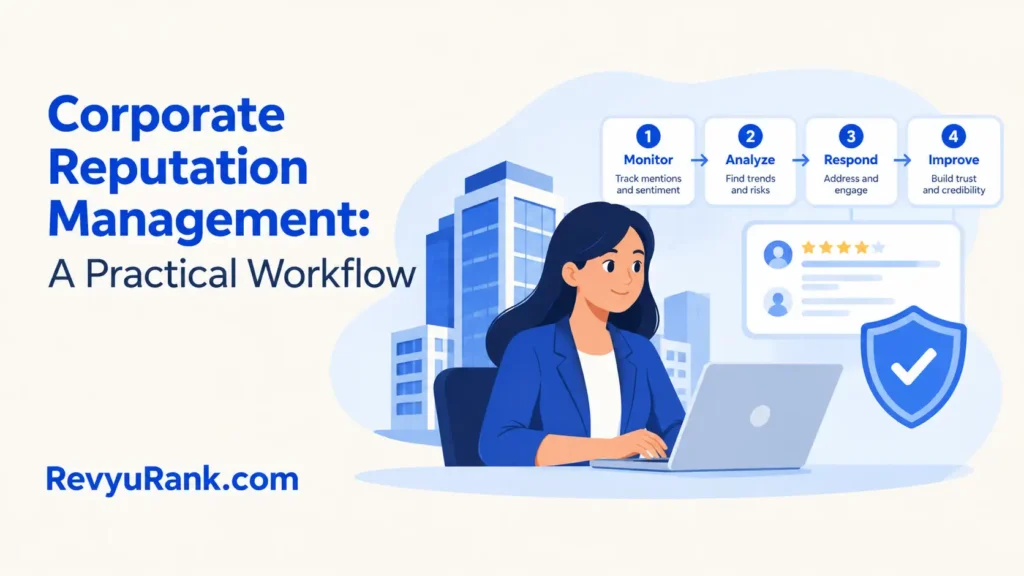
List the audiences and risks. Write down 5-8 groups that can affect trust, such as customers, employees, journalists, investors, regulators, and suppliers. Add the issue each group is most likely to raise.
-
Set up monitoring. Check your company name, key products, senior leaders, and major locations across search results, review sites, news, and social platforms. Review high-risk mentions daily and lower-risk feedback at least weekly.
-
Verify each serious claim. Save the URL, date, exact wording, customer or stakeholder details, and internal facts. Separate a real service failure from spam, an impersonation attempt, a personal opinion, or a complaint about a different company.
-
Assign an owner. Customer-service issues should go to customer service. Safety, privacy, financial, employment, or legal concerns should go to the qualified team before anyone publishes a reply.
-
Respond with a clear action. A useful reply acknowledges the concern, corrects only facts you can prove, protects private information, and gives one next step. Move sensitive cases to a private channel, but leave a short public note when others need to know that the issue is being handled.
-
Record the outcome. Mark the issue as open, verified, resolved, or disputed. Add the underlying cause, the owner, and the date for a follow-up check.
The key judgment is whether the reply should be public, private, or delayed for review. If the facts are confirmed and the issue affects other customers, respond publicly; if personal data, legal exposure, or safety is involved, limit the public reply and involve the proper team.
Reputation management numbers to use
These figures are operating choices, not universal legal deadlines. Use the shorter interval when the issue affects safety, privacy, money, a large audience, or a senior executive.
| Situation | What to use | How long | What to watch for |
|---|---|---|---|
| High-risk complaint | Daily monitoring and named owner | Same business day for acknowledgment | Don’t guess while facts are missing |
| Standard customer complaint | Review site and inbox check | Within 1 business day | Keep private details out of the reply |
| Routine feedback | Weekly review | 7-day cycle | Look for repeated themes, not one loud comment |
| News or search issue | Saved links and screenshots | Recheck after 24-48 hours | Track whether the story is spreading |
| Employee concern | HR or ethics review | Set a written follow-up date | Don’t investigate publicly |
| Resolved issue | Outcome record and cause | Review after 30 days | Confirm the fix lasted |
Details that improve reputation results
Preparation starts before a complaint arrives. Keep approved company facts, contact names, escalation routes, privacy rules, and response examples in one place. Templates should guide tone and structure, but they shouldn’t force the same reply onto every person.
Work in order: capture the claim, verify it, classify its risk, choose the owner, then answer. Check again after publication for new facts, copied misinformation, or a second complaint that reveals a wider problem. A reply that sounds polite but sends people to a broken form creates another reputation issue.
Leave some things alone. Don’t argue with obvious trolls, repeat a false allegation in a way that gives it more reach, or ask customers to post positive reviews to bury criticism. A company can also make things worse by deleting fair negative comments; the short-term appearance of control may cost trust when people notice the pattern.
The trade-off is speed versus certainty. A fast acknowledgment can reduce silence, but an unverified denial can turn a small complaint into a larger story. If the facts aren’t ready, say that the company is checking the matter and provide the next update point.
Corporate reputation problems and fixes

Start with the visible symptom, then check the business process behind it. Don’t treat every negative mention as a communications problem.
| What you notice | What it usually means | What to do first |
|---|---|---|
| The same complaint appears repeatedly | A process or product issue may be unresolved | Group the complaints and send them to the responsible owner |
| A post has incorrect company details | Confusion, outdated information, or impersonation | Verify the account and publish the correct contact path |
| A response gets more negative replies | The tone, facts, or proposed fix missed the concern | Pause replies and review the case with customer service |
| Search results show an old crisis first | The issue still has strong relevance or links | Fix the underlying issue and publish accurate current information |
| Review activity looks sudden and unusual | Spam, coordinated activity, or a real incident is possible | Preserve records and ask the platform about its reporting process |
Reputation rules and disclosures
The rules depend on the country, industry, audience, and claim. In the United States, the Federal Trade Commission says endorsements and testimonials must not mislead people, and material connections may need clear disclosure; read the FTC Endorsement Guides before using employee, creator, or customer promotion.
A company shouldn’t pay for hidden praise, make a false review, suppress a lawful complaint, or publish private customer information. Advertising, financial statements, employment claims, privacy notices, and safety statements can bring separate duties from different authorities.
If a complaint involves injury, a data breach, suspected fraud, securities disclosure, harassment, or a legal demand, stop improvising. Send it to the company’s lawyer, privacy officer, compliance team, HR lead, or other qualified professional.
Keeping reputation work current
Keep a dated log of important mentions, responses, owners, evidence, and outcomes. Review the log monthly, or sooner when a high-risk issue remains open. Remove duplicated notes, but preserve original screenshots and links for serious matters.
Refresh contact names and response templates whenever roles, products, policies, or support channels change. A process is due for attention when replies start going unanswered, the same complaint returns, or staff can’t tell who owns the next step.
When reputation management isn’t enough

This approach isn’t right when the company faces an active safety threat, criminal allegation, major data breach, or urgent regulatory action. Use incident response, legal counsel, security staff, or the relevant regulator instead.
It’s also not a substitute for product repair or service recovery. If customers are reporting the same defect, fund the operational fix before increasing promotional content.
Small companies with only occasional feedback may not need expensive software or a full communications team. A shared log, clear owner, and weekly review can be enough until the volume or risk grows.
Frequently asked questions
Can a company remove negative reviews?
Usually, no—not simply because a review is unfavorable. A company can report content that breaks a platform’s rules, such as spam, threats, or impersonation. It shouldn’t remove fair criticism just to create a cleaner public record.
Why is corporate reputation important?
It affects whether people trust the company’s claims and choose to work with it. Reputation can also shape employee interest, partner decisions, customer patience, and the attention a complaint receives. It won’t replace good performance, but poor trust can make problems harder to solve.
How long does reputation recovery take?
A simple factual correction may settle within days, while a serious crisis can require months of visible improvement. The deciding factor is whether the underlying problem has stopped and whether affected people can see credible evidence of change.
Is it safe to respond to angry customers publicly?
Yes, when the reply contains no private information and the issue is low risk. Keep account details, payment information, health data, and personal contact information private. Move the case to a secure support channel when those details are needed.
What happens if a company ignores bad reviews?
The reviews may remain visible while unanswered questions spread to new readers. Silence doesn’t prove the complaint is true, but it removes the company’s chance to provide facts, explain a fix, or show that someone owns the issue.
How often should a company check its reputation?
Use daily checks for high-risk names, products, and active incidents, and weekly checks for routine feedback. The right frequency changes with audience size, industry risk, and complaint volume, so record how quickly important mentions are being found.
Conclusion
Set a regular review date with leaders from customer service, operations, legal, and communications. Ask what customers may experience next, which promises the business must keep, and where small changes could prevent larger concerns. If the team treats feedback as useful evidence, trust will have room to grow.

Robert Miller works as a Reputation Management Consultant. He has been helping U.S. businesses for over ten years. His work involves helping people protect and enhance their online image.Robert has worked with a wide range of companies. He has helped new businesses, local places that give a service, and big companies. He helps turn customer reviews into something that helps people trust their company and drives business growth.