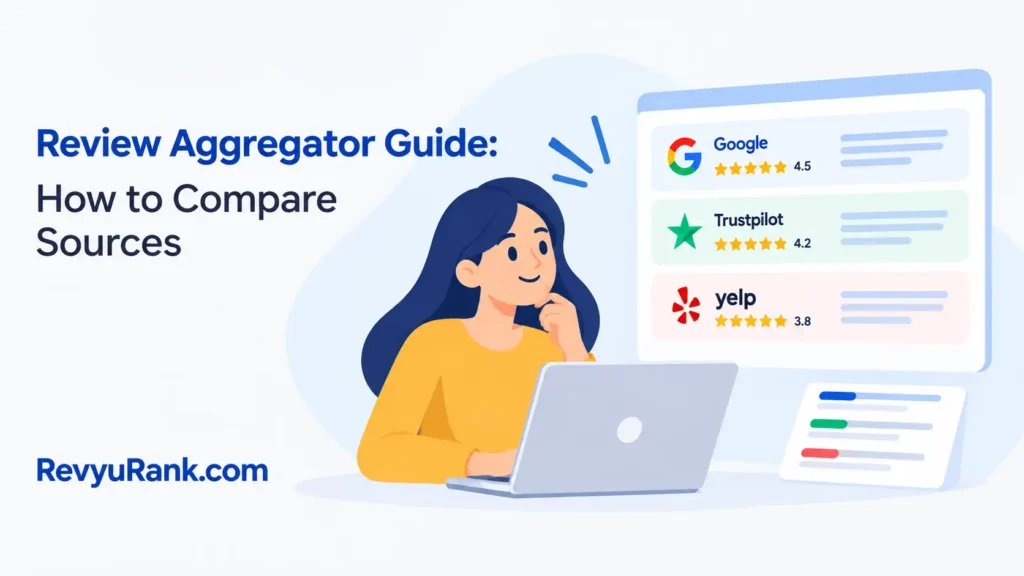
A review aggregator guide should help you collect reviews from several trusted sources, compare their methods, and make a decision without treating one score as the full truth. The safest reading starts with the review count, source quality, date range, rating scale, and any sign that reviews were filtered or paid for.
Your answer can change with the type of product, the number of reviews, and how much the sources agree. A business owner also needs to check display rules and fake-review laws, while a shopper mainly needs a clear way to compare products and spot weak evidence.
Who uses review aggregators

A shopper may type this search after seeing different ratings on Google, Amazon, Yelp, an app store, or a specialist website. This reader usually has a product in mind and needs help comparing review volume, recent complaints, and repeated strengths before spending money.
A business owner may already collect reviews but wants one dashboard or page that brings them together. This reader needs to know which sources can be imported, whether the wording stays unchanged, how negative reviews appear, and whether the display follows each platform’s terms.
A researcher, journalist, or buyer for a team may need a wider view. That reader needs a repeatable method for checking review dates, removing duplicate entries, comparing rating scales, and separating customer experience from marketing language.
This page serves readers who want to judge an aggregator or build a fair comparison from public review sources. It assumes you can open the original review pages and read basic product details. It isn’t the best fit if you need legal advice, a private reputation-management campaign, or a technical system for scraping websites; use a lawyer, the review platform’s business support, or a qualified developer instead.
What changes the review result
The source mix matters most. A score made from verified-purchase reviews, app-store ratings, and local business reviews isn’t automatically comparable because each source attracts different users and uses different controls. Write down every source shown by the aggregator, then check whether it names the source beside each score.
The number of reviews affects how much weight you should give a rating. A 4.8 score from 12 reviews gives you less evidence than a 4.5 score from 2,000 reviews, but volume doesn’t prove that the reviews are genuine or useful. Check the count for the exact product, model, location, and version, not just the parent brand.
The date range can change the answer quickly. A product may have changed its materials, software, support team, or subscription terms since older reviews were posted. Look for a chart or filter showing review dates; if the aggregator hides dates, treat the score as incomplete.
The rating scale is easy to get wrong. One platform may ask customers to rate the overall product, while another asks about delivery, support, or value. Compare the question wording and the number of stars before combining scores. This is the detail readers get wrong most often.
The review selection method also moves the result. An aggregator may show every available review, a sample, only reviews that meet a language or location filter, or a score calculated from selected sources. Read its methodology page and record whether it explains missing reviews, duplicates, incentives, and business responses.
If two sources disagree, don’t average them immediately. If the disagreement comes from different dates or questions, keep the results separate; if the same product and period are being rated, inspect the written complaints before choosing a side.
How to check review evidence
Use this process when you’re comparing an existing aggregator or creating your own research sheet. It works best for products, services, apps, restaurants, and local businesses where several public review sources are available.
-
Write the exact item name, model, location, and version. Include the model number or service plan when one exists. The step is complete when you can search for the same item without mixing it with an older or larger version.
-
List each review source separately. Record the platform name, page address, rating, review count, and date checked. Don’t copy a rounded score if the source shows a more precise figure.
-
Check what each rating measures. Read the question or label beside the stars, such as overall satisfaction, seller performance, delivery, or ease of use. Keep scores separate when the questions aren’t the same.
-
Check the review dates. Group the results by year or by the period shown on the page. If the product changed during that period, note the change before using older comments.
-
Read at least five positive and five negative reviews from each important source. Use the same product or location and look for repeated details, not colorful wording. You’re looking for patterns such as poor battery life, slow support, or inaccurate sizing.
-
Mark duplicate or copied comments. Compare unusual phrases, identical sentences, and the same photo across sources. Remove a duplicate from your personal count, but record that duplication as a warning about the aggregator.
-
Check for incentives and business responses. Look for labels such as verified purchase, invited review, sponsored, or free sample. Read the response to serious complaints, but don’t treat a business reply as proof that the complaint is false.
-
Write a decision note with the trade-off. For example, choose the higher-rated product if recent reliability complaints are rare; choose the lower-rated product if its warranty and support are stronger. This keeps the final choice tied to your priority.
The key judgment is whether repeated comments describe the same real-world problem. A polished dashboard can look complete while hiding different rating questions, old reviews, or missing low scores. Stop before exporting or publishing data if the source’s terms forbid copying it; ask the platform for permission or use its approved integration.
Review sources compared
The best source depends on what you’re checking, so don’t combine every rating into one number. A score is useful only when the reviews describe the same product, version, location, or service period.
| Situation | What to do | What it takes | What to watch for |
|---|---|---|---|
| New product | Check recent sources | More reading | Small review count |
| Established product | Compare several platforms | Moderate effort | Older model versions |
| Local service | Match exact location | Careful searching | Branch differences |
| Mobile app | Check current app version | Quick date check | Update-related complaints |
| Business reputation | Read replies and complaints | High attention | Incentivized reviews |
| Technical product | Use specialist sources | Extra research | Different test methods |
For a product, confirm the exact model or generation before comparing reviews. A review of an older version can describe a design, feature, or defect that no longer applies. For an app, match the review date to the current version and look for complaints that appeared after a recent update.
For local services, search the specific branch or service area rather than relying on the company-wide rating. Policies, staffing, wait times, and management can differ between locations. For businesses, read the owner’s replies and repeated complaints, not just the average score.
If sources disagree, check whether they used different test methods or reviewed different versions. Give more weight to sources that explain what they tested and identify both strengths and drawbacks. A small group of enthusiastic reviews can signal early interest, but it doesn’t establish a reliable pattern.
Details that improve the result

Prepare the comparison
Start with one question that matters to you, such as reliability, fit, customer support, or delivery. A product with the highest overall rating may still be a poor choice if the reviews don’t answer your main concern.
Use the same identity for every source. Check the exact model, storage size, plan, location, and date range before copying a score. A common mistake is combining reviews for several versions under one product name; that can make an older defect look current or make a new improvement look proven.
Keep original scores and normalized scores in different columns. You may convert a 10-point score to a 5-point display for convenience, but don’t pretend that conversion makes the underlying questions equal.
Check while reading
Look for repeated, concrete details. “Great quality” tells you little, while “the zipper failed after two weeks” gives you a point to compare with other reviews. A single dramatic complaint deserves attention, but a repeated pattern deserves more weight.
Notice what reviewers leave out. If a product has many comments about delivery but very few about durability, the aggregator can’t support a strong durability conclusion. If the platform highlights selected reviews, find out whether customers can see the full set.
Leave some claims alone until you can verify them. Don’t label a review fake because it’s negative, and don’t label it genuine because it sounds detailed. Compare dates, wording, purchase labels, photos, and the platform’s own explanation before deciding what the evidence supports.
Review aggregator problems and fixes
A visible rating can be useful, but the warning signs below tell you when to slow down.
| What you notice | What it usually means | What to do first | How to stop it happening again |
|---|---|---|---|
| One very high score | Limited evidence | Check review count | Compare source totals |
| Ratings suddenly change | New version or date mix | Check update dates | Separate product versions |
| Same text appears twice | Duplicate review | Count it once | Use source IDs |
| No negative reviews | Filtering or selection | Find full source | Read methodology |
| Conflicting star scores | Different questions | Compare labels | Keep scores separate |
| Reviews lack dates | Weak time context | Check original page | Reject stale summaries |
| Business replies dominate | Marketing framing | Read customer text | Weight replies separately |
These issues don’t prove that an aggregator is dishonest. They show that its result may not answer the question you’re asking. If the platform won’t explain its sources, filters, or calculation, use it as a lead list rather than as final evidence.
Rules for review displays
Review collection and display rules depend on the country, platform, and business model. In the United States, check the Federal Trade Commission’s consumer reviews rule questions before offering incentives, suppressing complaints, or publishing testimonials. Keep the request neutral: ask customers for their honest experience, not a positive rating.
Don’t make a reward depend on favorable wording or a particular star rating. Asking only customers who seem satisfied can also produce a misleading selection of reviews. If you collect feedback through a campaign, use the same basic invitation for the relevant customer group and retain records of what you asked.
The FTC’s rule addresses deceptive reviews and testimonials, including fake reviews, reviews created by people without the claimed experience, and certain forms of review suppression. It may also affect how a business uses reviews supplied by others. Don’t attach a precise legal conclusion to a feature without checking the current rule and its questions-and-answers guidance.
Platform terms can add separate limits. A website may forbid copying review text, collecting data automatically, changing wording, or displaying reviews outside its approved tools. Read the source platform’s current business or developer terms for the country and account type you use. If those terms conflict with your planned display, use the platform’s approved integration or obtain legal advice.
Sponsored or incentivized reviews need clear treatment. If a reviewer received money, a free item, a discount, or another benefit, preserve the disclosure instead of hiding it. Keep the disclosure close enough to the review that readers will see it. If you’re unsure whether a campaign is lawful, stop the campaign and ask a qualified attorney or the relevant regulator.
The real cost of comparison
For a shopper, the main cost is reading time. A quick star comparison may take minutes, while checking dates, versions, and written complaints takes longer. The trade-off is simple: less reading gives you speed, while more checking gives you better protection against a misleading average.
For a business, costs include software, setup, review permissions, staff time, and possible development work. Compare the vendor’s current pricing page, source limits, export rules, and support terms. Prices and features change, so don’t rely on an old article or a quote copied from another customer.
Data cleaning can become the largest effort. Matching product names, removing duplicates, preserving disclosures, and separating locations all take manual judgment. Ask for a sample export before signing up, and check whether the fields include the source, date, rating question, and review identifier.
A poor aggregator can cost more than a paid one if it creates false confidence. A business may spend time defending a blended score that customers can’t verify, while a shopper may buy the wrong version because old reviews were included. The cheapest useful option is the one that makes its limits visible.
Keeping review data accurate
Record the date when you collect each score, because ratings and review counts can change. Keep the original source name, page address, product identity, date, rating scale, and any disclosure beside the copied result. Record whether the figure is an average rating, a review count, or another measure; these numbers answer different questions and shouldn’t be combined. If the scale differs, display it clearly rather than making scores appear comparable.
Review the comparison when the product changes, the service moves location, the app receives a major update, or the source changes its review policy. Don’t use a fixed schedule as a substitute for checking these signs. Check that the page still refers to the same model, version, location, and time period. A new listing or merged page can make an old result look current when it’s not.
If a displayed review disappears, mark it as unavailable rather than silently changing the total. If a source corrects a rating or removes a duplicate, update your record and keep a note explaining the change. Preserve the prior value in internal history when practical, so reviewers can distinguish a correction from a transcription error. Recalculate any average or percentage that depended on the changed entry, and check that the displayed count matches the entries.
For a page, show the last checked date and link or identify the source where the platform allows it. If a source blocks republication, remove copied text and keep permitted summary data. Ask the platform or a lawyer before republishing disputed material.
When review aggregation is the wrong choice

A blended score is the wrong choice when products aren’t truly comparable. Different sizes, plans, locations, or model years can have different problems, even when they share a product name. Compare like with like: match the exact size, configuration, service tier, market, and model year before combining ratings.
If those details can’t be matched, separate the results rather than letting the better-reviewed version lift the other one. Use a specialist comparison that tests the exact versions when a difference could affect performance, compatibility, or total cost.
Aggregation is also weak when the review count is tiny or comments are mostly about shipping, packaging, or customer service. Those comments may describe the seller rather than the product, and a high score can conceal a repeated defect mentioned by only a few buyers.
Read original reviews and look for concrete details: the exact version, date of purchase, use case, failure, and seller response. Check independent specifications, warranty terms, return conditions, and recall notices. If evidence remains thin or mixed, report what is known and unknown instead of presenting a firm overall ranking.
Don’t use public reviews as a substitute for safety, medical, legal, or financial advice. A serious complaint involving injury, fraud, a regulated service, or a contract dispute needs the relevant regulator or a licensed professional. Stop DIY analysis when you need to prove what happened or protect a legal right. Keep receipts, contracts, screenshots, and correspondence if a dispute may follow; public ratings rarely establish liability or entitlement to compensation.
Frequently asked questions
Can I trust a review aggregator?
You can trust it only as far as its sources and method are clear. Check the original platforms, review dates, exact product or location, rating questions, and duplicate handling. An aggregator that hides missing reviews or combines different versions can still show a polished score, but that score shouldn’t decide the purchase alone.
Why do review aggregator scores differ?
Scores differ because platforms collect different audiences and ask different questions. They may also cover different dates, versions, locations, or review counts. Compare the labels and source periods before treating the numbers as a disagreement about quality. Sometimes both scores are accurate because they measure different parts of the experience.
How long should I spend checking reviews?
Spend about 15 minutes on a simple purchase with several clear sources, assuming the product identity and dates match. Spend longer when the price, safety, warranty, or return risk is high. Stop when you’ve checked the main sources, read repeated positive and negative themes, and can state the main trade-off.
Is it safe to copy reviews into one dashboard?
Not always. Safety here depends on the source platform’s terms, your country, the review wording, and whether the data is public or accessed through an approved tool. Check the platform’s current business or developer rules before copying text. Use an approved integration or ask for permission when the terms aren’t clear.
What happens if an aggregator removes bad reviews?
The score can become misleading, especially if the selection rule isn’t visible. Check whether the platform removes only spam and duplicates or also excludes ordinary negative reviews. Ask for the full review policy and compare the source. Don’t present a filtered score as an all-review average.
Does review count matter more than the star rating?
Neither matters alone. A large count can include old versions or a different customer group, while a high rating from very few reviews may be unstable. Compare the count, date range, source quality, and written patterns together. Give extra weight to details connected to the problem you need to avoid.
Can I combine ratings from different websites?
You can display them side by side, but a single combined score needs a defensible method. Keep ratings separate when the platforms use different questions or scales. If you calculate an average, document the conversion, weights, dates, and excluded entries so another reader can reproduce it.
Review aggregation first steps
Start by writing the exact product, service, location, version, and one decision factor that matters most to you. Add the date when it matters, such as for a software release, local business, or policy change. This prevents results for older versions, different locations, or similarly named products from being mixed.
Expect a useful result to show matching sources, clear dates, repeated themes, and an obvious trade-off rather than one unexplained star number. Check whether independent sources describe the same issue, and separate firsthand observations from copied wording, sponsored material, and claims with no detail. A single complaint may reveal a serious possibility, but it doesn’t establish how common the problem is.
If the sources agree on a pattern and the trade-off fits your priority, compare the evidence before deciding. If they conflict, narrow the search by version, location, or date instead of averaging together. Stop and get platform, legal, or professional help if the data is restricted, the complaint involves serious harm, or the source method can’t be checked.

Robert Miller works as a Reputation Management Consultant. He has been helping U.S. businesses for over ten years. His work involves helping people protect and enhance their online image.Robert has worked with a wide range of companies. He has helped new businesses, local places that give a service, and big companies. He helps turn customer reviews into something that helps people trust their company and drives business growth.