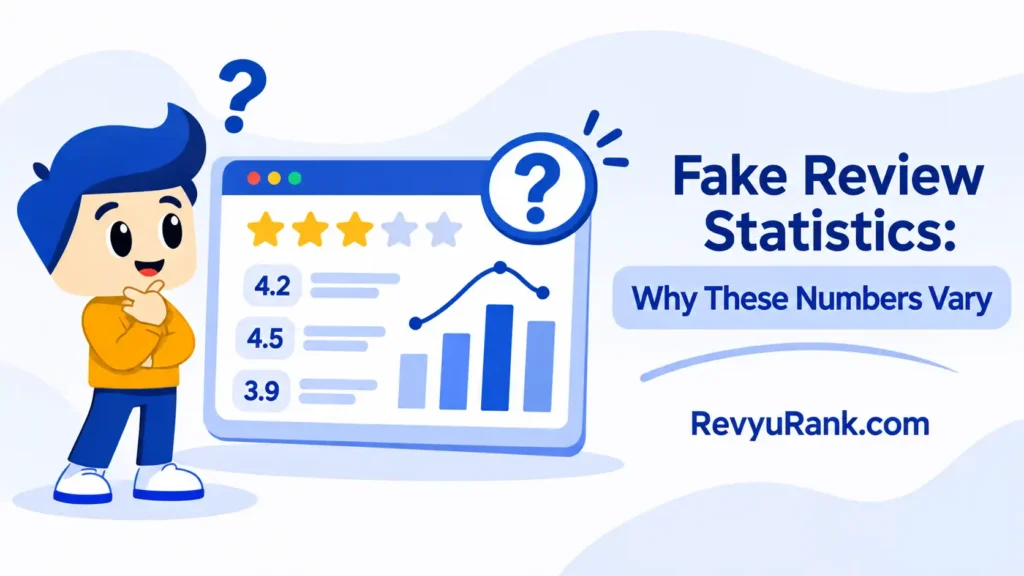
There isn’t one trustworthy global percentage for fake review statistics: a 2016 study of Yelp restaurant reviews estimated about 16% were fraudulent, while a 2021 European Commission sweep found possible review-rule breaches on 55% of 223 websites. Those figures measure different things and can’t be combined into one market average. Treat percentages as limited to their source, country, website, date, and detection method. This guide explains how to check review numbers and when statistics are too weak to trust.
What fake reviews mean
Fake reviews are ratings or comments that don’t come from a real customer’s genuine experience. They can be written by a seller, a paid writer, a competitor, a review broker, or a person using several accounts. Some are fully invented. Others describe a real purchase but change the rating or wording because someone offered money, a refund, or another benefit.
Businesses use review data to judge customer satisfaction, compare competitors, and decide where to spend money. Shoppers use it to reduce risk before buying. Researchers use it to study trust and marketplace behavior. The numbers matter to all three groups, but the same number can mean something very different in each setting.
The main misconception is that every unusual review is fake. A short review, a one-star rating, a spelling mistake, or a sudden group of positive comments isn’t proof by itself. A reliable assessment looks for several signals and checks how the number was produced.
One well-known academic study illustrates the limit of these figures. Michael Luca and Georgios Zervas estimated that about 16% of Yelp restaurant reviews in their research data were fraudulent, using patterns in the review record rather than direct proof of every individual review. That was a model-based estimate for one platform and category, not a universal rate.
The European Commission found a different problem in 2021. Its sweep of 223 websites found that 55% appeared potentially to breach European Union consumer rules around review authenticity or presentation. “Potentially” meant the websites needed further attention; it didn’t mean that 55% of all reviews were fake.
So, use percentages as evidence about a defined sample. Don’t present them as the share of fake reviews everywhere.
How to check review data
A useful check starts with the data source, not with a dramatic percentage. Record the platform, country, category, review dates, sample size, and definition of “fake.” Then use the same checks across the full set.
-
Write down the review population. Record the total number of reviews, the dates covered, the product or business category, and the platform. If you’re comparing two businesses, use the same date range and the same rating scale. A product with 40 reviews shouldn’t be compared directly with one with 40,000.
-
Separate observed facts from estimates. Count visible signs, such as repeated wording or several reviews posted within one hour. Keep those counts separate from a predicted fake rate produced by software. A pattern can justify a closer review, but it doesn’t prove the writer’s identity or motive.
-
Check timing and wording. Sort reviews by date and look for bursts, copied phrases, unusual language shifts, or reviews that discuss features the product doesn’t have. One signal is weak. Several independent signals in the same small group deserve more attention.
-
Check reviewer behavior. Look for accounts that review many unrelated businesses in a short period, leave only extreme ratings, or post near-identical text. Don’t treat a new account as fake automatically. New customers can be genuine, and established accounts can still post misleading reviews.
-
Compare the rating pattern with the text. A five-star review that describes serious defects may be mislabeled, incentivized, or poorly written. A one-star review that gives detailed, verifiable information may still be genuine. Read the words instead of using the star rating as the only evidence.
-
Check the platform’s labels and removal process. Some sites mark verified purchases, suspected incentives, or removed content. Save the page date and label because platforms can change displays. If you’re reporting a review, use the platform’s official reporting route rather than contacting the reviewer directly.
-
Calculate the rate only after defining the denominator. If 12 reviews in a checked sample of 300 are confirmed or formally removed, the observed rate is 4%. Don’t call it the platform’s fake-review rate unless the platform used a representative method and published that result.
-
Record uncertainty. Put confirmed removals, suspected reviews, and ordinary reviews in separate groups. If a review threatens safety, fraud, or serious financial loss, stop trying to investigate the person yourself and contact the platform, payment provider, regulator, or qualified lawyer.
The key judgment is whether the evidence shows a repeatable pattern rather than an odd individual review. If the sample is small or the platform gives little data, report the finding as limited instead of forcing a precise percentage.
Fake review numbers at a glance
These figures are useful only when you keep their source, sample, and meaning attached to them.
| Situation | What to use | How long | What to watch for |
|---|---|---|---|
| Academic estimate for Yelp restaurant fraud | Luca and Zervas research estimate: about 16% | Study period and dataset used by the researchers | It covers a modelled sample, not every Yelp review |
| European website compliance sweep | European Commission review of 223 websites | 2021 sweep | 55% were potentially non-compliant; this wasn’t a fake-review percentage |
| A single business review check | The full visible review set for that business | Use one defined date range | A small sample can make a percentage unstable |
| A sudden rating change | Reviews before and after the change | Compare matching periods | Seasonal demand, a product update, or a real event may explain it |
| Repeated text check | Exact or near-exact phrase matches | Review the whole sample | Common product language can create false matches |
| Reviewer activity check | Review history, dates, ratings, and categories | Use the same period for all accounts | Privacy limits and deleted reviews can hide context |
| Platform removal count | The platform’s own trust or transparency report | Use the report’s stated year | Removed content may include spam, policy violations, or duplicates, not only paid fakes |
What makes review data useful
Good review analysis begins with a clean question. “How many reviews are fake?” Is often too broad. Ask instead whether you’re measuring confirmed removals, suspected manipulation, paid incentives, copied text, or all reviews that look unusual.
Keep the review date, rating, text, reviewer history, and platform label together. Don’t copy only the reviews that support your view. If you’re checking a business, include positive, neutral, and negative reviews from the same period. That reduces the risk of mistaking a few striking comments for the whole record.
The order also matters. First preserve the original page or export, then remove duplicates, then classify the signs. If you begin by deleting reviews that “feel wrong,” you can create a biased sample. A spreadsheet with one row per review is enough for a basic check; add columns for date, rating, repeated wording, reviewer activity, and evidence strength.
Partway through, calculate separate counts for confirmed, suspected, and unclear reviews. Don’t combine them. If a platform removed a review, that’s stronger evidence of a policy problem than a reviewer having a new account. If several accounts share exact wording, save the wording and dates before the pages change.
Leave the motive alone unless you have direct evidence. You usually can’t tell whether a person was paid, confused, angry, or simply careless from the review text. The practical result is a confidence rating, not a claim about someone’s character.
A common costly mistake is turning a suspected percentage into a public accusation. That can damage a business’s reputation and may create legal risk, especially when the sample is small. Use careful wording such as “12 of 300 reviews showed the selected warning signs,” and explain exactly how you selected them.
Fake review warning signs
A warning sign helps you decide what to inspect next. It doesn’t prove that a review is fake on its own.
| What you notice | What it usually means | What to do first |
|---|---|---|
| Several reviews use the same unusual phrase | The text may have been copied or supplied | Compare the full wording and posting dates |
| A burst of extreme ratings appears together | Coordinated activity or a real event may be involved | Check timing, product changes, and other platforms |
| Reviews mention features the item doesn’t have | The writer may not have used the item | Check the product page and ask the platform to review it |
| One account posts on unrelated businesses in a short period | The account may be used for promotional activity | Review its history and avoid treating the pattern as proof |
| A review contains a discount, refund, or gift request | An incentive may affect the review | Save the wording and check the platform’s policy |
| The rating and written detail conflict | The rating may be accidental or manipulated | Read the full text and classify it as unclear until checked |
Don’t contact a suspected reviewer with threats or demands. Keep the evidence, report the content through the platform, and use a regulator or lawyer for serious fraud or defamation concerns.
Rules for review evidence
The Federal Trade Commission’s final rule on consumer reviews and testimonials prohibits fake or false reviews, buying reviews that must express a particular positive or negative sentiment, and certain forms of review suppression. It also addresses company-controlled review sites that falsely appear independent and fake social-media indicators.
The FTC says businesses can face civil penalties for violating the rule or other applicable laws. The amount and enforcement path can depend on the conduct and the current legal framework, so check the agency’s published rule and current penalty information before quoting a dollar figure. The FTC reviews and testimonials rule is the authoritative text for the prohibited practices.
The rule doesn’t mean a business must publish every review without moderation. A platform can remove spam, abusive content, private information, or material that breaks its published rules. The problem is hiding genuine negative reviews because they’re negative, or presenting paid or controlled content as independent customer opinion.
If you’re collecting evidence for a dispute, preserve the original page, date, account name, and platform policy. Don’t impersonate a reviewer, access someone else’s account, or scrape data in a way that breaks the platform’s terms. A lawyer or the relevant consumer-protection authority should handle a serious legal claim.
Keeping review records clean
Keep a dated copy of the review data you used, including the platform name, search method, filters, and category. Record the date and time zone of the check, and save the search results or screenshots when the platform allows it. A saved spreadsheet is helpful, but keep the original URLs or page references too. Platforms can remove, merge, relabel, or rearrange reviews after your check.
Review the record again when the platform reports a removal, a business changes ownership, or a product receives a major update. If the page is stable and low volume, a repeat check after a meaningful change may be enough; an active catalog needs a fresh snapshot when the platform signals change. There’s no honest universal schedule for this work because review volume differs sharply between a small local service and a large online catalog.
When a review is removed, mark the reason as reported by the platform rather than guessing why it disappeared. If a page no longer loads, record it as unavailable instead of calling it removed. When a new review looks suspicious, add it to a pending group and compare it with the existing pattern, using the same indicators and time window. Don’t rewrite old findings every time one new review appears; append the new observation and preserve the earlier version.
If your findings need to support a complaint, media report, or business decision, have another person repeat the sample and coding rules. Give them the same date range, search path, filters, and definitions, but don’t coach them through individual cases. If they get a different result, resolve the definition or sampling difference before publishing a percentage, and retain both versions of the record.
When fake review checks fail
A manual review check is the wrong choice when you need a platform-wide estimate. You won’t have a complete sample, deleted content, private account data, or the platform’s detection model. Use a published transparency report or commission an independent research project with a defined sampling method instead.
A hand-checked set can show what appeared in the pages you reviewed, but it can’t establish the rate across the service. If you inspect one, record the search terms, date, pages reviewed, and criteria used; call the result a sample finding rather than a platform-wide percentage.
This approach also doesn’t apply when the issue involves threats, extortion, identity theft, or a large financial loss. Don’t investigate the suspected person yourself. Preserve the evidence and contact the platform, your payment provider, law enforcement, a consumer-protection agency, or a lawyer, depending on the issue. Keep original files, URLs, timestamps, and transaction records intact. Don’t edit screenshots.
Skip a percentage when the denominator keeps changing. A claim such as “20% of reviews are fake” is weak if it mixes several websites, countries, years, and definitions. Report the count and the limits, or wait until you can compare like with like.
Frequently asked questions
Can fake reviews be detected accurately?
No, not from text or star ratings alone. Detection can flag patterns for review, but it usually can’t prove who wrote a comment or whether money changed hands. Platforms may also use hidden signals, including account links, device data, or transaction records, so automated labels and public estimates remain limited evidence.
Why do fake reviews happen?
Fake reviews happen because ratings influence trust, visibility, and buying decisions. A seller may try to improve a weak reputation, while a competitor may try to damage another business. Some review campaigns also use incentives, paid writers, or account networks. The reason behind a particular review can’t be known from unusual wording alone. Focus on the evidence available: timing, repeated text, account behavior, disclosures, and the platform’s response.
How long do fake reviews stay online?
There’s no reliable universal time period. A review may remain visible until a user reports it, an automated system detects it, or the platform conducts a later audit. Some content can disappear quickly, while other content may stay for a long time. If you need to report it, save the page, date, text, and account details before submitting the complaint. Don’t assume removal proves the original motive.
Is it safe to trust reviews with a verified label?
No, a verified label isn’t a complete guarantee. It may show that the platform connected the review to a purchase or other account event, but it doesn’t prove the review is unbiased or fully accurate. Read the detail, compare reviews over time, and look for specific information about use. A verified review can still contain an honest mistake, an incomplete experience, or a rating that doesn’t fit your needs.
What happens if a business pays for positive reviews?
Paying for a particular positive opinion can violate platform rules and consumer-protection law. The risk is greater when the payment or benefit isn’t disclosed, or when the business hides negative feedback. The exact consequence depends on the conduct, location, platform, and enforcement body. Keep records of the offer and report it through the platform or the relevant regulator. Don’t accept an incentive that requires a favorable rating.
How many reviews should I check before judging a pattern?
There’s no single minimum that works for every claim. The right sample size depends on the question. For a small business, inspect the full available set when practical; for a large platform, use a random sample and disclose its size and selection method. Larger samples reduce noise but can’t fix bias or an unclear definition of “fake.”
Conclusion
Before your next purchase, pause and test any striking claim against an independent source. If the evidence is thin or unclear, choose a more reliable guide and tell others what remains uncertain. You’ll make better decisions this way, and you won’t give weak information more power than it deserves.

Robert Miller works as a Reputation Management Consultant. He has been helping U.S. businesses for over ten years. His work involves helping people protect and enhance their online image.Robert has worked with a wide range of companies. He has helped new businesses, local places that give a service, and big companies. He helps turn customer reviews into something that helps people trust their company and drives business growth.