Stop responding defensively. When Google review bombing causes 1-star reviews to flood in, preserve evidence, report only reviews that break Google’s rules, and keep serving real customers. In the next minute, capture screenshots of the review names, dates, ratings, and text before anything changes. Don’t accuse a reviewer of being part of an attack in public.
If the reviews mention threats, private information, or extortion, stop direct contact and save every message. Contact local law enforcement if there’s a credible threat. If the posts are simply negative but describe a real customer experience, they may stay online even if several appear together. Your goal is a clean record and a calm response, not a fast removal at any cost.
Stop Google Review Bombing When 1-Star Reviews Flood In
-
Pause public replies for two minutes. Don’t argue, threaten legal action, or call the reviewers fake. A rushed reply can become another screenshot shared online. If you reply later, use the same calm wording and avoid mentioning private customer details.
-
Capture each review. Save the reviewer name, profile link, date, star rating, text, attached media, and your business listing name. Include the full browser or app screen where possible. Keep the files in one dated folder, and don’t edit the screenshots.
-
Record the sudden change. Note the date and time the flood began, the number of new reviews, and the rating before and after it. Use your account’s review view and write down the count you see. Check whether the accounts posted similar wording or reviewed several unrelated businesses at the same time.
-
Compare claims with your records. A harsh review can still describe a real customer visit, even if the rating feels unfair. Check booking, sales, delivery, or support records without publishing customer information. If you can’t match a reviewer to any interaction, record that fact as evidence rather than stating publicly that the person is fake.
-
Secure account access. Change the password for the Google account that manages the listing if you suspect unauthorized access. Turn on two-step verification and remove managers you don’t recognize. Review recent account activity, and preserve evidence before deleting or changing anything.
-
Tell staff one message. Ask employees not to contact reviewers or post defensive replies. Send all suspected abuse to one manager so the evidence and reports stay consistent. Report each review through Google’s available reporting process, using the specific concern that applies instead of filing identical accusations for every review.
These steps don’t prove the reviews violate Google policy. They stop extra damage while you separate coordinated abuse from a real service problem.
How Google Review Bombing Works
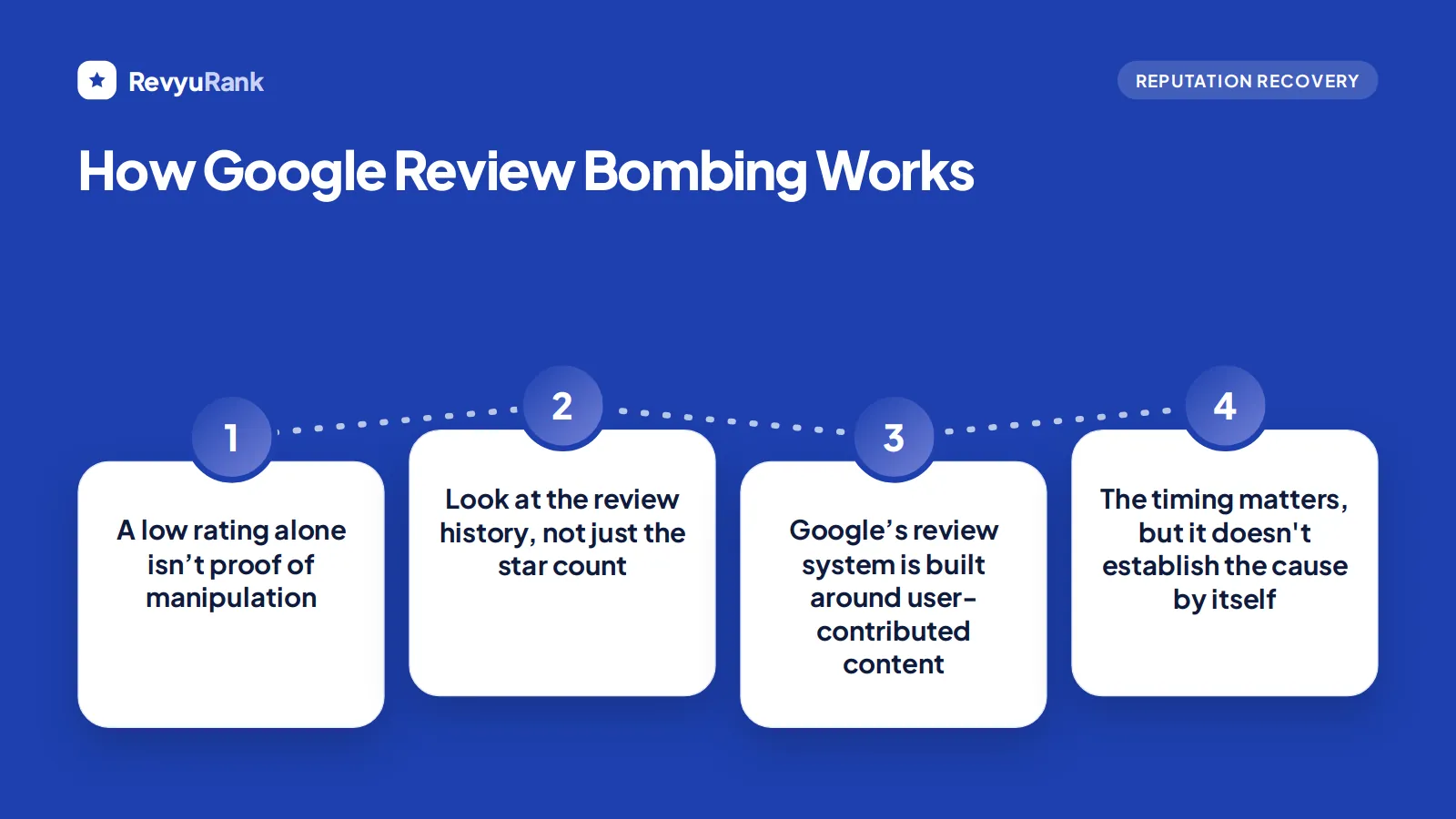
Google review bombing usually means a sudden group of low ratings that appears connected by timing, wording, or an outside event. The pattern can involve strangers, former customers, competitors, or real customers reacting to one incident. A low rating alone isn’t proof of manipulation.
Google’s review system is built around user-contributed content. Its policy can remove content that’s fake, posted through a conflict of interest, promotional, off-topic, harassing, or otherwise prohibited. The key question is not “Is this review unfair?” It’s “Does this review break a published rule?” Read the Google Maps user content policy before reporting.
A coordinated flood and a genuine complaint can look similar at first. A real complaint may come from several customers after the same outage, delay, product defect, or staff incident. A bombing pattern is more suspicious when reviews arrive from people with no clear connection to the business, repeat the same unusual wording, mention an unrelated dispute, or appear after a public call for negative reviews.
The timing matters, but it doesn’t establish the cause by itself. Compare the review dates with the incident, announcement, or post that may have triggered them. Save screenshots showing the dates, wording, reviewer profiles, and any public request for reviews before posts are edited or deleted.
Google may also treat a review as valid even when you dislike it. A customer doesn’t need to praise your business, use perfect grammar, or give detailed proof for a negative opinion to remain visible. Your trade-off is simple: a careful report takes longer, but mass-reporting every critical review can hide the genuine issue and weaken your credibility.
Look at the review history, not just the star count. The reviewer’s profile may show whether they reviewed places they actually visited, but you still shouldn’t publish their personal details or claim they’re fraudulent without proof. If several reviews describe the same verifiable problem, respond to the problem and investigate it internally. If you can’t verify the cause, describe the pattern and submit evidence rather than guessing.
Don’t ask employees, friends, or customers to post misleading reviews to offset the drop. That can create a separate policy problem and make the activity look more coordinated. Keep a dated record of the affected review links and your reports, especially if the same pattern continues.
Check Google Reviews From Cheapest First
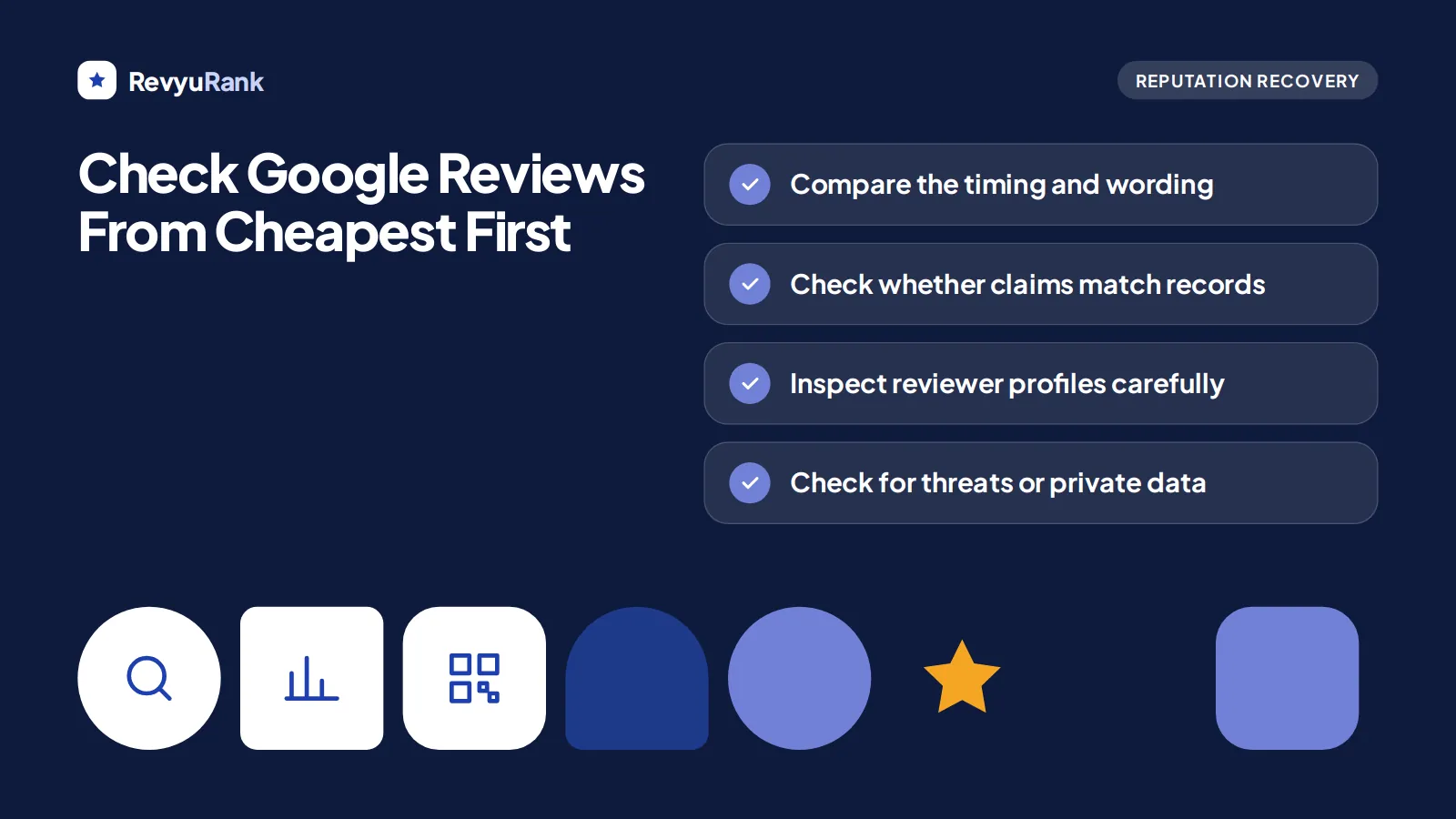
Start with the public listing, then move to account and business records. Don’t pay a reputation company until you know whether the problem is policy abuse, a real service failure, or an account-security issue.
Compare the timing and wording
List each new review by date, rating, and main claim. A cluster with copied phrases, identical errors, or the same unusual event deserves closer review. Similar wording can also come from customers describing the same real problem, so treat it as a clue rather than proof.
Check whether claims match records
Compare names, dates, orders, appointments, delivery logs, and support tickets. A missing customer record doesn’t prove a review is fake because the person may have used another name or visited a different branch. A clear match means you should fix the service issue as well as consider reporting abusive content.
Inspect reviewer profiles carefully
Look for public signs that the accounts are unrelated or newly active, but don’t contact people through their profiles. A sparse profile isn’t enough for removal. The useful result is a written pattern, such as several accounts posting within one hour about an event they couldn’t reasonably have experienced.
Check for threats or private data
Flag language that demands money, free goods, or special treatment in exchange for removing a review. Save messages that include threats, addresses, phone numbers, or employee details. Don’t repost that information in your reply; restrict it to the platform report or authorities handling the threat.
Review account managers and alerts
Open the Business Profile management area and check who has access. A good result is a list of people and agencies you recognize. Remove unknown access only after recording it, then change passwords and enable two-step verification. If you can’t access the profile, use Google’s official business support route rather than paying an unknown caller.
Check the full review count
Compare the visible reviews with your business records and any rating summary shown in your profile. Google’s displayed rating may change as reviews are filtered or added. Don’t promise customers a specific recovery score because the result depends on which reviews remain and how many genuine reviews you receive.
Remove Policy-Breaking Google Reviews
Report reviews one at a time through your Business Profile or the review-management tools available to the verified owner. Choose the closest policy reason and explain the evidence in plain language. “This is unfair” is weak; “five accounts posted the same unrelated accusation within 20 minutes, and the attached image contains an employee’s private phone number” gives a reviewer something to assess.
Use the same standard for every review. If one post contains a genuine complaint plus a personal threat, report the threatening part and answer the service issue separately. If a review is negative but relevant and based on a real visit, leave it in the review process and respond without trying to intimidate the writer.
Keep a simple case file with the review URL, screenshot, report date, selected reason, and any response from Google. Don’t submit dozens of duplicate reports for the same content. If Google declines the first report, use the available appeal or follow-up option and add new evidence instead of repeating the same sentence.
Your public reply should be short and useful: acknowledge the concern, avoid private details, invite the person to contact a named business channel, and state that you’re reviewing the matter. Don’t offer money or gifts for deleting a review. Incentives can create another policy problem and make the review dispute look like a transaction.
A fix has held when the abusive content is removed or the review pattern stops, while your listing remains accessible and genuine customers can contact you. If the flood returns within a week, treat that as an ongoing campaign or security concern: preserve the new evidence, review account access again, and escalate through Google’s support process rather than starting public arguments.
The mistake that costs businesses most is replying to every post with the same accusation. It can make legitimate customers feel dismissed, expose private information, and turn a review issue into a wider reputation story.
How to report a review and track the result
- Go to your Business Profile and select Read reviews.
- Next to the review, select Report.
- Choose the closest reason, such as Spam or Profanity, then select Send report.
You can check the status of each report in the Reviews Management Tool. If Google finds no policy violation and the review is eligible, select Appeal eligible reviews at the bottom of the tool. You can select up to 10 reviews at a time.
Google says processing times can run longer when many appeals come in, and it asks you not to send duplicate appeals. It also says not to report a review just because you disagree with it. Only reviews that break its policies can be removed.
When Google Review Help Needs a Professional
Stop DIY work when the issue involves extortion, credible threats, stolen account access, impersonation, private personal data, or a claim that could create serious legal exposure. Don’t try to identify anonymous reviewers, access their accounts, or publish their names. Those actions can create privacy, harassment, or defamation problems. Don’t retaliate with coordinated negative reviews or ask staff to attack the reviewer.
Contact Google Business Profile support for listing access, profile management, and review-reporting problems. A licensed attorney can advise on defamation, impersonation, extortion, or preservation of evidence. If someone threatens physical harm or demands money, contact local law enforcement and give them the saved messages and timestamps. Keep the original files, rather than relying only on cropped screenshots.
A qualified person will usually look first at the original review URLs, the timing pattern, your customer records, screenshots, report history, and any messages sent outside Google. Tell them which reviews appear connected and which ones match real transactions. Include what you’ve already tried, including the policy category and any appeal result.
A harsh review about a genuine customer experience is different from a review containing threats, private data, or no apparent connection to your business. The first may call for a calm public response and service recovery; the second may support reporting or legal advice. Don’t describe every unfavorable review as fraudulent, because that can weaken your credibility.
If the issue affects several locations, customer data, or an employee’s safety, a reputation professional may help coordinate records and communication. Choose one who explains the reporting basis clearly and doesn’t promise guaranteed removal. No legitimate adviser can guarantee that Google will delete a review simply because it harms your rating.
If someone demands payment to remove or stop reviews
Don’t pay and don’t negotiate. Save every message with its date. Then use Google’s separate Business Profile help page for reporting negative review extortion scams. This is a different step from flagging a single review, so do both when they apply. If there is a credible threat, contact local law enforcement as well.
When you want it set up without the guesswork, Google Reputation Recovery for Bad & Fake Reviews | RevyuRank is the place to start.
Need it done properly the first time? See our Google Review Generation service.
Frequently asked questions
Can Google remove a review bombing attack?
Yes, Google can remove reviews that violate its content rules, but coordinated timing alone isn’t enough. Reviews must be assessed for policy violations such as fake engagement, conflicts of interest, harassment, off-topic content, or personal information. Report specific posts with evidence, and appeal a rejection with factual details. Genuine criticism shouldn’t be reported solely because it arrived during a flood.
Why are my Google reviews suddenly all negative?
A sudden negative wave can follow a real service failure, a public dispute, a social-media post, or coordinated abuse. Check dates, wording, customer records, and outside messages before choosing a cause. The same phrase across several posts is a clue, not proof. If the reviews describe the same outage or incident, fix that issue and respond calmly. If reviewers demand payment or reveal private information, preserve the evidence and escalate the matter.
How long does Google take to review a reported review?
Google doesn’t provide one fixed review time for every report. The timing depends on the report type, evidence, account status, and any appeal. Save the report date and case details so you can follow up through the official support channel. Don’t assume silence means the review was accepted or removed. Keep serving customers and collecting genuine feedback while the case is open, without asking people to post only positive reviews.
Is it safe to reply to fake Google reviews?
Yes, a short public reply is usually safe if you avoid accusations, private data, threats, and unproven claims. Say you can’t match the details to a customer record and invite contact through your official channel. Don’t name the reviewer, publish an order number, or demand deletion. If the post includes threats, extortion, or personal information, preserve it and report it privately.
What happens if I report every 1-star review?
Reporting every 1-star review can waste time and leave genuine complaints unanswered. Google evaluates policy violations, not whether the rating is low. A real customer can give one star without breaking a rule. Separate reviews into three groups: genuine criticism, suspicious but unproven activity, and clear policy violations. Report the third group, respond professionally to the first, and document the second while you look for supporting evidence.
Does it matter if the reviewers never visited my business?
Yes, it matters if you can show the content is fake, unrelated, or posted by people with a conflict of interest. Your own records may help, but no customer record isn’t automatic proof because people can use different names or visit without an appointment. Compare dates, claims, profile activity, and messages. Report the policy issue without publishing personal information. If the review includes a real event, address that event separately.
Can I pay customers to remove bad reviews?
No, don’t pay for review removal or require a customer to change a review after receiving help. That can create a new trust and policy problem, and it may make the original dispute look manipulated. You can ask customers for honest feedback after a normal transaction, without asking for a specific rating. If a review is genuine, resolve the service issue and invite the customer to update their experience voluntarily.
What to do next
Once the immediate pressure eases, make reputation care part of your regular routine. Invite genuine customers to share honest feedback, watch for unusual changes, and keep your team focused on helpful service. A calm, consistent presence won’t erase unfair criticism overnight, but it’ll help trust grow again over time.

Robert Miller works as a Reputation Management Consultant. He has been helping U.S. businesses for over ten years. His work involves helping people protect and enhance their online image.Robert has worked with a wide range of companies. He has helped new businesses, local places that give a service, and big companies. He helps turn customer reviews into something that helps people trust their company and drives business growth.