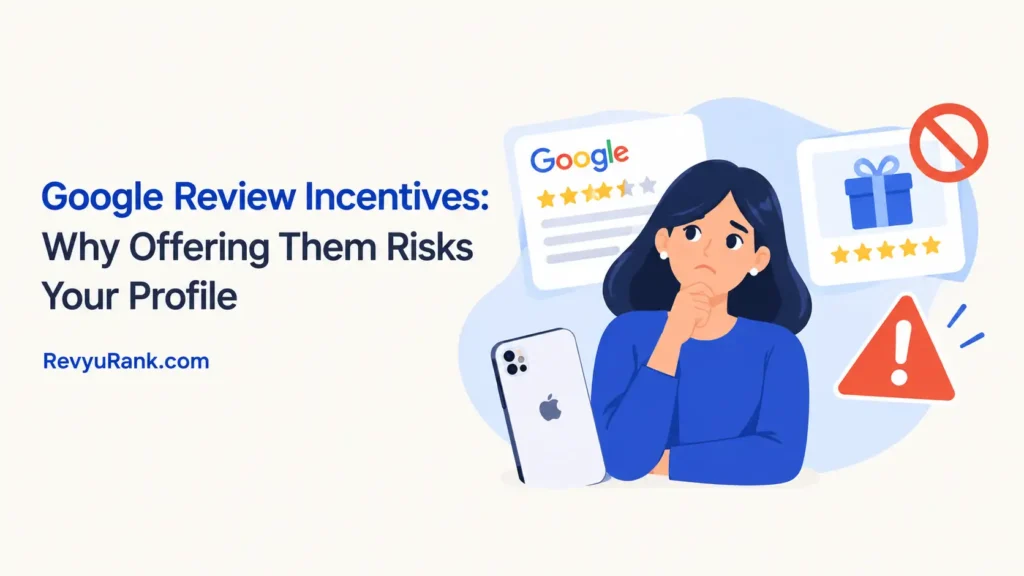
No. Offering Google review incentives breaks the platform’s rules, and getting caught can wipe out your business profile entirely. The deciding condition is whether you give anything of value—money, discounts, free items, or prize draw entries—in exchange for a review or a five-star rating specifically.
When offering incentives for Google reviews is risky
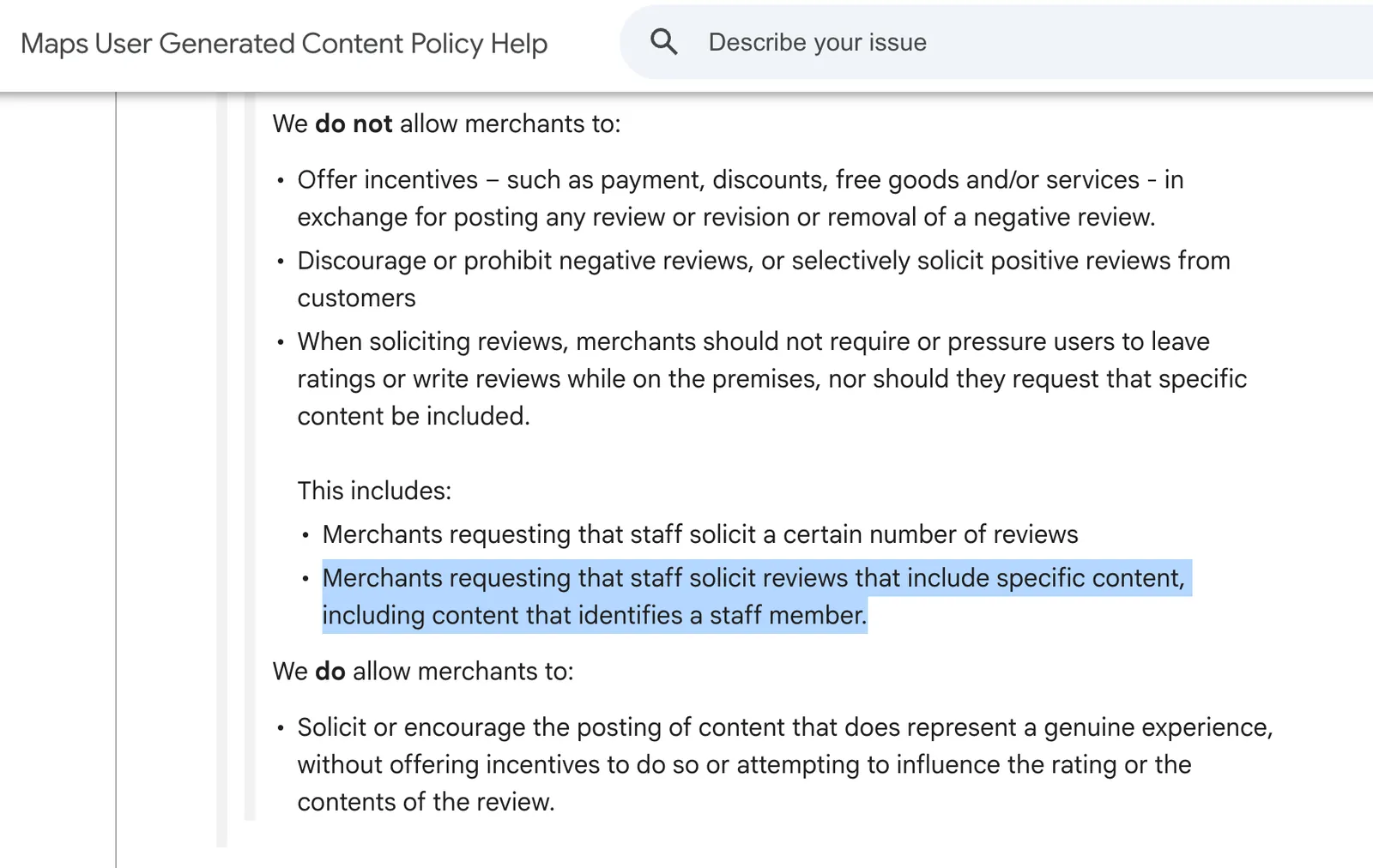
The risk depends entirely on what you offer and how you ask. A direct payment for a review is always banned. Asking customers to share their honest experience after a purchase is allowed. But the line between asking and buying gets crossed faster than businesses realize. Here’s how different situations sort out under the current policies.
| Situation | Safe? | Why |
|---|---|---|
| Paying cash for a five-star review | No | Direct violation of platform policies |
| Giving a discount code in exchange for a review | No | Counts as compensation for feedback |
| Entering reviewers into a prize draw | No | A chance to win is still an incentive |
| Sending a follow-up email asking for honest feedback | Yes | No reward is offered for the action |
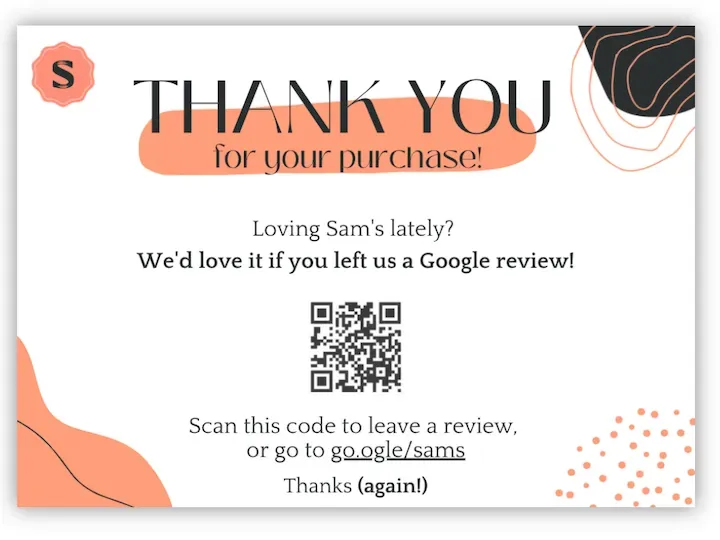
| Placing a QR code at checkout linking to your profile | Yes | Passive request without any compensation |
| Offering a free product upgrade for leaving a review | No | Goods count the same as money here |
| Replying publicly to thank someone who reviewed you | Yes | Public replies aren’t private compensation |
Businesses often try to soften the transaction by calling it a “thank you gift” sent after the review appears. That framing changes nothing if the customer knew about it beforehand. Mentioning a future perk during the sale makes every subsequent review a compensated one.
Loyalty points create another trap because they feel like standard business practice rather than bribery. Awarding points specifically for writing a review violates the policy just like handing over cash does. Points earned through purchases are fine, but they can’t be tied to the act of reviewing.
If your request includes a reward, don’t send it. If you’re simply providing a link so happy customers can find your page easily, that stays within the rules.
What actually happens when you incentivize reviews
The harm falls into three buckets: losing your profile, facing legal trouble, and destroying the trust you were trying to build. None of these are rare edge cases. The platform uses automated systems to flag unusual patterns, like fifty reviews appearing in one week from accounts that never reviewed anything else. When that happens, the algorithm doesn’t investigate—it just removes the reviews and restricts your account.
Losing your profile means disappearing from local maps and search results. For a shop or service business that relies on foot traffic or local calls, that silence costs real revenue every single day. Rebuilding a suspended profile takes weeks or months, and there’s no guarantee the support team will reinstate it.
Legal trouble is the second risk. In the US, the Federal Trade Commission requires endorsements to reflect honest opinions and demands that any material connection between a business and a reviewer be disclosed. Paying for a review without disclosing it violates those endorsement guidelines. Competitors who notice your sudden spike in ratings can report you directly to regulators, not just to the search platform.
The third harm is invisible until it hurts. Customers recognize bought reviews. When someone reads ten identical five-star posts written in the same tone, they don’t think your service is amazing—they think you’re hiding something. A profile with forty-five five-star reviews and zero complaints looks less trustworthy than one with forty-two fives and three fours that mention specific details about the actual work.
You can check your own profile’s standing by logging into your Business Profile manager and looking for warnings or suspension notices under the account status section. That’s where the platform tells you if you’ve already crossed the line.
Signs your review strategy is breaking the rules
Stop immediately if you see any of these signals. They mean your profile is already flagged or about to be penalized. Continuing will only make the damage worse.
- A sudden batch of reviews appears overnight. This means an automated system or a paid service delivered them. The platform’s spam filters will catch the unnatural timing.
- Your Business Profile dashboard shows a warning or suspension notice. This means enforcement has already started. Adding more activity right now makes reinstatement harder.
- Reviewers mention the discount or free item they received in their text. This means you’ve handed the platform written proof of the transaction yourself.
- Customers message you asking how to claim their reward for reviewing. This means your staff framed the request as a trade rather than a favor.
- Your overall rating drops sharply because legitimate reviews were removed alongside fake ones. This means the filter swept too wide. You’ve lost genuine social proof.
- A competitor files a formal complaint through the platform’s redressal form. This means someone outside your business noticed the pattern and triggered a manual review.
Platforms track velocity, not just volume. Five reviews in one hour from accounts created that same week trigger an automatic hold. Five reviews spread across five months rarely do.
Businesses often mistake a quiet period after a campaign for success. That silence usually means the algorithm is holding new posts in a review queue before publishing them.
If you spot these signs, stop all outreach campaigns immediately. Don’t try to explain your way out of it by messaging the reviewers. Every direct message creates another data point investigators can pull later.
At the point where your profile faces suspension or legal scrutiny, handling it yourself usually makes things worse. You’ll need to contact the platform’s official support team directly. Alternatively, consult a lawyer who handles digital advertising compliance.
How to get more reviews without offering incentives
You can grow your review count safely by removing friction instead of adding rewards. The goal is making it effortless for satisfied customers to leave feedback on their own terms. Follow these steps exactly.
-
Send your review request within 24 hours of completing the service or delivering the product. Waiting longer drops response rates significantly. This assumes you’re sending a standard email or SMS; if you rely on printed cards handed out in-store, allow up to 7 days for the customer to act.
-
Use your Business Profile’s built-in link generator to create a short URL. Don’t send people to your homepage and expect them to search for your listing. Copy the exact link provided in the “Ask for reviews” section of your profile manager.
-
Write a plain message asking for their honest experience. Keep it under 50 words. Say “We’d appreciate your honest feedback on our service” rather than mentioning star ratings or specific compliments you want to see.
-
Place a printed QR code at your physical checkout counter or reception desk. Link it directly to the review URL from step 2. This assumes customers have smartphones ready; if your audience skews older or lacks mobile access, hand them a card with the short link typed out instead.
-
Train your staff to mention the review link verbally at the end of a positive interaction. Give them one simple sentence to use: “If you have a moment, we’d love to hear how we did.” Don’t tie this to their performance bonuses, as that turns staff into pressure points.
-
Reply to every new review within 48 hours. Thank the person by name and reference one specific thing they mentioned. This proves to future readers that a real human runs the page, which encourages others to write detailed feedback.
-
Track your incoming reviews weekly inside your profile dashboard. Count how many arrive organically versus how many follow your email requests. If you send 100 emails and get 2 reviews, change your subject line or timing before sending another batch.
What to do if your profile is already penalized

If you’ve already offered incentives and the platform caught it, acting quickly limits the damage. Don’t panic and don’t buy more reviews to replace the deleted ones—that restarts the penalty clock.
First, log into your Business Profile manager and check the status. Look for any alerts, warnings, or suspension notices. Take screenshots of everything you see before clicking anything, because the interface changes once you start appealing.
Second, stop whatever campaign caused the problem. If you used a third-party marketing agency or software to generate reviews, cancel that contract today. If your staff handed out discount codes for feedback, tell them to stop immediately.
Third, remove any public posts, website banners, or email templates that promise rewards for reviews. The enforcement team checks your broader web presence during an appeal. Leaving those offers visible tells them you haven’t actually changed your process.
Check your printed receipts and packaging too. A QR code linking to a review page with a coupon offer counts as an incentive even if it only exists on paper.
Fourth, submit an appeal through the official reinstatement form if your profile was suspended. State clearly what happened, what you stopped doing, and what your new process is. Keep it factual. Don’t blame the algorithm or argue that your competitors do the same thing.
Attach the screenshots showing your cleaned-up pages. Include the cancellation confirmation from any third-party service you fired. Reviewers reject appeals that ask them to take your word for it without proof.
Fifth, wait. Reinstatement reviews typically take between 3 and 14 business days, assuming your documentation is complete and you haven’t violated the terms repeatedly. Check your email daily for responses from the support team.
Don’t submit a second appeal while the first one is pending. Each duplicate ticket pushes your case to the back of the queue.
If your profile remains suspended after two appeals, or if you face legal action from a regulatory body over deceptive practices, this stops being a task you handle alone. You’ll need a lawyer specializing in consumer protection law or digital compliance to represent you.
Frequently asked questions
Can I give a discount for a review?
No, you cannot. A discount counts as compensation under the platform’s policies, even if the customer leaves a negative rating. Any material benefit exchanged for feedback violates the rules. If you want to offer a discount, give it as a general thank-you to all customers after a purchase, without ever mentioning reviews in the same conversation or email. Tying the two together triggers penalties.
Why does paying for reviews hurt my ranking?
Paying for reviews risks having those reviews removed and your profile suspended, which eliminates the visibility those reviews provided. When a system detects purchased reviews, it removes them and may restrict or suspend the profile. Your visibility drops when fake reviews are deleted, and the profile is restricted. Recovering your standing after enforcement action takes months of consistent, organic activity.
How long does a review suspension last?
Repeat violations or severe cases involving large-scale fraud can result in permanent removal. The exact timeline depends on the volume of policy-breaking activity detected and how fast you prove the behavior has stopped.
Is it safe to run a giveaway for reviewers?
No, it isn’t safe. Entering customers into a prize draw in exchange for leaving a review violates the rules against incentivized feedback. A chance to win holds the same weight as guaranteed cash in the eyes of the enforcement systems. If you want to run a giveaway, open it to everyone regardless of whether they interact with your review page. Never make writing a review the entry ticket.
What happens if I only ask for five stars?
Asking specifically for five-star ratings is treated as review gating, which the platform prohibits. You can’t filter out unhappy customers by directing only satisfied ones to your review link. If the system catches you using software or scripts to gate reviews, it will strip away your existing ratings and potentially suspend the profile. Always send the same review link to every customer.
Does replying to reviews count as an incentive?
No, it doesn’t. Replying publicly to thank a customer for their feedback is encouraged and expected. It becomes a problem only if you reply privately to offer money, refunds, or gifts specifically to change a low rating into a high one. Public, professional responses build trust. Private bribes to alter scores violate the policies and can lead to immediate suspension.
Can my employees leave reviews for our business?
No, they shouldn’t. Reviews must come from actual customers who experienced your service independently. Employees have a clear conflict of interest, and the platform’s systems often detect reviews originating from the same network or location as the business itself. If you encourage staff to write reviews, those posts will likely be filtered out as spam, and your profile could face a manual penalty for artificial inflation.
Conclusion
Getting more feedback comes down to timing and ease, not payment. Ask when the experience is fresh, provide a direct link, and accept whatever rating the customer chooses to give. Profiles built on honest transactions survive algorithm updates, while those relying on rewards eventually collapse under scrutiny.

Robert Miller works as a Reputation Management Consultant. He has been helping U.S. businesses for over ten years. His work involves helping people protect and enhance their online image.Robert has worked with a wide range of companies. He has helped new businesses, local places that give a service, and big companies. He helps turn customer reviews into something that helps people trust their company and drives business growth.