Online review management services handle the day-to-day work around your reviews: they collect new reviews from your profiles, alert you to new feedback, draft or post replies, send review requests to customers, and report on what’s changing. Some are software you run yourself; others are teams that do the work for you. Either way, you stay in control of what’s said in your name. This guide explains how these services work, what they include, what they can and can’t do, how much effort they save, and how to choose one without falling for promises nobody can keep.
In short:
- A good service organizes reviews, speeds up replies, and keeps a steady flow of honest reviews coming in.
- No service can remove genuine negative reviews or guarantee a rating; only platforms decide what comes down.
- Choose between software (you do the work), a managed service (people do it for you), or a mix.
- Avoid any provider that offers fake reviews, review gating, or guaranteed removals.
What an Online Review Management Service Includes
Most services combine the same building blocks. Each one handles a different stage, from finding new feedback to showing whether changes are working.
| Part | What it does | What you notice when it goes wrong |
|---|---|---|
| Review connections | Collects reviews from Google and other platforms | Reviews missing from the dashboard |
| Alerts | Notifies the right person about new or low-star reviews | Replies arrive days late |
| Response workspace | Drafts, approves, and posts replies | Staff post inconsistent or copied replies |
| Review requests | Invites customers to leave reviews after a purchase or visit | Requests go to the wrong people, or stop entirely |
| Reporting | Shows rating, volume, reply time, and themes over time | Recurring problems stay hidden |
| Permissions | Controls who can view, draft, approve, and publish | The wrong person changes settings or replies |
How Online Review Management Works, Step by Step
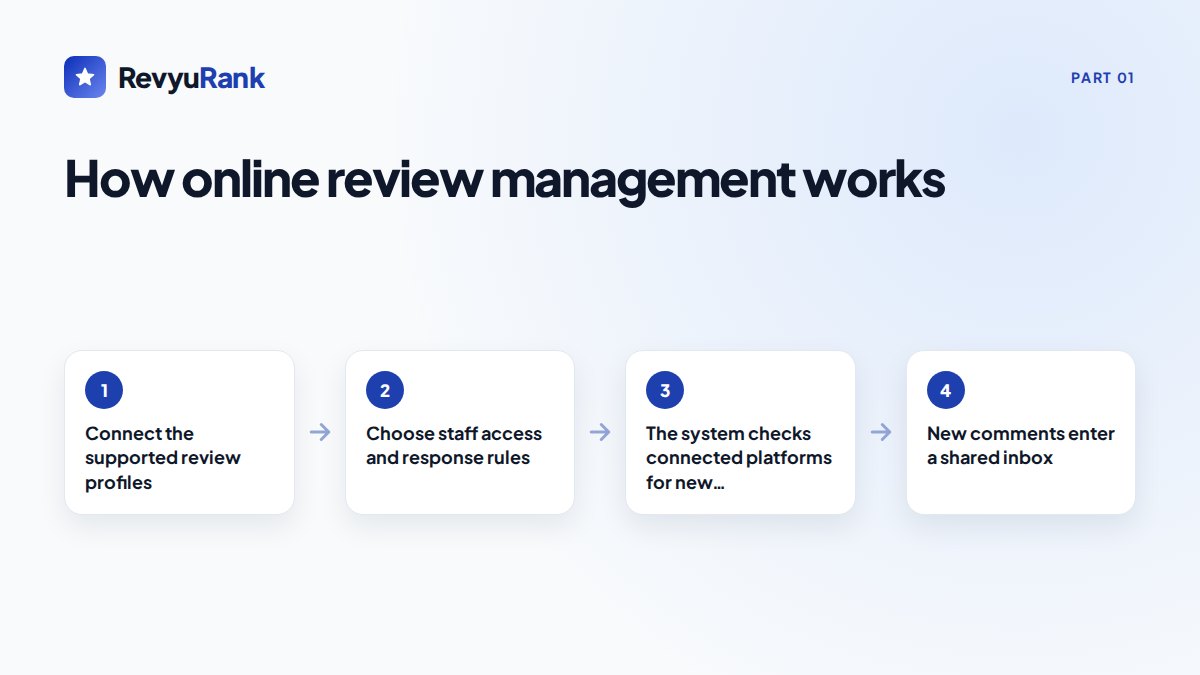
- Connect your profiles. You grant access to your Google Business Profile and other review sites. Setup often takes minutes; account verification can take longer.
- Set roles and rules. Decide who can view, draft, approve, and publish replies, and which reviews need a manager’s approval.
- Collect new reviews. The service checks connected platforms and brings new reviews into one inbox with the rating, name, date, and text.
- Draft replies. A team member (or the provider’s team) writes a reply based on what the customer actually said.
- Approve and publish. The approved reply is posted on the platform. Check the public page shows it under the right business.
- Send review requests. After purchases or visits, customers receive an invitation with a direct link. Every customer should get the same invitation.
- Report and improve. Monthly reports compare review count, rating, reply time, and recurring themes, so you can fix what customers keep mentioning.
If giving a service manager access to your Google Business Profile stalls at verification, we can walk through it with you or do it for you.
Software, Managed Service, or Both?
| Option | Who does the work | Best for | Trade-off |
|---|---|---|---|
| Do it yourself with free tools | You | One location, low review volume | Easy to fall behind when busy |
| Review management software | Your team, using the tool | Several locations or sites, a team with time | Monthly cost plus staff time |
| Managed service | The provider’s team | Busy owners, high volume, no one to own replies | Higher cost; needs clear guidance on tone |
| Hybrid | Provider drafts, you approve | Businesses that want control without the workload | Needs a quick approval routine |
Our guide to review management software covers the tool side in depth, and our comparison of the best Google review management websites looks at specific platforms.
Why Review Management Affects Results
Reviews shape both visibility and conversion. Google says review count and rating feed into local prominence, and BrightLocal’s Local Consumer Review Survey 2026 found that 89% of consumers expect owners to respond to reviews, while half are put off by generic, templated replies. A service that keeps replies fast and personal, and keeps new reviews arriving, directly supports both.
But a service can’t fix a poor customer experience on its own. What it can do is show where complaints repeat, help your team answer faster, and make it easy to ask every customer for feedback. A sudden drop in new reviews usually points to a broken connection or a paused request campaign; a rise in complaints about one issue points to operations, pricing, or staff, not the software.
What Review Services Can and Can’t Do
What a good service can do
- Bring all your reviews into one place and alert you quickly.
- Help write personal, on-brand replies to every review.
- Send compliant review requests to every customer, with one reminder.
- Organize evidence and report reviews that break platform rules.
- Show trends and recurring themes in clear monthly reports.
What no service can do
- Remove honest negative reviews. Platforms only remove reviews that break their policies.
- Guarantee a rating, a ranking, or a number of reviews.
- Control what customers write.
- Speed up platform approval or moderation decisions.
Any provider promising otherwise is either overselling or planning to use methods that break the rules.
The Rules a Service Must Follow
Review services operate under the same rules as you. In the US, the FTC’s guidance on its consumer reviews rule explains that businesses must not create fake reviews, buy reviews, or condition incentives on positive sentiment. Google’s own rules go further: no incentives of any kind for Google reviews, no asking only happy customers (review gating), no staff review quotas, and no asking reviewers to mention specific words or staff names.
That means a trustworthy service will:
- Ask every customer the same way, not just the ones expected to be happy.
- Never post reviews itself or use accounts that aren’t real customers.
- Never offer rewards in exchange for reviews.
- Report fake reviews through official channels, not threaten reviewers.
Which reviews can be reported?
Asking for reviews is allowed, but every review must reflect a genuine experience. A service can report reviews that break Google’s policy. It should not report a review just because the feedback is negative.
- Reviews that were paid for, directly or in kind, count as fake and misleading content.
- Reviews based on a conflict of interest are not allowed.
- Reviews may not include email addresses, phone numbers, social media links or links to other websites.
- Reviews posted for advertising or solicitation are not allowed.
- Respectful reviews that describe a negative experience are allowed, even when they are hard to read.
Google’s Business Profile help has separate pages on reporting inappropriate reviews and on negative review extortion scams.
How to Choose a Review Management Service
- List your platforms and locations. Make sure the service covers every review site that matters to you.
- Decide how much work you want to hand over: tools only, drafts for approval, or full management.
- Ask how replies are written: by people, by AI with human review, or by AI alone. Sensitive replies should always involve a person.
- Ask how review requests work: every customer, one reminder, no incentives, no filtering.
- Check reporting: what you’ll see each month and whether you can export your data.
- Check access: the provider should use manager access, not your account password.
- Start with a trial or one location before rolling out everywhere.
For a detailed checklist of questions, read how to properly vet a review management company.
Red flags
- Guaranteed removal of negative reviews or a guaranteed star rating.
- Offers to “boost” reviews with new accounts or review exchanges.
- “Review funnels” that send only happy customers to Google.
- Requests for your Google password.
- Vague reports with no list of actions taken.
What It Costs, in Money and Time
Pricing usually depends on the number of locations, the platforms covered, review volume, and how much of the work the provider does. Software is typically billed per location or user; managed services usually charge a monthly fee based on volume and scope. Whatever the price, count the time it saves: replying daily, sending requests, and reporting monthly can easily take several hours a week for a busy business.
A useful test: if reviews regularly go unanswered for days, or requests only go out when someone remembers, a service may help you keep up and win back customers.
What You Control and What’s Fixed
| You control | Fixed by platforms or customers |
|---|---|
| Which profiles are connected | Platform removal rules |
| Who approves replies | A customer’s honest rating and comment |
| Tone and length of replies | Which platforms a service can connect to |
| When and how customers are asked | Moderation and approval delays |
| What reports you review | How platforms rank and display reviews |
A Typical Month With a Managed Service
| When | What the service does | What you do |
|---|---|---|
| Daily | Monitors new reviews and drafts or posts replies | Approve sensitive replies if required |
| After each sale or visit | Sends the review request and one reminder | Keep customer data flowing from your booking or POS system |
| As needed | Flags policy-breaking reviews and prepares reports | Confirm facts and provide evidence |
| Monthly | Reports rating, volume, reply time, and themes | Act on the top recurring complaint |
Multiple Locations
For chains and franchises, check that a service can separate reviews, replies, and reports by location, give local managers access to their own branch only, and keep templates and escalation rules consistent across the brand. A combined dashboard is useful for leadership, but each location needs its own view to spot local problems.
If the Service Uses AI
Many services now use AI to draft replies or summarize themes. Ask whether a person reviews every reply before it’s posted, which review types are never automated, and how they keep replies from sounding identical. Good answers: humans approve complaints and sensitive topics, AI drafts are edited, and replies are varied and specific.
Habits That Get the Best Results
- Read the original review before approving any drafted reply.
- Give each complaint a specific answer, not a copied apology.
- Handle complaints through your normal support process, and keep review requests the same for every customer.
- Check connection status after any change to your profiles.
- Compare the same date range when reading reports.
- Ask for honest reviews, never “five stars”, and act on repeated themes.
If you’d like a team to handle replies for you, our Google review response management service writes personal replies matched to your tone, with your approval where you want it.
Prefer a done-for-you option? Read about Google Reputation Recovery for Bad & Fake Reviews | RevyuRank.
If you would rather have this handled for you, our Google Review Generation service covers it end to end.
Frequently Asked Questions
What does an online review management service do?
It collects your reviews in one place, alerts you to new ones, helps write and post replies, sends review requests to customers, and reports on trends.
Can review management services remove bad reviews?
Only reviews that break platform rules, and only the platform decides. A service can organize evidence and submit reports, but it can’t guarantee removal.
Why are new reviews missing from the dashboard?
The connection may have expired, the platform may not be supported, or the platform may delay access. Check the connection page and the original profile.
Is it safe to automate review replies?
For simple positive reviews with approved templates, it can be. Complaints, personal data, threats, legal claims, refunds, and health topics need a human.
How long does setup take?
Basic setup often takes minutes with account access. Verification, approvals, and connecting several locations take longer.
Is a review management service worth it for a small business?
Yes, when reviews arrive often enough that replies or requests slip. If feedback is rare and one person can keep up easily, free tools may be enough.
Can a service guarantee more 5-star reviews?
No. A good service increases the number of customers asked and the speed of replies, which usually improves results, but outcomes depend on your customers’ real experiences.
Do I lose control of my profile with a managed service?
No. You stay the owner. The provider should use manager access, which you can remove at any time.
What’s the difference between review management and reputation management?
Review management focuses on reviews: collecting, replying, and reporting. Reputation management is broader and also covers search results for your business name, social media, and crisis handling.
How quickly will I see results?
Reply rates and reply times can improve quickly once someone owns replies. More reviews and a stronger rating take longer, and depend on how many customers you ask and their real experiences.
What to Do Next
- Count your locations, platforms, and weekly review volume.
- Decide whether you want tools, a managed service, or a hybrid.
- Shortlist two or three providers and ask the vetting questions above.
- Start with one location for a month, then compare reply times and new reviews.

Robert Miller works as a Reputation Management Consultant. He has been helping U.S. businesses for over ten years. His work involves helping people protect and enhance their online image.Robert has worked with a wide range of companies. He has helped new businesses, local places that give a service, and big companies. He helps turn customer reviews into something that helps people trust their company and drives business growth.