The crackdown on fake reviews has brought clearer rules and stronger enforcement for businesses, platforms, and paid reviewers in 2025–2026, especially in the United States and United Kingdom. Fake reviews, paid sentiment without disclosure, review suppression, and fake social proof now pose bigger legal risks than before. The practical answer is simple: don’t buy reviews, don’t block honest criticism, and clearly disclose any real incentive. The details below explain the rules, evidence standards, platform duties, and safer alternatives.
What the new rules cover
The 2025–2026 crackdown targets reviews and endorsements that give shoppers a false picture of a product, service, or business. It covers made-up reviews, reviews written by people who never used the product, paid praise without clear disclosure, and fake accounts that create the appearance of real customer support.
The United States Federal Trade Commission’s rule addresses specific forms of business review manipulation, including fake reviews and review suppression carried out through prohibited threats or intimidation. It can cover buying or creating fake reviews, using company-controlled websites that pretend to be independent, and suppressing negative reviews while showing only positive ones. The FTC published the rule after reviewing public comments and enforcement concerns.
The United Kingdom took a different route. Its Digital Markets, Competition and Consumers Act makes fake reviews and misleading review practices part of the consumer-protection system. The Competition and Markets Authority can enforce consumer law directly in cases covered by the Act.
A common misconception is that a review becomes legal just because it contains a real opinion. A real customer can still create a problem if a business pays for a particular positive rating or hides a material connection.
The basic test is whether a normal reader could be misled about who wrote the review, why it was written, or how independent the review system is. A business doesn’t need to prove that every customer lost money before the practice becomes risky.
The FTC rule covers several review and endorsement practices, including fake reviews and certain review suppression methods. You can read the agency’s final rule on fake reviews for the exact wording and scope.
How to handle reviews legally
Handle reviews legally by confirming who wrote each one, disclosing any incentive, and keeping honest criticism visible. A business or platform usually makes these decisions in order:
-
Identify who wrote the review. Keep a record showing that the reviewer had a real connection with the product or service. If the person never bought, used, or received the item, don’t publish the review as customer feedback.
-
Check for payment or another benefit. Money isn’t the only issue. Free products, discounts, gifts, contest entries, loyalty points, or future work can create a connection that readers may need to see. On Google, incentivized reviews are not allowed and will be removed from Maps.
-
Separate honest feedback from required praise. You may ask for a review, but don’t require a five-star rating or specific wording. If the incentive depends on positive sentiment, stop and redesign the campaign.
-
Use a clear disclosure. Put the disclosure beside the review or endorsement. “Received a free sample” is clearer than a vague label such as “partner” or “ambassador.”
-
Keep negative reviews in the system. Remove content for a real reason, such as spam, threats, personal data, or content unrelated to the product. Don’t remove it only because it hurts the rating.
-
Check review tools and agencies. A vendor’s promise to deliver “verified five-star reviews” is a warning sign. Your business can still face trouble when an outside agency creates the content.
-
Keep evidence for each campaign. Save the offer, disclosure wording, reviewer eligibility, moderation reason, and payment record. These records help show what happened if a regulator, platform, or customer asks.
The hardest judgment is separating moderation from suppression. If a review breaks a published rule, remove or limit it consistently; if it only says something negative, leave it visible and respond with facts.
A campaign that needs legal review, specialist advertising advice, or a platform investigation shouldn’t be handled by guessing. Ask a consumer-protection attorney or the platform’s compliance team before publishing a large campaign.
Review rules by situation
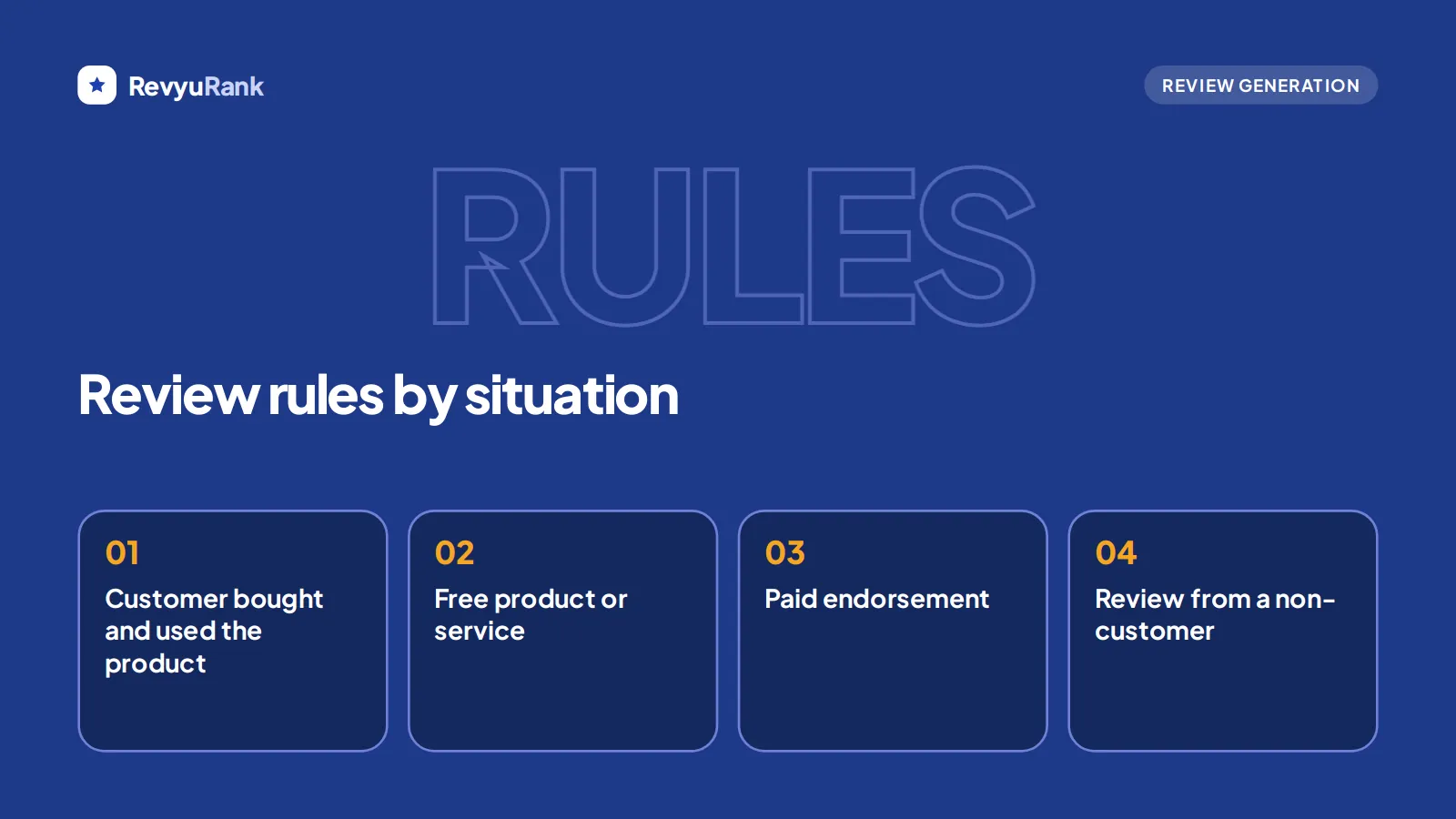
The table below covers the main situations businesses and creators face in the United States and United Kingdom.
| Review situation | What to use or do | Rule or timing that matters | What to watch for |
|---|---|---|---|
| Customer bought and used the product | Ask for an honest review | No fixed waiting period applies in general law | Don’t ask only happy customers |
| Free product or service | Request honest feedback with a clear disclosure; on Google, don't offer the item in exchange for a review | The connection should be disclosed when the review appears | A free item can affect reader judgment |
| Paid endorsement | State the paid relationship clearly | Disclosure must be easy to notice and understand | Don’t hide it in a profile or long caption |
| Review from a non-customer | Don’t present it as customer experience | The person’s lack of use changes the claim | Expert commentary needs a different label |
| Negative review | Keep it unless it breaks a stated content rule | The reason for removal should be consistent | Removing criticism can look like suppression |
| Agency-run review campaign | Audit the agency before publishing | The business remains exposed to the campaign’s conduct | “Guaranteed positive reviews” is a major warning |
| UK consumer-facing business | Check the current DMCC requirements | The CMA publishes the relevant consumer-law guidance | Rules can differ from U.S. FTC enforcement |
The exact result depends on the country, audience, platform, and relationship with the reviewer. For a cross-border campaign, follow the stricter practical standard unless local counsel gives a different written answer.
What reliable review programs do
Reliable review programs ask every customer for honest feedback, disclose any incentive, and moderate by written rules. A sound program starts before the review request. It defines who may review, what benefits are allowed, how disclosures will appear, and which content rules apply. The request should ask for an honest experience, not a positive rating.
The order matters. First confirm the customer or recipient connection, then send the same basic invitation to positive and negative customers, and only afterward moderate content under written rules. A business that asks satisfied customers for reviews but ignores complaints creates an unreliable sample.
Check the process partway through each campaign. Look for repeated phrases, identical timing, clusters from one account, reviews from people who never received the product, or a sudden rise in perfect ratings. These signs don’t prove fraud alone, but they deserve verification before publication.
Leave the star rating alone when the written comment is critical but relevant. Don’t rewrite a reviewer’s words, change a rating, or ask for a replacement review after a complaint unless the customer freely chooses to update it.
One mistake costs more than the review itself: paying for a batch of “guaranteed five-star” posts. The business may have to remove the content, explain the campaign, refund customers, and defend its conduct to a platform or regulator.
The trade-off is real. Strong verification takes time and may reduce the number of reviews. It usually gives you a smaller but more credible record, while a fast, heavily rewarded campaign can produce volume that damages trust.
What Google allows when you ask for reviews
Google lets businesses ask for reviews, but the reviews must reflect a genuine experience. You can share a review request link or QR code. The ‘Get more reviews’ option sits under Read reviews in your Business Profile. Google suggests placing the link or QR code on receipts and in thank-you emails.
- Don’t offer payment, free items or other rewards for reviews. Google removes incentivized reviews.
- Don’t ask only happy customers, and don’t discourage or prohibit negative reviews.
- Don’t ask staff to collect a set number of reviews.
- Don’t pressure customers to review while they are on your premises, and don’t ask for specific content.
- Reviews can’t include email addresses, phone numbers, social media links or links to other websites.
Review problems and first fixes
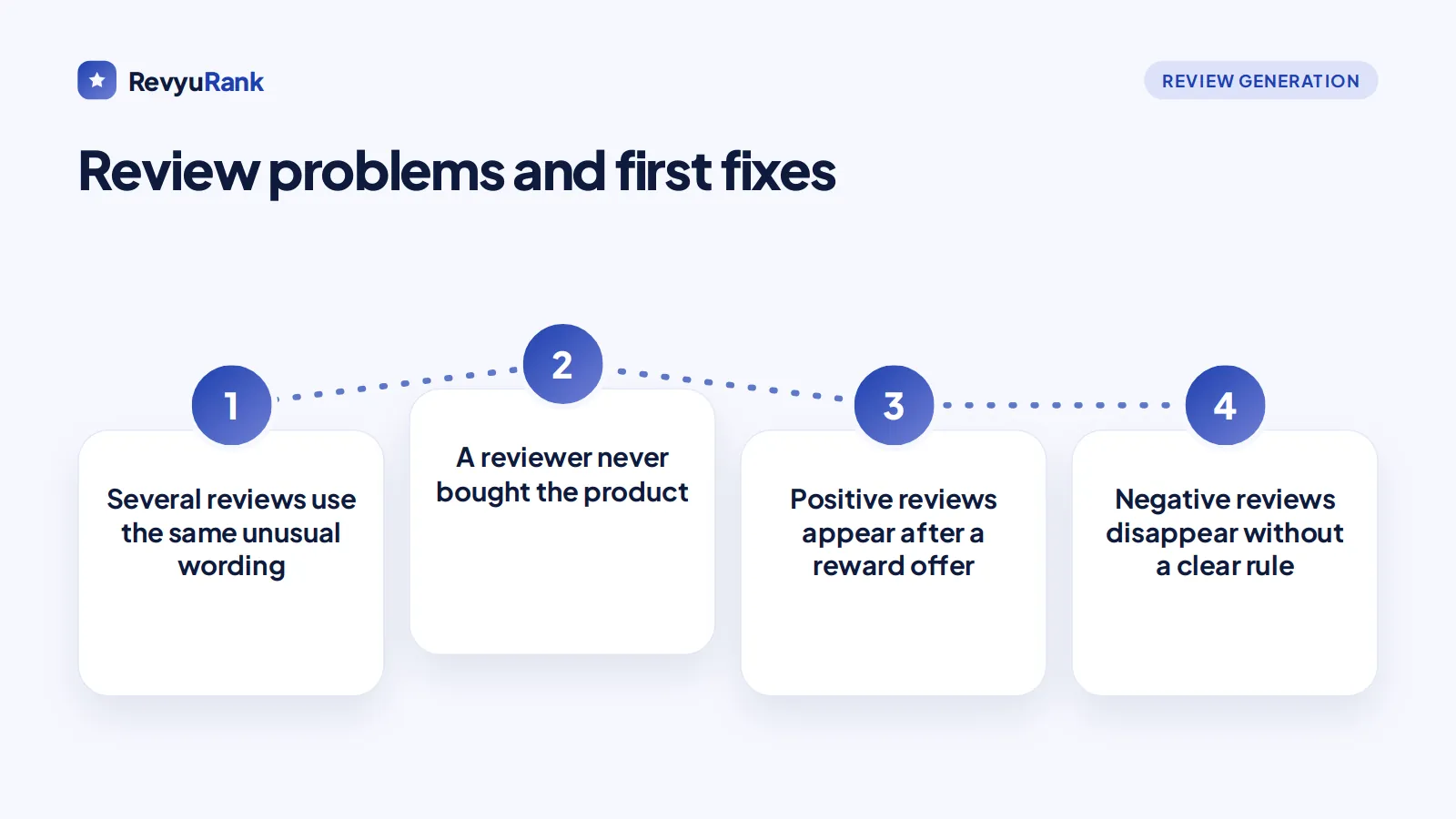
The first response should preserve evidence, not delete everything. Save the review URL, account details, message history, payment record, and the platform’s moderation notice before changing the campaign.
| What you notice | What it usually means | What to do first |
|---|---|---|
| Several reviews use the same unusual wording | The posts may come from one script or vendor | Pause the campaign and compare order records |
| A reviewer never bought the product | The review may be misrepresented as customer feedback | Hide it from the customer-review area and investigate |
| Positive reviews appear after a reward offer | The incentive may be shaping the rating | Stop the offer and rewrite it for honest feedback |
| Negative reviews disappear without a clear rule | Moderation may be suppressing criticism | Restore eligible reviews and publish the moderation rule |
| A review says “gifted” or “paid” but the label is hard to see | The relationship may not be clear enough | Place a short disclosure beside the review |
| A vendor promises only five-star posts | The campaign carries a high fraud risk | End the contract and preserve the vendor’s messages |
If you can’t tell whether a review is genuine, don’t accuse the writer publicly. Ask for order or interaction details through a private support channel, and escalate repeated patterns to the platform or a consumer-protection lawyer.
What businesses should check after the fake reviews crackdown
Before a 2025–2026 review campaign, check the law where the customer lives, the platform’s review policy, and the contract with any marketing agency. A platform may ban conduct even when a regulator hasn’t publicly challenged that exact example.
Confirm whether the reviewer received money, a product, a discount, free access, points, employment, or another benefit. Then confirm where the disclosure will appear and whether a reader can understand it without opening another page.
Check how the business handles negative reviews. Ask who can remove content, which written rules apply, whether the same rule applies to praise and criticism, and whether the business keeps an audit trail.
For U.S. campaigns, review the Federal Trade Commission’s published rule and current enforcement material. For U.K. campaigns, check the Competition and Markets Authority and the government’s Digital Markets, Competition and Consumers Act guidance.
If the campaign involves legal claims, health claims, financial results, or a large number of compensated creators, get advice from a qualified advertising or consumer-law attorney. A normal marketing employee shouldn’t guess where a disclosure or claim crosses the legal line.
Keeping review records clean
Keep the request, response, disclosure, order connection, moderation reason, and payment record together. Store them in a way that lets you find the evidence by reviewer, campaign, product, and date.
There’s no single universal retention period that fits every business and country. Your record schedule may depend on tax rules, advertising law, contracts, privacy duties, and the platform’s own policy, so check the official rules for your market.
Review the program when a platform changes its policy, a regulator publishes new guidance, or your incentive changes. A discount that was once offered to every customer may become risky if it later depends on a positive rating.
If a review is challenged, don’t quietly edit the words and keep the original campaign running. Pause the questionable source, preserve the record, correct the public display, and document why the correction happened.
The limit is that review counts and star ratings don’t tell you exactly how genuine a review is. You can judge your own program by its customer records, disclosure visibility, moderation log, and pattern of positive and negative feedback.
When fake reviews aren’t the answer
This approach isn’t for a business that needs instant five-star results after a product launch. Use real product trials, customer support, and a balanced feedback request instead. Invite feedback from buyers whether their experience was positive or negative, and don’t tie a reward to a favorable rating. A slower rating is safer than a sudden pattern that customers can’t believe.
It also isn’t for a creator who hasn’t used the product. If you only received a press release or saw a demonstration, label the content as commentary or sponsored material, not personal customer experience. If you were paid, given a free item, or offered an affiliate benefit, disclose that connection where the review appears. Don’t imply firsthand use that never happened.
It’s the wrong choice when a company wants to remove every critical review. Improve the product, answer the complaint, and remove only content that breaks a clear rule such as spam, threats, or exposure of private information. A harsh opinion isn’t the same as a fake review.
If you can’t verify a reviewer or explain an incentive, don’t publish the review yet. Ask for records, change the campaign, or get legal advice before continuing. Keep copies of consent, purchase details, and disclosures so you can explain how the review was obtained.
Related guides
- How to Get Fake Google Reviews: A Step-by-Step Guide
- How to Remove Fake Google Reviews: Tips for Businesses
- Are Google Reviews Fake? The Impact on Local Businesses
Want an expert to set this up with you? Take a look at Google Review Generation.
Frequently asked questions
Can a business pay for an honest review?
Not on Google, where reviews paid for directly or in kind count as fake. Elsewhere, payment must not secretly buy positive sentiment, and the relationship may need a clear disclosure. The reviewer should be free to give a favorable, mixed, or negative opinion. A campaign that pays only when the rating is positive is much riskier than one that pays for an honest evaluation under the same terms.
Why are fake reviews illegal?
They can mislead customers about real product experience, popularity, quality, or independence. The concern isn’t only the false words. A fake account, hidden payment, controlled “independent” website, or selective removal of criticism can also create a false impression.
How long should a business keep review records?
Keep them for the period required by the laws, contracts, tax rules, and platform policies that apply to your business. There’s no single safe number for every country. At minimum, preserve campaign terms, reviewer eligibility, disclosures, payments, moderation reasons, and related customer records while the campaign could reasonably be challenged.
Is it safe to offer a discount for a review?
Not for Google reviews. Google treats reviews paid for, directly or in kind, as fake and misleading, and removes incentivized reviews from Maps. Other platforms and laws may allow an incentive for an honest review if the connection is disclosed, so check each platform's rules first. Use the same invitation for different customer experiences. Don’t cancel the benefit because a customer gives a low rating, or the offer may look like payment for praise.
What happens if a company removes negative reviews?
It may create a misleading impression if the reviews were removed only because they were unfavorable. The business should publish clear content rules and apply them to positive and negative posts. Reviews containing spam, threats, private data, or unrelated material can be handled under those rules.
Can a company use reviews from another country?
Yes, but the company should check the law where the audience and business operate. A disclosure that works in one market may not meet another market’s expectations. Keep evidence that the reviewer had the stated experience, and don’t present an overseas comment as a local customer review if that would mislead readers.
What to do next
Make honest customer feedback part of your regular business routine. Review your invitations, incentives, moderation records, and supplier agreements, then update them before a complaint arrives. Keep clear evidence of what you’ve done, train your team, and check official guidance as enforcement develops. Trust is easier to protect than rebuild.

Robert Miller works as a Reputation Management Consultant. He has been helping U.S. businesses for over ten years. His work involves helping people protect and enhance their online image.Robert has worked with a wide range of companies. He has helped new businesses, local places that give a service, and big companies. He helps turn customer reviews into something that helps people trust their company and drives business growth.